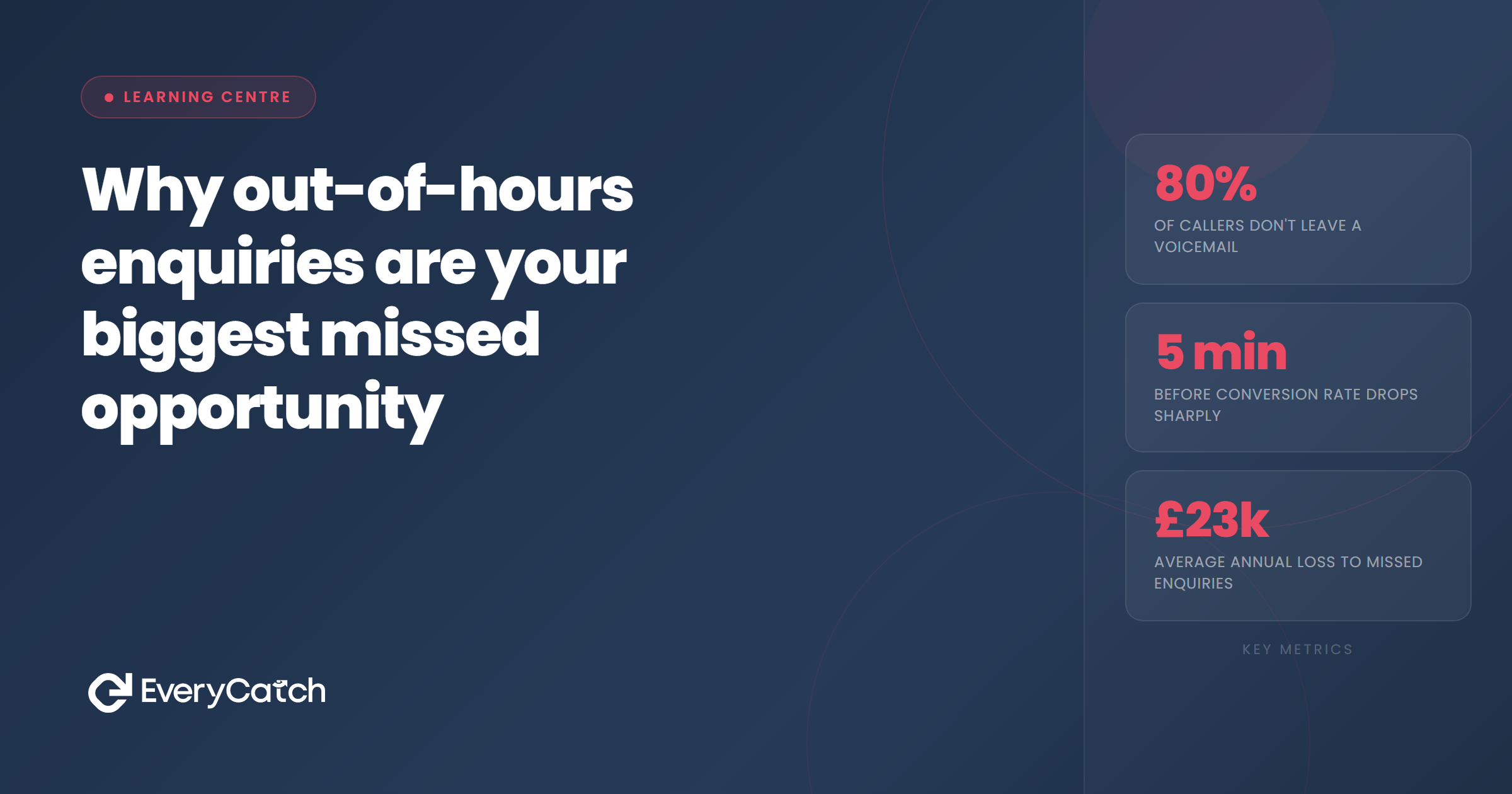
- Between 40% and 60% of service enquiries arrive outside standard business hours
- Evening and weekend enquiries typically have higher booking intent than weekday calls
- Waiting until Monday morning to respond destroys conversion rates on weekend leads
- Competitors who respond immediately take the job, even if their price is higher
- Simple automation beats delayed personal responses every time
When leads actually arrive
Most service business owners believe the phone rings during office hours and goes quiet in the evening. The data tells a different story. Tracking systems across plumbing, electrical, landscaping, and cleaning businesses show that between 40% and 60% of all enquiries arrive after 5pm or at weekends.
People search for tradespeople when they have time to think about the problem, not when they're at work. That means Saturday morning with a coffee, Sunday evening planning the week ahead, or Wednesday at 9pm after the kids are in bed. Your potential customers are sitting on the sofa with their phone, comparing three or four businesses, and sending messages through contact forms or leaving voicemails.
The pattern repeats across every trade. Plumbers see a spike on Sunday evenings when homeowners notice a dripping tap or slow drain. Electricians get a surge of enquiries on Saturday mornings when people are planning home improvement projects. Gardeners receive most quote requests between 7pm and 10pm on weekdays, when the owner has just looked out at an overgrown lawn and decided to do something about it.
What unites all these enquiries is urgency mixed with choice. The person contacting you has a real need, money to spend, and several businesses open in different browser tabs. The one who responds first almost always wins.
Why timing reveals intent
An enquiry that arrives at 8pm on Thursday is not the same as one that arrives at 11am on Tuesday. The evening enquirer has thought about the problem enough to act on it outside working hours. They're not casually browsing. They've decided to solve the issue and they're choosing who gets the job.
Weekend enquiries carry even higher intent. Someone spending Saturday morning getting quotes for a bathroom refurbishment has blocked out time specifically for this task. They're motivated, they have budget, and they want to book someone quickly so they can move on to the next item on their list.
Compare that to a Wednesday lunchtime enquiry. It might be genuine, but it could also be someone killing time between meetings or doing preliminary research with no immediate plan to proceed. Out-of-hours leads self-select for urgency. The fact they're contacting you at 9pm or on Sunday tells you they're serious.
The paradox is that most businesses treat these high-intent leads as low priority. They see the enquiry on Monday morning, three days after it arrived, and send a reply assuming the person is still waiting. They're not. They booked someone else on Saturday afternoon.
What happens when you miss them
Let's follow a typical weekend enquiry through the system. A homeowner notices their boiler making strange noises on Friday evening. They search for local plumbers, find your business, and submit a contact form at 7:30pm asking for a quote. The form goes to your email. You're having dinner with your family and your phone is in another room. You don't see it until Saturday morning, but you're at your daughter's football match, so you make a mental note to reply later.
Saturday afternoon arrives. You remember the enquiry, but you're doing jobs, and replying to emails on your phone while balanced on a ladder isn't practical. You tell yourself you'll send a proper reply when you get home. By the time you sit down with your laptop on Sunday evening, 48 hours have passed. You write a friendly, helpful email explaining your availability and asking for more details about the job.
The homeowner doesn't reply. They booked a plumber on Saturday at 9am, four hours after they sent their enquiry. That plumber responded within 15 minutes with an automated text confirming receipt and promising a call first thing Saturday morning. The plumber rang at 8:30am, arranged to visit at midday, and left with a £2,000 boiler service contract signed.
You never find out what you lost because the lead simply vanishes. You don't know if they booked someone else, changed their mind, or found a solution another way. Your conversion tracking shows one more enquiry that went nowhere, but you have no idea it was worth two grand and took a competitor less than four hours to close.
Want to stop losing weekend leads?
We'll show you exactly what's slipping through and how to catch it.
Book a free discovery callThe competitor advantage window
Speed matters, but it matters even more outside business hours because the response gap widens. During a normal Tuesday, five businesses might all reply to an enquiry within an hour or two. The customer chooses based on price, availability, or who they liked the sound of. Competition is tight.
At 9pm on Saturday, the same five businesses receive the same enquiry. Four of them will see it on Monday morning and reply around lunchtime, 60 hours later. One business replies immediately with an automated text, then calls first thing Sunday morning. That business faces no competition at all for a 36-hour window. By the time the other four send their Monday emails, the job is booked, the deposit is paid, and the customer has mentally moved on.
This isn't about being better. It's about being there. The business that wins isn't necessarily cheaper or more qualified. They simply responded when the customer was still in decision mode. Everyone else is invisible because they arrived too late to the conversation.
The advantage compounds over time. When you consistently respond to out-of-hours enquiries faster than competitors, you build a conversion rate advantage that shows up in every metric. Your cost per lead drops because more enquiries turn into jobs. Your calendar fills faster because you're booking work while others are still replying to last week's emails. Your profit margin improves because customers who are responded to quickly are less price-sensitive.
The businesses you're competing against don't realise this is happening. They see their enquiry numbers and assume they're converting at a reasonable rate. They don't track response time, so they never discover that 60% of their weekend leads book someone else before they even reply.
Automation without answering machines
The obvious objection is that you can't work 24 hours a day. You need evenings off and you deserve weekends with your family. Answering every enquiry instantly means being glued to your phone, and that's not sustainable or healthy.
The solution is not to work more hours. It's to automate the initial response so the customer knows you've received their enquiry and will follow up at a specific time. That buys you the time you need without losing the lead.
A simple automated text or email response sent within one minute of someone filling out your contact form changes the entire dynamic. The customer receives confirmation, feels acknowledged, and knows when to expect your call. They stop searching for other businesses because they've already got someone lined up. You wake up on Monday morning with a warm lead who's expecting to hear from you, not a cold enquiry that went to three other competitors over the weekend.
This doesn't require complex technology or expensive software. Most modern CRM systems include basic automation that sends a templated message when a new enquiry arrives. The message can be personal, friendly, and reassuring. It explains that you've received their request, you'll call them at a specific time, and you're looking forward to helping them.
The key is specificity. "We'll get back to you soon" doesn't work because soon is vague. "We'll call you Monday morning between 9am and 11am" works because the customer can plan around it. They know you're coming and they don't need to keep looking.
For phone calls, voicemail creates a different problem because people don't always leave detailed messages. An automated missed call text-back solves this. When someone rings outside business hours and hangs up or leaves a voicemail, they immediately receive a text thanking them for calling and asking them to reply with details of what they need. Most people respond, which turns a dead voicemail into a qualified lead with written information you can act on.
The goal is not to replace personal contact. It's to protect the lead until you can make personal contact. Automation stops the customer moving on to the next business while you're unavailable. Once you've secured their attention, you follow up with a real conversation and convert them the same way you always have.

From the EveryCatch team
We built EveryCatch to solve exactly this problem. Our system responds to every enquiry in under 60 seconds, books follow-up calls automatically, and makes sure no lead falls through the cracks, even at 11pm on a Sunday.