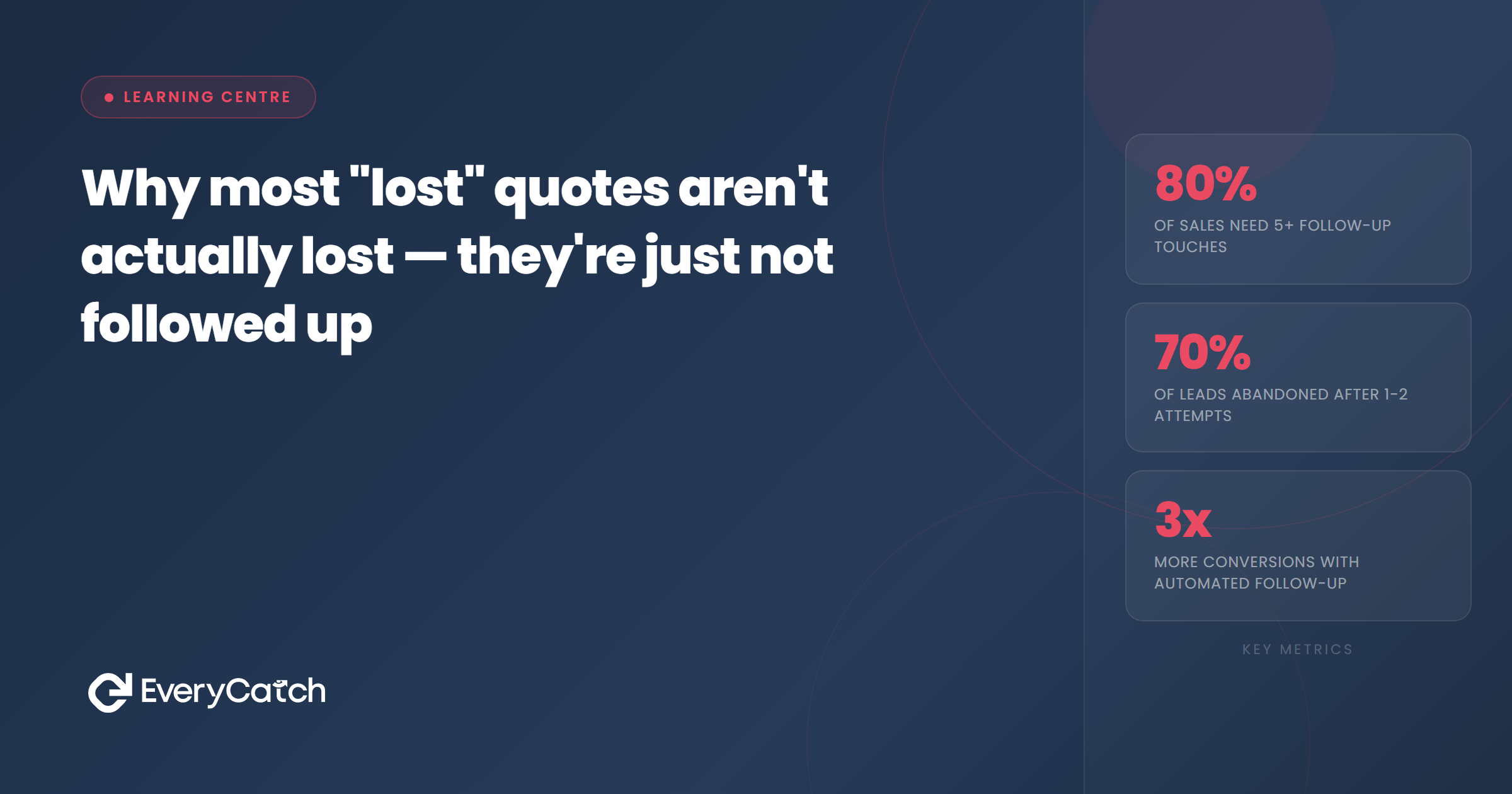
- Most "lost" quotes never received more than one follow-up attempt, if any
- Studies show 80% of sales require five or more follow-ups, but most businesses stop after two
- Customer silence usually means "not yet", not "never"
- Businesses with structured follow-up systems convert 30 to 40% more quotes than those without
- The time between quote and decision varies enormously by job type and customer circumstances
Most service businesses carry a mental list of "lost" quotes. Potential customers who received a price, went quiet, and never booked. The file gets closed, the quote gets marked as lost, and attention moves to the next enquiry.
But here's what actually happened in most of those situations. The customer received the quote, fully intended to book, got distracted by work or family obligations, and simply never came back to it. They did not choose a competitor. They did not decide the price was too high. They just moved on with their day.
The quote was not lost. It was forgotten. Not by the customer exactly, but by the process. No reminder came. No follow-up landed in their inbox. The business assumed silence meant rejection and moved on too.
The real definition of a "lost" quote
A quote is only truly lost when the customer has made an active decision not to proceed. That means they have either explicitly told you no, or they have booked with someone else. Everything else is just dormant.
Most businesses do not operate with this definition. They define a quote as lost when it goes quiet for a week, or two weeks, or whenever they decide to give up. That's a procedural definition, not a commercial one.
When you examine the quotes marked as "lost" in your records, you'll find the majority fall into one of these categories:
- Customer never responded to the initial quote email
- Customer said they'd "think about it" and was never heard from again
- Customer asked a follow-up question, received an answer, then went silent
- Customer expressed interest verbally but never committed to a date
None of those represent rejection. They represent an incomplete sales process. The customer simply was not moved far enough through the decision journey before the business stopped trying.
What the data actually shows
Research across service industries consistently shows the same pattern. Most quotes are followed up once, sometimes twice, then abandoned. Meanwhile, customer behaviour research shows that purchasing decisions, especially for higher-value services, typically require between five and eight touchpoints.
The mismatch is enormous. Businesses are giving up at exactly the point where customers are still forming their decisions.
In one study of home improvement companies, businesses that implemented a structured seven-day follow-up sequence saw conversion rates increase by 38%. The leads had not changed. The pricing had not changed. The only variable was the number and timing of follow-up attempts.
Another analysis of service trades found that 60% of customers who eventually booked did not respond to the first follow-up. They needed a second or third prompt before they engaged. Those businesses that stopped after one attempt were literally walking away from six out of ten bookings.
Why silence doesn't mean no
Customers go quiet for dozens of reasons that have nothing to do with their level of interest. They receive your quote on a busy Tuesday morning and mean to reply later. A work crisis erupts. A child gets sick. A family obligation takes over the weekend. By Monday, your quote is buried in their inbox under forty new messages.
They did not reject you. They just got busy. But without a follow-up, they never come back to it. The decision never gets made because the prompt never arrives.
Another common pattern is decision paralysis. The customer wants the service but feels overwhelmed by the decision. Your quote sits in their inbox as a reminder of something they need to deal with. They keep meaning to respond, but they do not. A well-timed follow-up that makes the next step simple can break that paralysis instantly.
Price is also frequently misinterpreted as a reason for silence. A customer receives a quote, does not respond, and the business assumes the price was too high. But often, the customer was perfectly comfortable with the price. They just needed time to clear budget, coordinate schedules, or get approval from a partner. Silence does not indicate price resistance. It indicates process.
How many quotes are sitting dormant in your pipeline?
We'll show you exactly what a structured follow-up system could recover.
Book a free discovery callWhat happens without a system
In businesses without structured follow-up, quote management becomes entirely reactive. Quotes get sent, and the business waits to see who responds. The customers who book are the ones who were ready immediately. Everyone else falls through.
This creates a false impression of market conditions. The business owner sees a low conversion rate and concludes that the market is tough, or the pricing is wrong, or customers are just tyre-kickers. None of those conclusions may be accurate. The real problem is the absence of a system that keeps customers engaged through their decision window.
The other problem is inconsistency. Without a system, follow-up depends on individual memory and motivation. One staff member might follow up diligently. Another might send one email and forget. Quotes get lost in inboxes, CRM tasks get ignored, and potential customers never hear from you again.
The result is wasted marketing spend. You paid to generate that enquiry. You invested time to quote it. Then you abandoned the customer at the exact moment they needed more guidance. That is not a sales problem. It is a systems problem.
The quote recovery window
Different types of services have different decision windows. Emergency repairs get decided quickly. Planned renovations take weeks. Ongoing services like cleaning or maintenance sit somewhere in between.
The mistake most businesses make is applying a single follow-up approach across all quote types. A quote for emergency plumbing needs follow-up within hours. A quote for a new bathroom can be followed up over three or four weeks.
The most effective follow-up systems match the sequence length to the decision window. Quick-turnaround services get short, frequent follow-up. Considered purchases get longer sequences with educational content mixed in.
But the principle remains the same. Most quotes die not because the customer said no, but because the conversation stopped too early. A structured system ensures that every quote gets the appropriate number of touchpoints before it is genuinely marked as lost.
Timing also matters. Follow-ups sent at random intervals feel like nagging. Follow-ups sent at structured intervals feel like helpful reminders. A sequence that goes out at one day, three days, seven days, and fourteen days creates a rhythm that keeps you present without feeling pushy.
Content matters too. A follow-up that just says "any thoughts on the quote?" adds no value. A follow-up that includes a case study, answers a common objection, or highlights a limited-time offer gives the customer a reason to re-engage.
When you combine proper timing, appropriate sequence length, and valuable content, you turn dormant quotes into active conversations. That is where the revenue sits. Not in getting more leads, but in converting more of the ones you already have.

From the EveryCatch team
We built EveryCatch specifically to solve this problem for service businesses. Our follow-up sequences turn dormant quotes into revenue without any manual effort from your team.