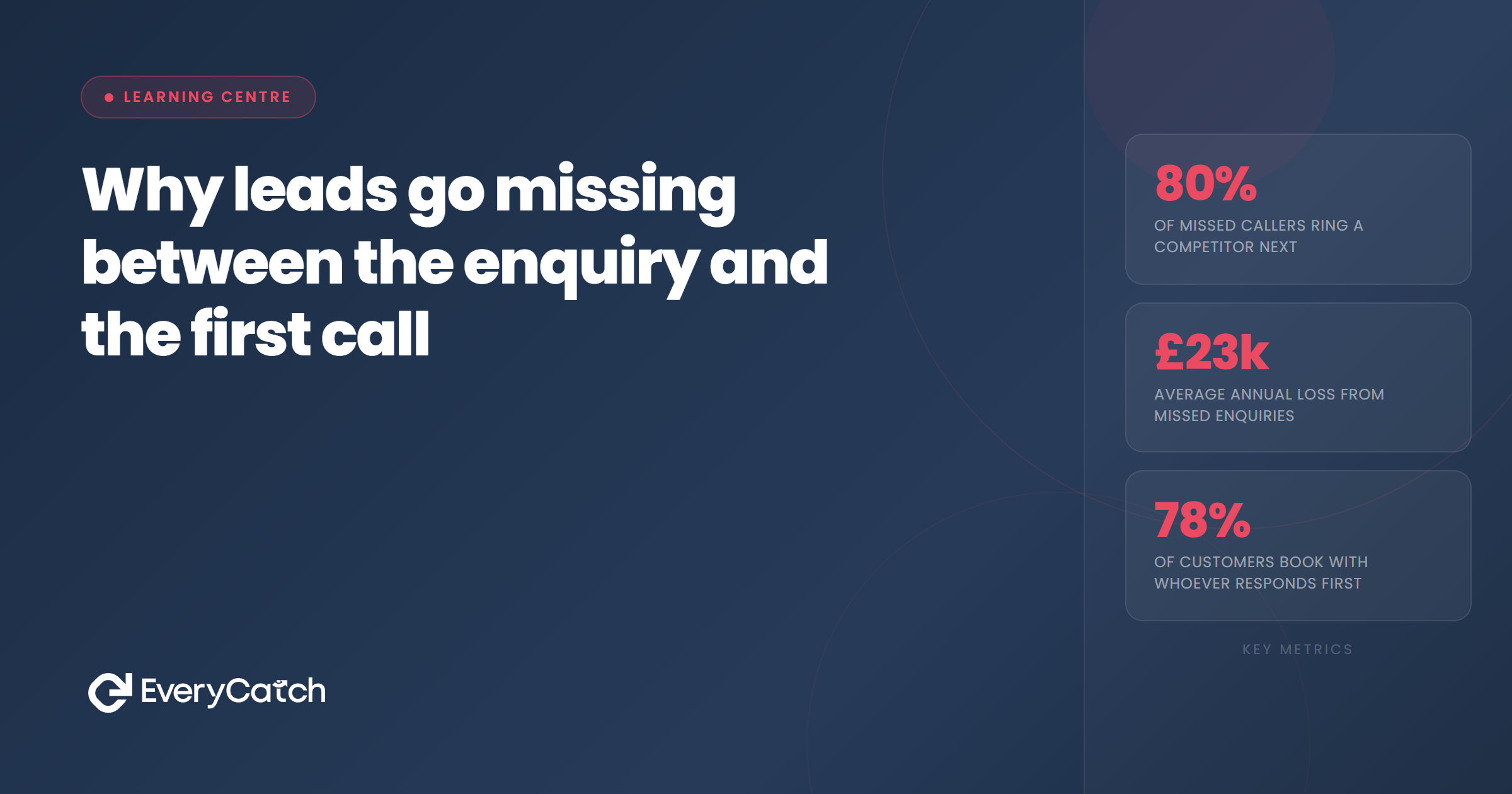

- The window between an enquiry arriving and the first call is where most leads are lost, not at the quote or negotiation stage.
- A lead contacted within five minutes is far more likely to convert than one contacted an hour later, and most businesses take much longer than that.
- Leads slip away when no single person or system owns the enquiry from the moment it lands.
- Enquiries scattered across email, web forms, social messages and voicemail rarely make it into one list anyone checks.
- A single missed call or unanswered email is not a dead lead, but most businesses treat it as one by never trying again.
The gap nobody watches
Ask a business owner where they lose work and they will usually talk about price. They lost the job because a competitor quoted lower, or the customer decided not to go ahead. That story is comfortable because it puts the loss outside the business. The data tells a different story. For most service businesses, the biggest leak is not at the quote stage at all. It sits earlier, in the gap between someone sending an enquiry and someone in the business picking up the phone.
That gap can be twenty minutes or three days. During it, the lead exists but nothing is happening to it. The form submission sits in an inbox. The Facebook message waits behind a notification nobody saw. The voicemail plays to an empty office. Every hour that passes, the person who enquired cools off, gets busy, or contacts someone else. Nothing dramatic happens. The lead simply goes quiet, and the business never knows it lost anything.
Four things widen that gap, and they compound. Fix one and you improve. Fix all four and the leak largely closes.
Speed kills leads first
Response time is the single biggest factor in whether an enquiry becomes a conversation. Research on lead response has shown the same pattern for years. Contact a lead within five minutes and your odds of a meaningful conversation are dramatically higher than if you wait an hour. Wait a day and most of the value has already drained away. We cover the evidence in detail in our article on how fast you should respond to a new lead.
The reason is simple. A person who fills in a form or sends a message is at their peak moment of intent right then. They have the problem in front of them and their phone in their hand. An hour later they are in a meeting, on a job, or cooking dinner. Two days later they have often forgotten which businesses they even contacted. Speed does not just improve your chances. It changes which business the lead remembers.
Most small service businesses respond in hours or days, not minutes, because the people who could respond are on the tools, on site, or with a customer. That is not a discipline problem. It is a structural one, and structural problems need systems rather than willpower.
Nobody owns the enquiry
The second cause is ownership. When an enquiry lands, whose job is it to respond? In many businesses the honest answer is everyone and therefore no one. The email goes to a shared inbox. The office manager assumes the owner saw it. The owner assumes the office manager is handling it. Three days later someone asks about it and discovers nobody called.
This gets worse as a business grows, because more people can plausibly be responsible. It also gets worse at the edges of the day. Enquiries that arrive at 6pm on a Friday are the most likely of all to fall through, because the person who would normally handle them has switched off and by Monday morning there are forty other things demanding attention.
The fix is not a rota pinned to the wall. It is a system that assigns every enquiry to a next action the moment it arrives, so that a human failure to notice does not become a lost lead.
How many enquiries slipped through last month?
A short call with our team will show you exactly where leads are leaking out of your business and what it would take to catch them.
Book a free discovery callToo many channels, no single view
Twenty years ago a lead was a phone call or a walk-in. Today an enquiry might arrive by phone, voicemail, website form, email, Facebook message, Instagram DM, WhatsApp, Google Business Profile message or a directory listing. Each channel has its own inbox, its own notifications and its own login. Nobody checks all of them consistently, so some channels quietly become black holes.
The channels a business checks least are usually the ones a customer used most recently, because customers adopt new channels faster than businesses build habits around them. The Instagram enquiry from a thirty-year-old homeowner is genuinely likely to sit unread for a week while the office email gets checked hourly. From the customer's side, the experience is identical to being ignored.
The answer is consolidation. Every enquiry, whatever channel it arrived through, should land in one place where it can be seen, assigned and actioned. Our article on tracking every enquiry in one place walks through how to set that up. This is also the core of how EveryCatch works. Calls, forms, messages and DMs feed one pipeline, so a lead cannot hide in a channel nobody is watching.
The one-attempt problem
The final cause is what happens after the first try. A staff member calls the lead back, gets voicemail, and moves on. In their mind the lead has been handled. In reality, nothing has happened. The customer missed one call from an unknown number, which describes almost every call most people receive.
Studies of sales contact rates consistently show that it takes several attempts, often six or more, to reach a typical lead, yet most businesses stop after one or two. A lead that did not answer once is not a dead lead. It is a lead that needs a text, a follow-up call the next day, and perhaps an email later in the week. Businesses that follow a simple multi-touch sequence reach far more of their enquiries than businesses that rely on a single call, without spending meaningfully more time. We break down what a good sequence looks like in our guide to how many times you should follow up with a lead.
How to close the gap
Closing the gap between enquiry and first call comes down to four commitments. Respond within minutes, even if the first response is an automated text confirming you have received the enquiry and will call shortly. Give every enquiry a clear owner and a visible status so nothing depends on someone remembering. Pull every channel into one view so no enquiry can arrive somewhere nobody looks. Follow up more than once, on a schedule, until you get an answer either way.
None of this requires more staff or longer hours. It requires the moments after an enquiry arrives to run on a system rather than on whoever happens to be free. When a missed call triggers an instant text back, when a form submission gets an immediate reply and lands in a pipeline with an owner attached, and when follow-up messages go out automatically until the lead responds, the gap shrinks from days to seconds. The leads were always there. The gap was simply swallowing them before anyone noticed.

From the EveryCatch team
EveryCatch helps service businesses catch and convert every enquiry with instant responses, automated follow-up and one pipeline for every channel. We write the Learning Centre to answer the questions our customers ask us most.