- Google Ads leads are in active buying mode when they enquire, which makes them faster to convert but also faster to walk away.
- The same results page that delivered your lead also shows them three or four of your competitors, so slow response hands them a shortlist of alternatives.
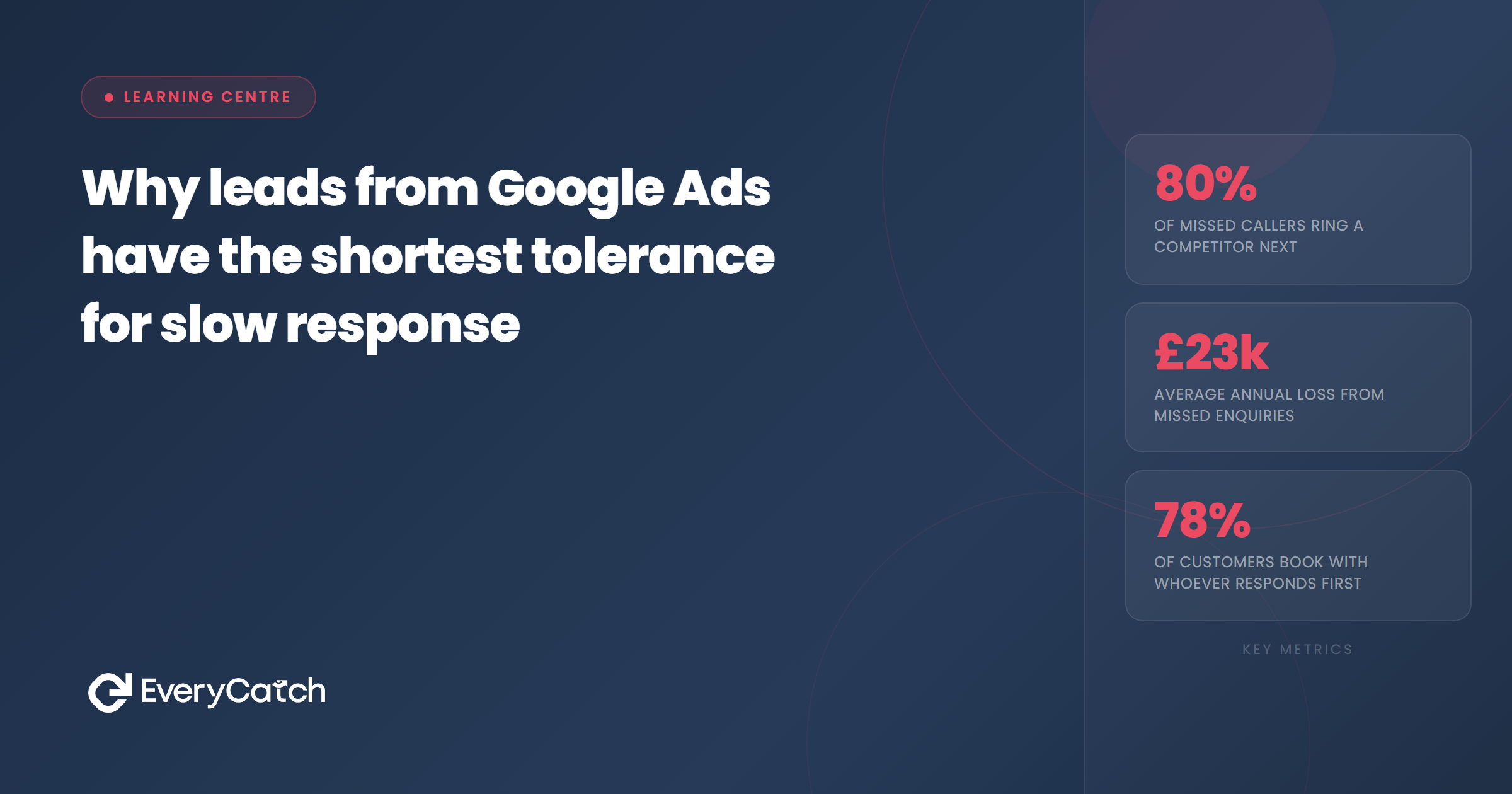
- Every unanswered ad lead is money spent twice: once on the click and again on the lost job.
- Response within five minutes is the realistic benchmark for paid traffic, not the hours that might be acceptable for referrals.
- Automated instant replies protect ad spend without requiring anyone to sit by the phone all day.
Not all leads arrive with the same level of patience. A referral from a happy customer might wait a day or two for a call back, because they were told you were worth waiting for. A lead from your Google Ads campaign will not. They typically expect a response within minutes, and when they do not get one, they go straight back to the search results and click the next name on the list.
That is not a flaw in your advertising. It is a direct consequence of what a paid search click actually represents. Understanding why these leads behave this way is the first step to stopping them from leaking out of your business.
Why ad clicks behave differently from other leads
Someone who clicks a Google Ad has just typed a phrase like "emergency plumber near me" or "roof repair quote" into a search engine. They are not browsing, researching for next year or idly collecting ideas. They have a problem right now and they are actively looking for someone to solve it. Google calls this commercial intent, and it is precisely why you pay a premium for these clicks.
High intent cuts both ways. The same urgency that makes an ad lead more likely to buy also makes them far less willing to wait. A homeowner with water coming through the ceiling does not think of your response time as a customer service metric. They experience it as the difference between a solved problem and an unsolved one. If your reply takes two hours, the problem has usually been handed to someone else long before you pick up the phone.
Referral leads and repeat customers carry trust with them, which buys you time. Ad leads carry none. You are a stranger they found thirty seconds ago, and the only thing they know about you is how quickly you got back to them. That first response is your reputation, in its entirety, at the moment it matters most.
The comparison-shopping problem
There is a second reason ad leads are so unforgiving, and it is structural. The search results page that produced your lead also displayed your competitors. Above your ad, below it and beside it in the map pack, the searcher saw three, four or five other businesses offering the same service in the same area. Many of them opened several tabs before they enquired with you.
In practice, a Google Ads lead is rarely your lead alone. Research into inbound enquiries consistently shows that a large share of searchers contact more than one business, and that most award the work to whichever company responds first. They are not being disloyal. They simply have no loyalty to give yet. The fastest responder wins because speed is the only signal of quality the searcher has received so far.
This is why a slow response to an ad lead hurts more than a slow response to almost any other enquiry. A referral who does not hear back might chase you. An ad lead who does not hear back already has a shortlist of alternatives sitting in their browser. We cover the wider pattern in our article on why the first business to respond usually wins the job.
What slow response does to your cost per lead
Missed ad leads are uniquely expensive because you have already paid for them. In competitive trade and service categories in the UK, a single click can cost anywhere from £3 to £30, and it typically takes several clicks to generate one enquiry. A lead that cost you £50 to acquire and then went unanswered is not a neutral event. It is £50 spent to introduce a warm prospect to your competitor.
The effect on your reported numbers is quietly corrosive. If your campaign generates twenty enquiries a month and you convert six, the instinct is to blame the ads, the keywords or the landing page. But if eight of those twenty enquiries waited more than an hour for a reply, the campaign may be performing perfectly well. The leak is downstream, in the gap between the enquiry arriving and someone acting on it. Plenty of business owners pause profitable campaigns because slow response made the results look worse than they were.
Paying for clicks that never become customers?
A short call will show you exactly where your ad leads are going and what an instant response would recover.
Book a free discovery callHow fast is fast enough for paid traffic
The widely cited research on lead response, including the Harvard Business Review study of over a million enquiries, found that contacting a lead within five minutes makes you dramatically more likely to qualify them than waiting even half an hour. For paid search traffic, five minutes should be treated as the target, not the aspiration.
The reason is behavioural rather than arbitrary. Within the first few minutes, the searcher is still in the same session, phone in hand, thinking about the problem. Respond then and you catch them at peak attention. Wait an hour and they have moved on, contacted someone else or lost the urgency that prompted the click. Wait until the next morning and you are effectively cold calling someone who has forgotten they enquired.
For most service businesses, hitting a five-minute standard manually is unrealistic. You are on a roof, under a boiler, with a client or driving between jobs. The maths of manual response simply does not work for ad leads, which is why the businesses that convert paid traffic well almost always automate the first touch. Our guide to responding to every lead within five minutes without hiring anyone walks through how that works in practice.
Closing the gap without watching your phone all day
The fix is not more discipline. It is removing the human bottleneck from the first response entirely. When an enquiry arrives from your ad landing page, an automated system can acknowledge it by text or email within seconds, confirm the details, ask a qualifying question and offer a booking link. The lead gets the instant reply their expectations demand, and you get a warm, engaged prospect waiting for you when you finish the job you are on.
The same principle applies to the phone calls your ads generate. A missed call from an ad click is the most expensive missed call your business can receive, because the caller found you seconds ago and will find your competitor just as quickly. An automatic text back that lands the moment the call goes unanswered keeps that conversation alive instead of ending it. This is exactly the gap EveryCatch was built to close: instant responses to every enquiry, from every channel, followed by structured follow-up so ad leads never sit ignored while your budget keeps spending.
The businesses that get the most from Google Ads are rarely the ones with the cleverest campaigns. They are the ones where every click that turns into an enquiry meets a response fast enough to match the intent that produced it.

From the EveryCatch team
EveryCatch helps service businesses respond to every lead in seconds, follow up automatically and stop paying for enquiries that go nowhere. We write these guides based on what we see working across hundreds of UK trade and service businesses.