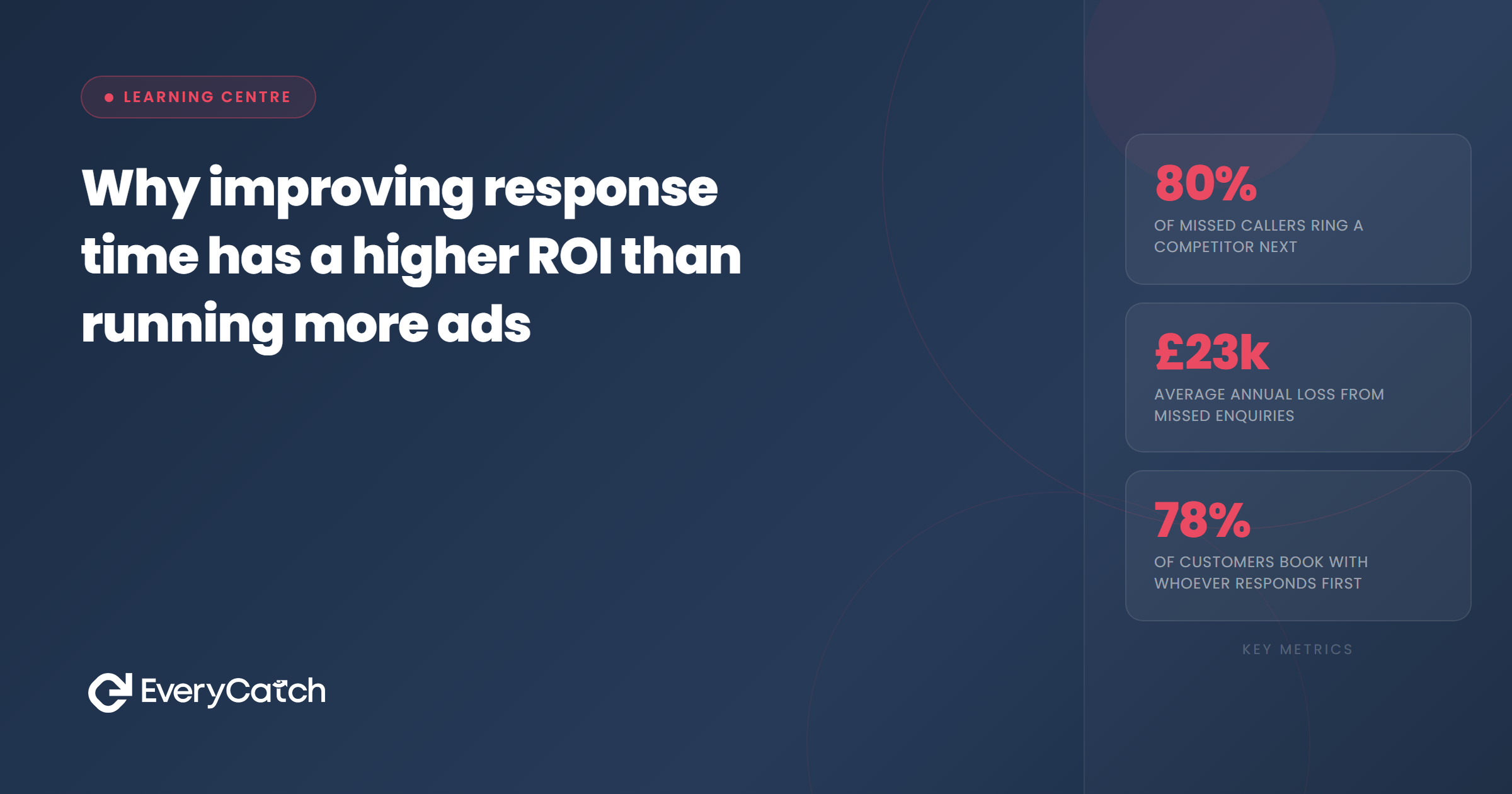

- Extra ad spend multiplies your current conversion rate, including all its flaws. Faster response improves the rate itself.
- Research consistently shows that replying within five minutes makes you many times more likely to qualify a lead than replying after half an hour.
- A response-time fix typically costs a small fixed monthly amount. A meaningful increase in ad spend usually costs hundreds or thousands per month.
- Improving response time raises the return on every enquiry source at once, including free ones like referrals and Google Business Profile.
- More ads only make sense once your response process converts the leads you already receive.
The leaking bucket problem
When enquiries feel thin, the instinct is to buy more of them. Increase the Google Ads budget, boost a few Facebook posts, and the phone should ring more often. That logic is not wrong, but it skips a question that matters far more. What happens to the enquiries you already get?
For most service businesses, the honest answer is uncomfortable. Calls go to voicemail during jobs. Web form submissions sit unanswered until the evening, or until tomorrow. Facebook messages get spotted three days late. Industry studies have found that the average business takes well over 40 hours to respond to a new lead, and a large share never respond at all. Every one of those slow or silent responses is a lead you paid to generate and then handed to a competitor.
Running more ads into that situation does not fix anything. It pours more water into the same leaking bucket. You will get more enquiries, lose the same percentage of them, and pay for the privilege. We covered the scale of this in how many leads your business is actually missing, and the numbers surprise most owners.
The maths, side by side
Consider a business receiving 40 enquiries a month, converting 25 per cent of them into jobs worth an average of £600. That produces 10 jobs and £6,000 in monthly revenue.
Option one is spending an extra £800 a month on ads. If the ads perform well, they might add 10 more enquiries. At the same 25 per cent conversion rate, that is 2.5 extra jobs and roughly £1,500 in new revenue, against £800 in cost. The net gain is around £700 a month, and it disappears the moment you stop paying.
Option two is fixing response time so that every enquiry gets an answer within minutes rather than hours. If that lifts conversion from 25 per cent to 35 per cent, which is conservative given what the research says about speed, the same 40 enquiries now produce 14 jobs and £8,400 in revenue. That is £2,400 of new monthly revenue from leads you were already generating, for the cost of a system that typically runs at a small fraction of the ad budget in option one.
The second option wins on cost, wins on revenue, and wins on durability. A better conversion rate keeps paying whether the leads come from ads, referrals, or your Google listing.
Why speed converts so strongly
The research on this has been consistent for years. The widely cited Lead Response Management study found that contacting a lead within five minutes made a business roughly 21 times more likely to qualify that lead than waiting 30 minutes. A separate Harvard Business Review study found that firms responding within an hour were nearly seven times more likely to have a meaningful conversation with the decision maker than those who waited even an hour longer.
The reason is behavioural rather than technical. A person who fills in a quote form or rings a plumber is at their peak moment of intent. They have the problem in front of them, the phone in their hand, and time set aside to deal with it. Ten minutes later they are back at work, on the school run, or filling in the next company's form. Most buyers do not shortlist five firms and patiently compare them. They go with the first competent business that responds. We explored this in more detail in what happens to a lead in the first five minutes.
More ad spend cannot buy that moment back once it passes. Only speed can capture it.
How much revenue is slow response costing you?
A 20-minute call is enough to estimate your leak and show you exactly how EveryCatch would close it.
Book a free discovery callThe compounding effect on everything else
There is a second reason response time beats ad spend on ROI, and it gets less attention. Ad spend improves one channel. Response time improves all of them.
When you reply within minutes, your paid leads convert better, your referral leads convert better, and your Google Business Profile enquiries convert better. Faster jobs completed means more reviews collected, which lifts your map ranking and produces more free enquiries. Customers who experienced a sharp, responsive business are more likely to recommend you, which feeds the referral channel. None of that shows up in a single month's figures, but over a year it changes the shape of the business.
It also changes the economics of any future advertising. If you do eventually increase ad spend, every pound of it lands on a conversion rate that is 10 or 15 points higher than before. Fixing response time first does not just beat more ads as an investment. It makes more ads a better investment later.
When more ads genuinely make sense
None of this means advertising is a bad idea. If you answer every call, respond to every form within five minutes, and follow up persistently, then your bucket does not leak and more volume is exactly what you need. Some businesses reach that point. Most have not.
A simple test settles it. Look at your last 20 enquiries and note how long each one waited for a first response. If any waited more than an hour, or any got no response at all, you have a conversion problem, not a volume problem, and your next pound is better spent on speed. If every enquiry got a reply within minutes and your diary is still quiet, then advertise with confidence.
Fixing response time without hiring anyone
The practical objection is obvious. You cannot answer the phone from up a ladder, and hiring a receptionist to cover every hour costs far more than any ad campaign. This is where automation earns its keep.
A missed-call text-back sends an instant message to anyone whose call you could not take, keeping the conversation alive until you are free. Instant acknowledgements to web forms and Facebook enquiries do the same for written leads. Automated follow-up sequences then chase the leads that do not reply first time, which is most of them. EveryCatch sets all of this up as a single system, so every enquiry gets a response in under a minute regardless of what you are doing at the time. The result is the conversion lift described above, achieved for a fixed monthly cost rather than an ever-growing ad budget. If you want the step-by-step version, start with how to respond to every lead in under five minutes.

From the EveryCatch team
EveryCatch helps service businesses catch every enquiry with instant responses, automated follow-up, and missed-call text-back. We write these guides because the businesses that understand the problem fix it fastest.