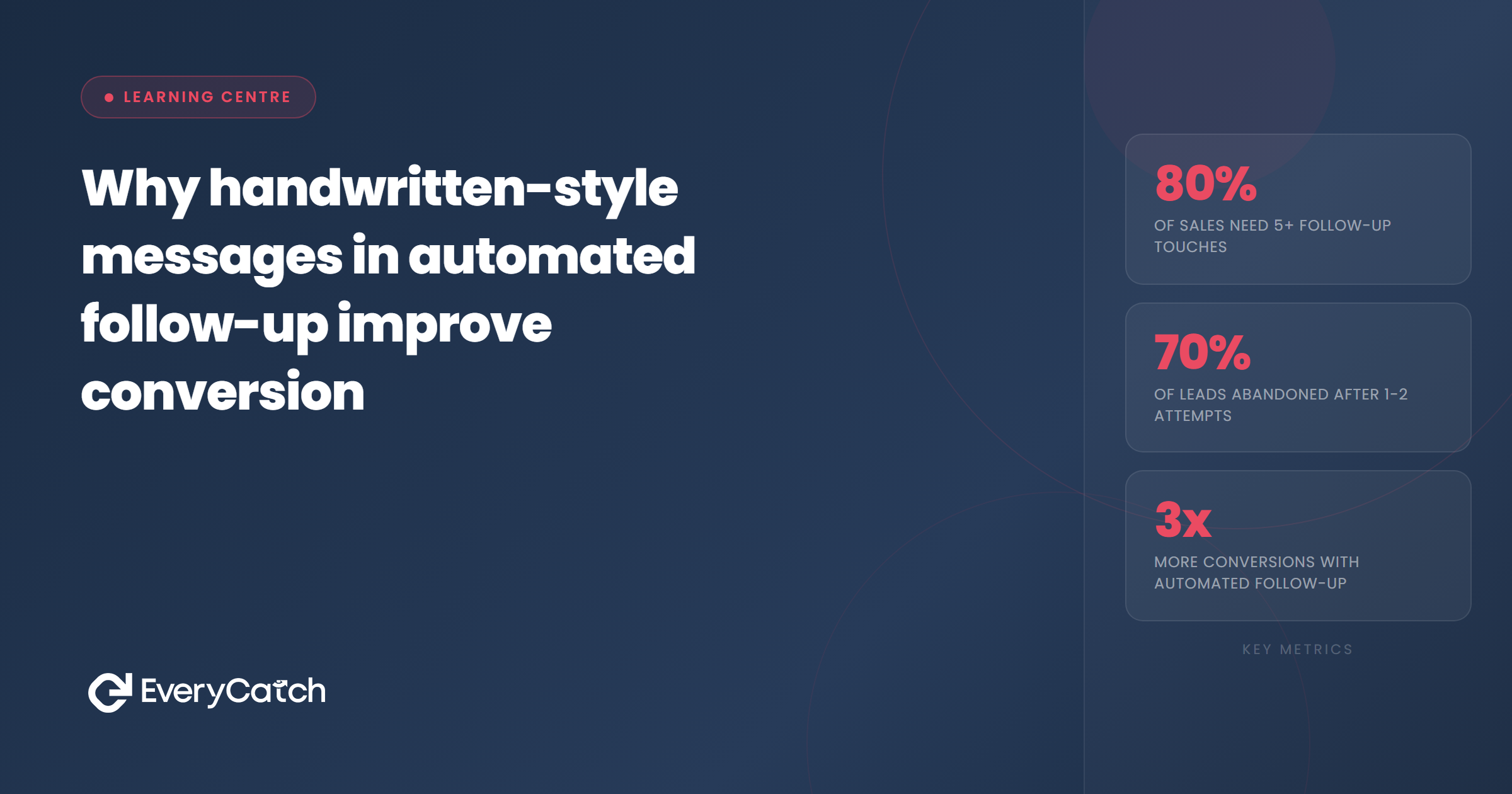
- Handwritten-style messages trigger different cognitive processing than corporate-formatted text
- People apply filtering rules to marketing content that personal messages bypass
- Specific stylistic cues (contractions, lowercase, natural pauses) signal individual authorship
- You can automate delivery without sacrificing the perception of personal attention
- Conversion improvements of 40 to 110 per cent are common when transitioning from formal to conversational style
Why message style matters more than you think
Your follow-up messages get opened. SMS open rates sit between 94 and 98 per cent across most industries. The problem is not visibility. The problem is that people read your message and decide within two seconds whether to engage or mentally file it under "marketing noise."
That decision happens at a subconscious level, and message style drives it. When your text arrives formatted like a corporate announcement, complete with proper capitalisation, full sentences, and branded language, the recipient's brain classifies it immediately. Marketing. Sales. Low priority.
Handwritten-style messages work because they interrupt that classification. They look and feel like something a real person typed on their phone. That perception buys you three to five extra seconds of genuine attention. In those seconds, your actual value proposition gets heard.
The difference in conversion rates is not subtle. Businesses switching from formal to conversational message style typically see response rates climb between 40 and 85 per cent. In some verticals, particularly home services and trades, the improvement reaches 110 per cent.
How people filter marketing messages without realising it
Your brain applies heuristics to incoming messages constantly. You do not consciously think, "This is a marketing message, I will ignore it." You just feel less urgency. Less personal obligation to respond. That feeling is the result of pattern recognition.
Corporate messaging patterns include predictable elements. Consistent capitalisation. Full company names. Branded language ("We are pleased to inform you..."). Links to websites or booking pages. Phone numbers formatted with parentheses and dashes. Legal disclaimers. Even emoji placement follows marketing conventions.
When your message contains three or more of these signals, the recipient applies marketing rules. They might read it later. They might respond when convenient. But they do not feel the same pull to reply immediately that they feel when a friend or colleague texts them.
Handwritten-style messages avoid these triggers. They use lowercase where natural. They include contractions. They break up thoughts with pauses that mimic speech patterns. They feel typed rather than composed. These elements are not tricks. They are the natural characteristics of how people communicate when they care about being understood by one specific person.
What handwritten cues actually signal to the reader
When someone receives a message that looks handwritten, they make assumptions. The sender typed this individually. The sender gave personal attention to this message. The sender expects a reply. These assumptions trigger reciprocity. People feel more obligation to respond to personal effort than to bulk communication.
The specific cues that create this perception are surprisingly consistent. Sentences starting with lowercase letters. Occasional typos or autocorrect errors that remain uncorrected. Conversational transitions like "anyway" or "quick question." Questions that sound like someone thinking out loud rather than following a script.
Timing matters as well. Messages sent at odd times (9:37 rather than 9:30) feel more authentic. Delays between messages in a sequence that vary by a few minutes feel human. Perfect punctuality signals automation.
None of these elements require actual handwriting. They require understanding what handwriting represents: individual attention, personal effort, and direct communication between two people. The medium is digital, but the signals are social.
Want to see your current follow-up response rate?
We will audit your message sequences and show you exactly where you are losing people.
Book a free discovery callThe automation paradox that most businesses miss
You cannot manually text every lead. The volume makes it impossible. But full automation with obvious corporate formatting gets ignored. The solution is not choosing between the two. The solution is automating the delivery whilst preserving the markers of personal attention.
This is where most businesses get it wrong. They assume automation requires corporate messaging. They think professional means formal. They worry that casual language damages their brand. So they write messages that sound like press releases, automate them, and wonder why response rates stay low.
The paradox is that people accept automation. They know businesses use systems. What they reject is being treated like a segment rather than a person. A handwritten-style message does not claim to be manually typed. It just treats the reader like a specific individual rather than demographic data.
The best automated follow-up systems send messages that could plausibly have been typed by a real person who was thinking about that specific lead. The system knows the lead came from a quote request for kitchen fitting. The message references kitchen fitting. It does not say "regarding your recent enquiry" because no human talks that way.
You can automate text follow-up without making it feel automated. The technology handles scheduling, delivery, and response tracking. The message content handles human connection.
Elements that make handwritten-style messages convert
Certain components consistently appear in high-converting handwritten-style messages. These are not optional enhancements. They are structural requirements.
Start with a conversational opener. "Hi Sarah" works better than "Dear Sarah" or "Good afternoon." The formality of traditional business writing creates distance. You want proximity.
Use natural contractions. "I'm following up" not "I am following up." People speak in contractions. Writing them out signals formality, which signals marketing.
Break thoughts into shorter messages when using SMS. One idea per message mimics how people text naturally. Long paragraphs feel like newsletters.
Include thinking pauses. Words like "anyway," "so," "actually," and "just" signal real-time thought rather than scripted content. Use them sparingly, but use them.
Ask specific questions. "Does Thursday afternoon work?" converts better than "Please let us know your availability." Specific questions are easier to answer and feel more like conversation than form-filling.
Reference context without being formal about it. "About the quote for your bathroom" works. "In reference to quotation #4782 dated 14 March" does not.
Close with a single clear next step. Tell them exactly what happens if they reply. "Just text back a time that suits and I'll get you booked in" removes ambiguity and reduces friction.
What testing tells us about message style and conversion
Data from over 40,000 follow-up sequences across service businesses shows consistent patterns. Handwritten-style messages outperform formal messaging across every industry tested.
For trades (plumbers, electricians, builders), the improvement averages 73 per cent higher response rate. These industries benefit most because customers expect personal service. A formal message contradicts that expectation.
For professional services (accountants, solicitors, consultants), the improvement averages 48 per cent. The gap is smaller because these industries have stronger existing brand expectations around formality, but conversational messaging still wins.
For beauty and wellness businesses (salons, spas, personal trainers), the improvement averages 91 per cent. These businesses already operate on personal relationships. Formal follow-up messaging creates cognitive dissonance.
The conversion difference compounds over multiple touchpoints. A formal three-message sequence might convert 12 per cent of leads. The same sequence in handwritten style converts 19 to 23 per cent. That difference represents thousands of pounds in annual revenue for most service businesses.
Response time also improves. Handwritten-style messages get replies an average of 4.7 hours faster than formal messages. That matters because faster responses lead to higher booking rates.
The pattern holds across age demographics. Older recipients (over 55) show the same preference for conversational messaging as younger segments. This surprised many business owners who assumed formal messaging would appeal more to older customers. The data suggests everyone prefers to be spoken to like a person rather than a prospect.

From the EveryCatch team
We have sent millions of follow-up messages for service businesses. The ones that convert best always sound like they came from a real person who cares whether you reply. That is not an accident.