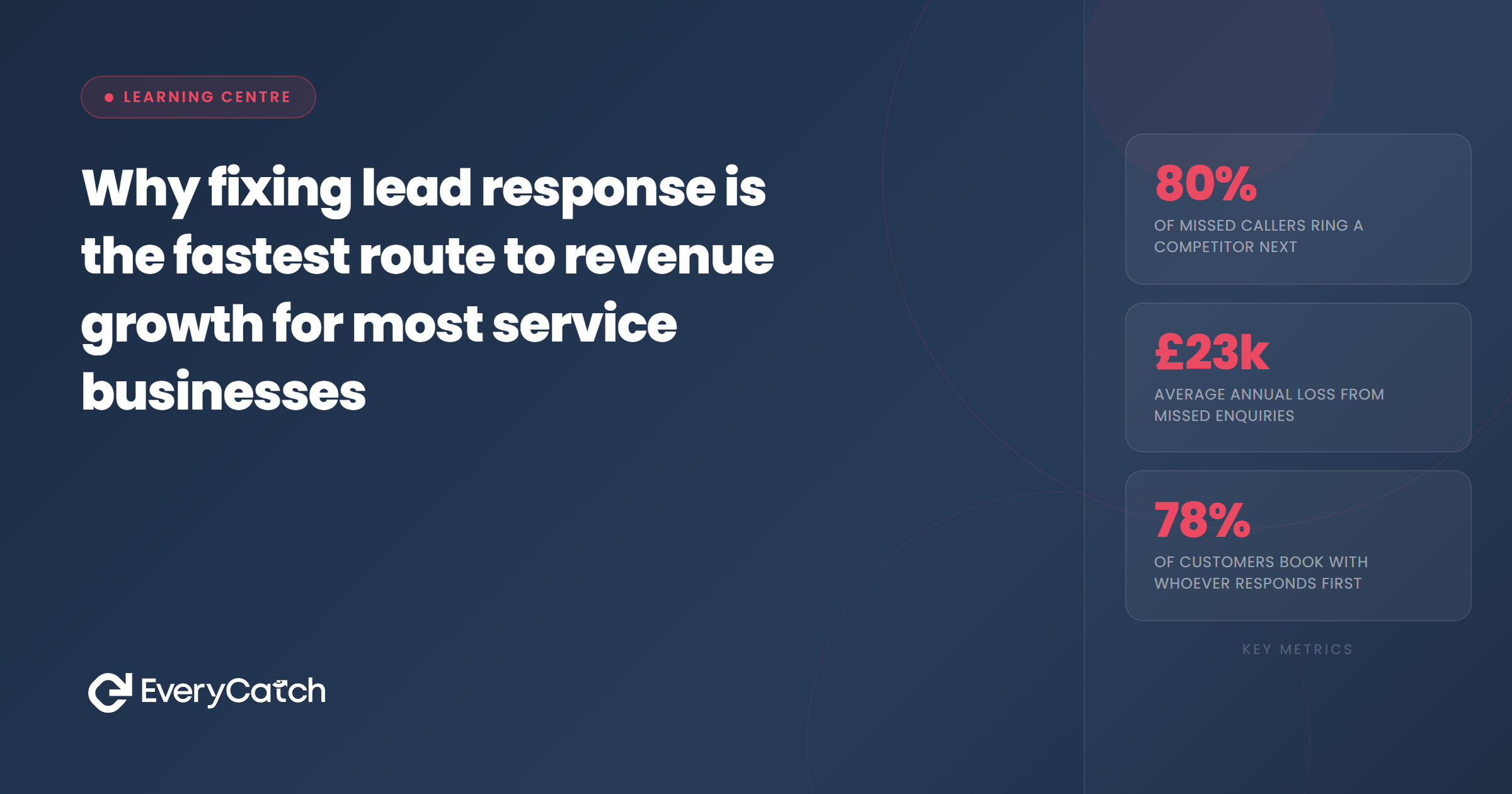

- Most service businesses lose more revenue to slow or absent responses than to any shortage of enquiries.
- Fixing response speed improves the return on every existing marketing channel at once, which is why it outpaces other growth levers.
- Leads contacted within five minutes convert at many times the rate of leads contacted after an hour.
- The fix pays back in weeks rather than months because the enquiries already exist. Nothing new needs to be generated.
- Response speed only fails as a lever when a business has almost no enquiry volume or no capacity to take on work.
Ask a growth consultant how to increase revenue and you will usually hear the same list. Spend more on advertising. Raise your prices. Add a new service line. Hire a salesperson. Every one of those levers can work, and every one of them takes months and carries real risk. There is a quieter lever that most service businesses have never pulled, and it sits right at the front of the pipeline. It is the gap between an enquiry arriving and someone actually responding to it.
The honest answer to the question in the title is this. Fixing lead response is the fastest route to revenue growth for most service businesses because it converts demand you have already paid for, it requires no new customers to exist, and the results show up within the first month. No other lever combines those three properties.
The growth levers compared
Consider what each common growth lever actually demands before it produces a single extra pound. More advertising requires budget, testing, and typically a three to six month runway before the numbers settle. A price rise risks losing existing customers and takes a full billing cycle to show its effect. A new service line needs training, equipment, and marketing of its own. A salesperson needs a salary from day one and rarely covers their own cost inside six months.
Now compare fixing lead response. The enquiries already exist. The marketing budget has already been spent. The customer has already decided they want the work done, which is why they contacted you. The only thing missing is a fast, consistent reply. When you close that gap, you are not creating demand. You are simply stopping demand from escaping. That distinction is why the payback is so quick.
There is a second advantage that gets overlooked. Response speed is a multiplier, not a channel. If your Google ads, your website, your Checkatrade profile, and your word-of-mouth referrals all feed into the same slow response process, then fixing that process lifts the return on all four at once. Spending more on any single channel only improves that channel, and it improves it at the same leaky conversion rate you started with.
The maths of a leaking pipeline
Put some plausible numbers on it. A trades business receives 60 enquiries a month across calls, web forms, and directory listings. The owner answers what they can between jobs, which in practice means around 20 of those enquiries get a response within the hour and the rest wait until the evening or the next day. Research on lead response consistently shows that contacting a lead within five minutes makes you far more likely to reach and qualify them than waiting even thirty minutes. After a day, most enquirers have already spoken to a competitor.
If the fast responses convert at 40 per cent and the slow ones at 10 per cent, that business wins 12 jobs a month rather than the 24 it could win with consistent fast response. At an average job value of £600, the gap is £7,200 a month. That is £86,400 a year lost not to weak marketing but to timing. We have written a fuller breakdown of this calculation in how to calculate what missed leads cost your business, and the numbers surprise almost everyone who runs them.
The reason the loss stays invisible is that nobody sends you an invoice for it. A missed call looks like a missed call, not like a £600 job walking to a competitor. Owners feel busy, the diary looks full enough, and the leak carries on quietly underneath.
Want to know what slow responses are costing you?
We will look at your enquiry channels with you and show you where leads are slipping through, free and without obligation.
Book a free discovery callWhy this lever works so quickly
Speed of payback comes down to where the fix sits in the pipeline. Marketing improvements work at the top of the funnel, so their effect has to travel through every later stage before it becomes revenue. A response fix works at the point of conversion itself. The next enquiry that arrives after the fix is live gets the improved treatment. There is no lag while a campaign learns or a hire settles in.
It also works quickly because the behaviour it exploits is already well established. Customers who enquire with several firms overwhelmingly book with the one that responds first, partly because responsiveness signals reliability. A plumber who replies in two minutes feels like a plumber who turns up on time. That perception forms before you have quoted a single number, and it is very hard for a slower competitor to claw back.
Businesses that automate the first response see this compounding effect within weeks. A missed call triggers an instant text back. A web form gets an immediate reply that asks a qualifying question and offers a booking slot. The enquirer stays engaged instead of dialling the next name on the list. None of this requires the owner to be less busy. It requires the first touch to happen without the owner at all.
What fixing it actually involves
The fix has three parts, and they matter in this order. First, capture every enquiry in one place so nothing arrives unseen. Calls, texts, web forms, Facebook messages, and directory leads should land in a single inbox rather than five separate ones. Second, automate the first response so it happens within seconds regardless of what you are doing. A text that says you have seen the enquiry and will call shortly holds the customer far better than silence. Third, follow up persistently, because a single reply is not enough when the customer is comparing three firms. Our guide to building a follow-up system that runs without you covers that third stage in detail.
Tools like EveryCatch exist to handle all three parts without adding admin. The missed call text back fires the moment a call goes unanswered, follow-up sequences run automatically, and every conversation sits in one pipeline view so you can see exactly which enquiries are live. The point is not the software, though. The point is that the first response must stop depending on whether a human happened to be free.
When it is not the right lever
Honesty matters here. Response speed is not the fastest lever for every business. If you receive fewer than a handful of enquiries a month, there is not enough leakage to plug, and generating demand should come first. If your diary is genuinely full for months and you have no intention of expanding, converting more leads only lengthens a waiting list. And if your conversion problem happens after the quote rather than before the first conversation, the fix lies in pricing or sales technique instead.
For everyone else, which in our experience is the large majority of trades and service firms, the leak at the front of the pipeline is the biggest and cheapest problem to solve. It is worth auditing before you spend another pound on marketing, because faster response makes every pound that follows work harder.

From the EveryCatch team
EveryCatch helps service businesses respond to every enquiry in seconds, follow up automatically, and stop losing paid-for leads to slow replies. We write these guides to answer the questions our customers ask us most.