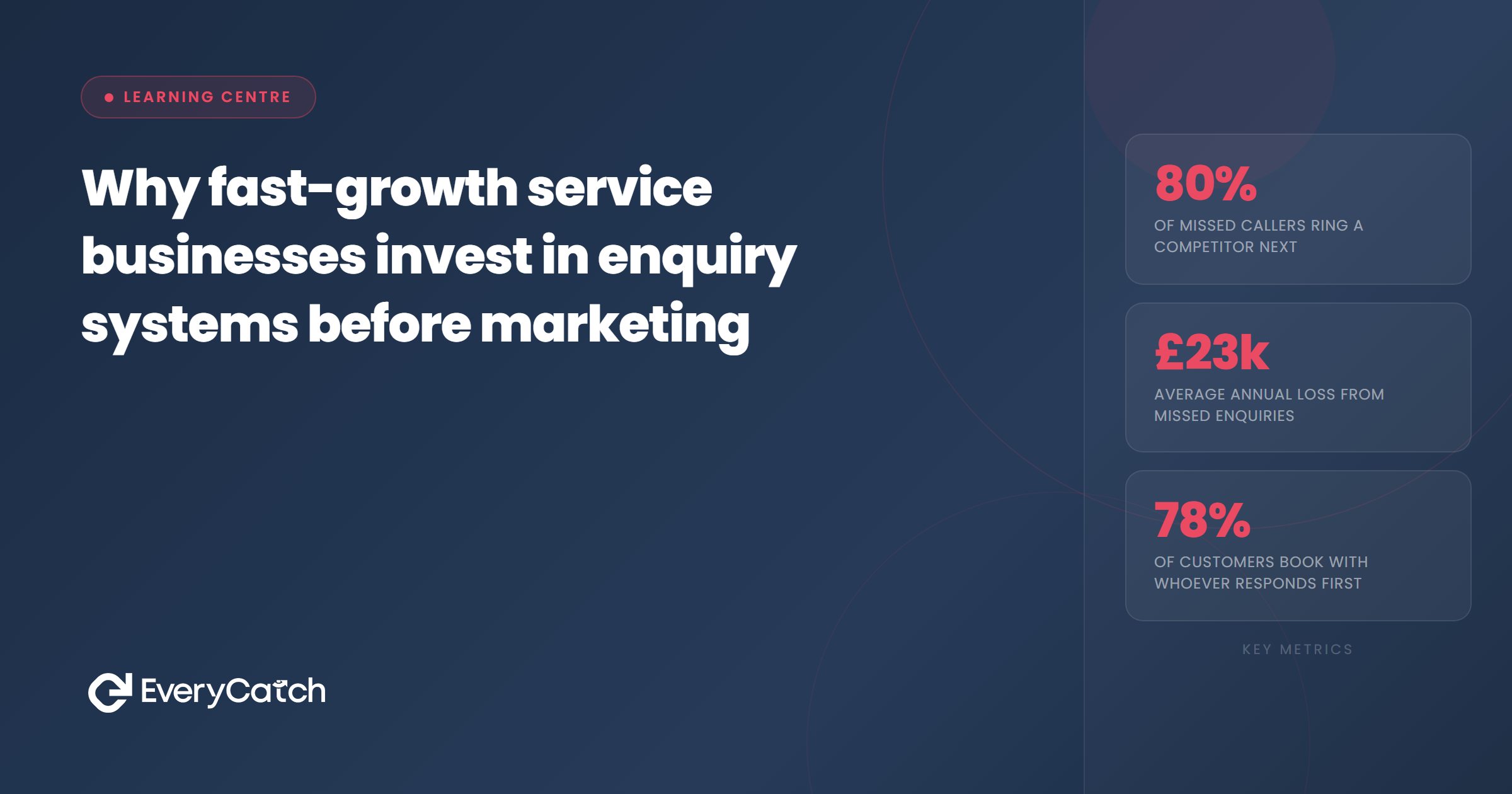

- Marketing multiplies your existing conversion rate, so pouring budget into a business that loses enquiries multiplies the losses too.
- Most established service businesses already receive enough enquiries to grow, and simply fail to capture and convert them.
- An enquiry system covers three jobs: catching every contact attempt, responding within minutes and following up until the enquiry resolves.
- Fixing capture typically costs a fraction of a monthly advertising budget and improves the return on every channel at once.
- The right time to increase marketing spend is when your capture rate is high and your calendar still has gaps.
Ask most service business owners how they plan to grow and the answer usually involves marketing. More Google Ads, a new website, a social media push, maybe a leaflet drop. The instinct makes sense. More visibility should mean more enquiries, and more enquiries should mean more work.
The businesses that grow fastest tend to do something different. Before they spend a pound on generating new demand, they build a system that guarantees they capture the demand they already have. The order matters more than most owners realise, and this article explains why.
Marketing pours water into whatever bucket you own
Every marketing channel does the same fundamental job. It sends more people towards your phone, your website form and your inbox. What happens after that point is entirely down to your business, not the marketing.
Consider what typically happens when a busy trade or clinic gets an enquiry. The phone rings while the owner is on a job or with a client, so it goes to voicemail. Research consistently shows that most callers who reach voicemail do not leave a message. They phone the next business on the list instead. Web form enquiries often wait hours or days for a reply, by which point the prospect has booked elsewhere. Quotes go out and nobody chases them.
None of this is unusual. It is the default state of a business where the person answering enquiries is also the person doing the work. The problem is what happens when you add marketing spend on top. If your business converts three enquiries out of every ten it receives, a doubled advertising budget doubles your enquiries and also doubles the seven you lose. You pay full price for every lead, including the ones that vanish into voicemail. We cover the mechanics of this in more detail in how missed calls quietly drain revenue from service businesses.
Fast-growth businesses understand that marketing is a multiplier, not a fix. Multiplying a leaky process gives you a bigger leak.
What an enquiry system actually is
The phrase sounds grander than it needs to. An enquiry system is simply a set of arrangements that guarantee three things happen every time someone tries to contact your business.
The first job is capture. Every call, form submission, WhatsApp message and Facebook enquiry lands in one place and gets logged, so nothing depends on someone remembering to check five different inboxes. A missed call triggers an automatic text back within seconds, which keeps the conversation alive while you finish the job in front of you.
The second job is speed. Prospects who receive a reply within five minutes are dramatically more likely to convert than those who wait an hour, and the drop-off gets worse from there. An enquiry system replies instantly on your behalf, acknowledges the person and moves them towards a booking, even outside working hours.
The third job is persistence. Most enquiries do not convert on the first touch. A system follows up automatically over the following days, chases unanswered quotes and only stops when the prospect books, declines or asks it to. Human memory is a poor tool for this. Software never forgets and never feels awkward about the third follow-up message.
How many enquiries is your business losing right now?
A 20-minute call will show you exactly where enquiries slip through and what capturing them would be worth.
Book a free discovery callThe maths behind fixing capture first
The commercial argument comes down to cost per outcome. Suppose a business receives forty enquiries a month and converts twelve, losing the rest to missed calls, slow replies and forgotten follow-up. It could spend an extra £1,000 a month on advertising to generate perhaps fifteen more enquiries, of which it would convert four or five at the same rate. That works out at over £200 per new job before it has done anything else.
Alternatively, it could spend a fraction of that on capturing and following up the forty enquiries it already gets. Lifting the conversion rate from twelve out of forty to twenty out of forty produces eight extra jobs from the same enquiry volume, at a far lower cost per job. Those enquiries were already paid for, whether through past marketing, reputation or word of mouth. Converting them costs almost nothing extra.
There is a second effect that compounds the first. Once the capture system exists, every future marketing pound performs better. The same £1,000 advertising budget that previously converted at thirty per cent now converts at fifty per cent or more, which cuts the effective cost of every lead across every channel permanently. Fixing the system first is not an alternative to marketing. It is what makes marketing affordable.
What fast-growth businesses do differently
Watch how the fastest-growing service businesses in any local market operate and a pattern emerges. They treat responsiveness as a competitive weapon rather than an admin chore. When a homeowner rings three plumbers and only one replies within five minutes, that plumber wins the job most of the time regardless of price. Speed of response is one of the few advantages a small business can hold over larger competitors, and it costs very little to secure.
They also measure enquiry flow before they try to increase it. An owner who knows how many enquiries arrived last month, how many got a same-day response and how many converted can make sensible decisions about where to invest. An owner who only knows their revenue figure is guessing. Our article on how to calculate what missed leads cost your business walks through the numbers step by step.
Finally, they automate the repeatable parts of the enquiry journey early, before growth makes the volume unmanageable. Bolting a system onto a chaotic, overloaded business mid-growth is far harder than building it in while things are calm.
When marketing spend does make sense
None of this means marketing is wasteful. It means marketing has a correct place in the sequence. The signal to increase spend is simple: your capture and follow-up system is working, your conversion rate has stopped climbing and your diary still has capacity you want to fill. At that point, new demand is genuinely the constraint, and every lead you buy arrives into a machine built to convert it.
Some businesses reach that point within weeks of fixing their enquiry handling. Others discover they never needed more marketing at all, because the enquiries they were already receiving were enough to fill the calendar once they stopped losing them. Either outcome beats spending on advertising while the back door stands open.

From the EveryCatch team
EveryCatch builds enquiry capture and follow-up systems for UK service businesses, so every call, message and form submission gets a fast reply and consistent follow-up. We write the Learning Centre to answer the questions owners actually search for, honestly and without the sales pitch.