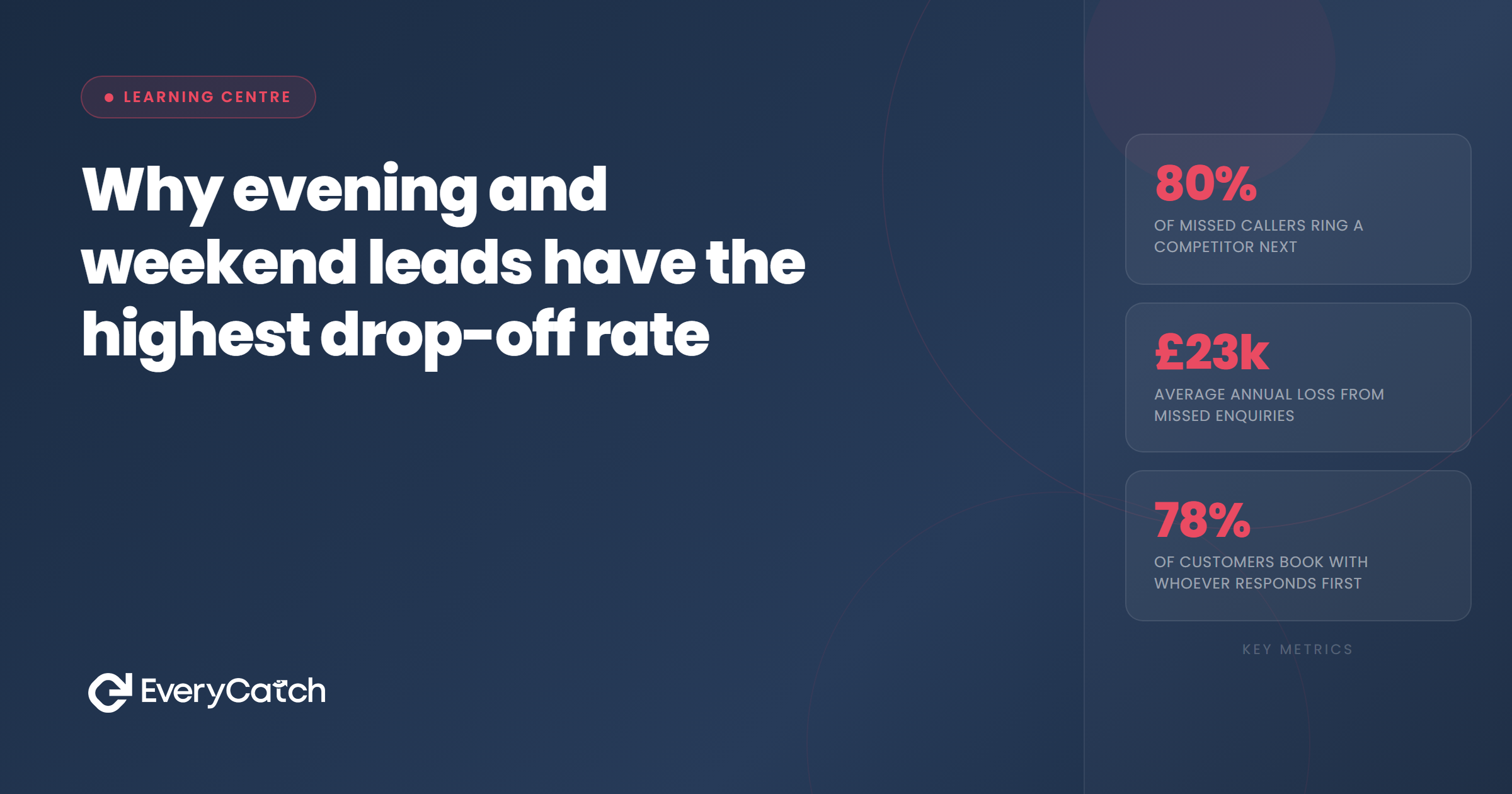

- A significant portion of enquiries to service businesses arrive outside standard working hours, often 30 to 40 per cent.
- Evening and weekend customers are highly motivated in the moment, and that motivation fades quickly once the moment passes.
- Out-of-hours customers rarely contact just one business, so the first firm to respond usually wins.
- Replying on Monday morning to a Friday evening enquiry is functionally the same as not replying at all for many customers.
- Automated instant responses hold the lead until a human is available, which closes most of the drop-off gap.
Evening and weekend leads drop off at a higher rate than any other enquiries for one simple reason. They arrive when nobody is there to answer them, and the customer who sent them is not prepared to wait until you are. The gap between when they reach out and when you reply is longer than at any other time of the week, and every hour of that gap gives them another reason and another opportunity to book with someone else.
That is the direct answer. The rest of this article explains why the effect is so strong, why it costs more than most business owners realise, and what you can do about it without working seven days a week.
When leads actually arrive
Most service business owners assume their enquiries roughly follow their working hours. The data says otherwise. Depending on the trade, somewhere between 30 and 40 per cent of enquiries land in the evening, overnight, or at the weekend. For consumer-facing trades like plumbing, roofing, landscaping and cleaning, the weekend share is often even higher.
The pattern makes sense once you think about how customers behave. A homeowner notices the leaking gutter on Saturday morning while they are actually at home to see it. A couple decides to finally sort the bathroom over dinner on Wednesday evening. Someone gets paid on Friday and starts pricing up the extension that night. People research and contact service businesses during their own free time, and their free time is your closed time.
Mobile browsing pushes the numbers further. The customer is on the sofa at 9pm scrolling through local firms. Contacting you costs them thirty seconds. There is no barrier stopping them from enquiring at that hour, so they do. The barrier only appears on your side, because nobody is watching the inbox.
Why the drop-off happens
Three forces combine to make out-of-hours leads the most fragile leads you receive.
Motivation peaks at the moment of enquiry
A customer who fills in your contact form at 8.45pm on a Sunday is dealing with the problem right then. It is in front of them, it is annoying them, and they have decided to act. That emotional state does not carry over to Tuesday. By the time your reply lands, the boiler noise has faded into background irritation, the budget conversation has moved on, or life has simply crowded the job out. Research on lead response consistently shows that contact rates collapse within the first hour of an enquiry. An overnight or weekend delay stretches that window from minutes into days.
They contacted your competitors too
Almost no customer enquires with a single business. The same person who messaged you at 8.45pm messaged two or three other local firms in the same sitting. If any one of those firms responds first, even with an automated message, they take the lead position in the customer's mind. The others become backups. This is why speed wins jobs before competitors even reply. At the weekend, whichever firm has any form of response running takes nearly everything, because the rest are silent.
Silence reads as disinterest
Customers do not think about your opening hours. From their side, they asked a question and heard nothing. Some will forgive it. Many will quietly conclude that a firm too busy to acknowledge an enquiry will also be slow on site, and they move on without telling you. You never see this happen, which is exactly why the cost stays invisible. If you have never measured it, our article on calculating the real cost of missed leads walks through the maths.
How many weekend leads are you losing right now?
We will look at when your enquiries actually arrive and show you where the drop-off is happening.
Book a free discovery callThe Monday morning problem
Most businesses handle out-of-hours leads the same way. Everything waits until Monday, or until the next working morning, and then gets a reply in a batch alongside the day's other admin. On paper that looks responsible. In practice it means a Friday 6pm enquiry waits more than sixty hours for a first response.
Sixty hours is not a delay. It is a decision. During that window the customer has had the entire weekend, which is the time they most likely set aside to sort the problem, and you were absent for all of it. A competitor who replied Saturday morning has probably already quoted. One who booked a visit has effectively closed the job. Your Monday reply arrives into a decision that has already been made, which is why so many Monday follow-ups get no answer at all. The lead did not go cold on Monday. It went cold on Friday night, and Monday just confirmed it.
The weekend batch also creates a quality problem. Monday morning is usually the busiest admin period of the week, so out-of-hours leads get the shortest, most rushed replies exactly when they need the most effort to revive.
What actually fixes it
The instinctive answers are the wrong ones. Answering your phone at 9pm on a Saturday is not sustainable, and hiring evening cover is expensive for a volume of leads that arrives unpredictably. The fix is not more of your time. It is removing the silence.
An automated instant response changes the customer's experience completely. When they enquire at 8.45pm, they get a reply within seconds that acknowledges them, tells them when a human will follow up, and ideally asks a useful question or offers a booking link. That single message does three things. It confirms their enquiry landed, it puts your firm first in the response race, and it gives them a reason not to keep contacting competitors.
The same principle applies to calls. A missed evening call followed instantly by a text saying you have seen it and will call back keeps the lead warm in a way that a voicemail greeting never will. Most customers will happily wait until morning once they know they have been heard. What they will not do is wait in silence.
Pair the instant response with a structured follow-up the next working morning and the drop-off gap largely closes. The customer enquired Saturday, got acknowledged Saturday, and heard from a human first thing Monday with the context already captured. That sequence outperforms almost every competitor in your area, because almost none of them run it. This is precisely the gap EveryCatch was built to fill. The system replies to every enquiry and missed call instantly, at any hour, and queues the lead with full context for you to pick up when you are actually working. You keep your evenings. The lead keeps its momentum.

From the EveryCatch team
EveryCatch helps service businesses respond to every enquiry instantly, follow up automatically, and stop losing jobs to slow replies. Everything we publish in the Learning Centre comes from patterns we see across real customer data.