
- Enquirers interpret fast response as evidence of competence, reliability, and market demand
- Buyers who receive instant responses are less likely to shop around or negotiate on price
- The highest conversion rates and strongest margins occur when enquiries are answered within 30 minutes
- Speed creates urgency that moves the buyer towards decision faster, reducing exposure to competitors
- Fast-responding businesses spend less time per lead because they close more first-touch enquiries
Most service business owners believe that winning work is about being the best at what they do. That belief is correct, but incomplete. Prospective customers rarely have enough information at the point of enquiry to judge who is best. What they do judge, immediately and instinctively, is who responds fastest.
Fast response is not simply about efficiency. It functions as a proxy for quality, professionalism, and demand. When someone submits an enquiry and receives a meaningful reply within minutes, their perception of the business shifts. That perception affects every subsequent interaction, including their willingness to accept your quote without haggling.
The correlation between response speed, conversion rate, and margin is not coincidental. It reflects a predictable chain of psychological and commercial dynamics that unfold in the first few minutes after an enquiry arrives.
Speed becomes a quality signal
When an enquirer receives a fast, personalised response, they do not just think "this business is quick." They draw broader conclusions. Fast response suggests that the business is organised, busy enough to need good systems, and confident enough to engage immediately. Slow response suggests the opposite.
This inference is almost instantaneous. The buyer does not consciously think "their fast response indicates superior operational capacity." They feel it. The business that replies within five minutes feels more professional than the one that takes two days, even if both provide identical answers.
This perception carries through the rest of the sales process. A buyer who has already formed a positive impression based on responsiveness is more likely to interpret ambiguities in your favour. When you explain why your price is higher than a competitor's, they are more receptive. When you suggest a particular approach, they trust it more readily.
Conversely, when response takes hours or days, the buyer has already started to form negative assumptions. Your eventual reply must overcome that impression, which takes effort and time. In many cases, it is too late. The buyer has moved on, not because your service was inadequate, but because your delayed response suggested it might be.
How urgency protects your premium
Price sensitivity increases with time. When a buyer submits an enquiry, their need feels immediate. They want the problem solved, the question answered, the decision made. If you engage them whilst that urgency is live, price occupies less mental space. They are focused on solving the problem, not minimising cost.
When response is slow, urgency fades. The buyer cools off. They start comparing options methodically. They research alternatives. They begin to wonder whether they need the service at all. By the time you reply, the conversation has shifted from "can you help me?" to "why should I pay this much?"
This shift is structural, not personal. The buyer is not being difficult. Their psychological state has changed. The longer the gap between enquiry and response, the more likely they are to treat your quote as a negotiation starting point rather than a decision trigger.
Businesses that respond within minutes face fewer price objections. Not because their prices are lower, but because the buyer is still in decision mode rather than comparison mode. They have not yet gathered three competing quotes. They have not spent an evening searching for cheaper alternatives. They are still solving a problem, and you are the first credible option to appear.
The 30-minute window
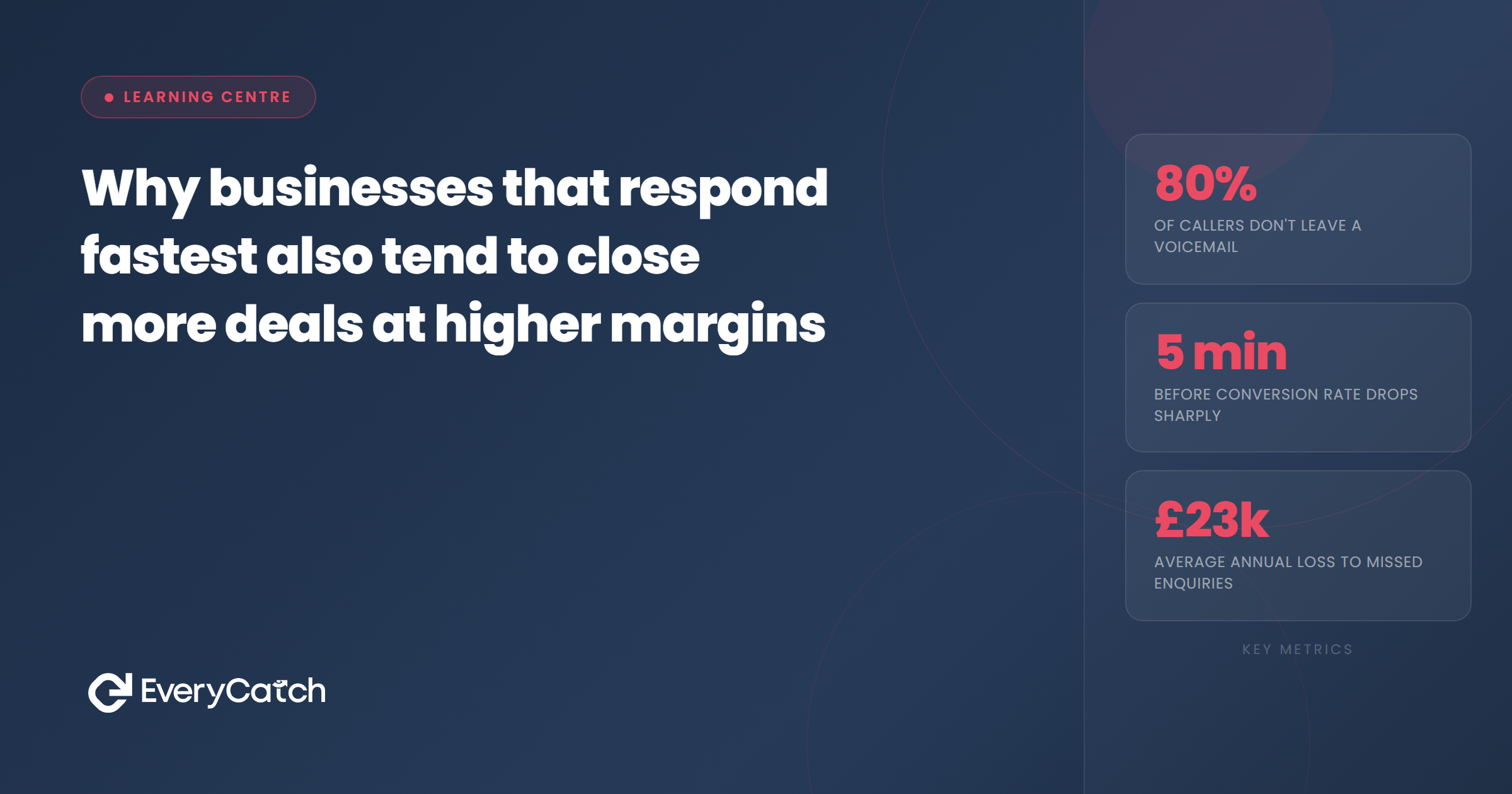
Data from thousands of service businesses shows that conversion rates decline sharply as response time increases beyond 30 minutes. Within the first five minutes, conversion rates can be 60% or higher for warm, qualified enquiries. By the time response stretches to an hour, that figure often halves. After 24 hours, conversion rates frequently drop below 10%.
The mechanism is straightforward. Within 30 minutes of submitting an enquiry, most buyers are still engaged with the problem. They are checking their phone. They remember submitting the form. They are mentally prepared to continue the conversation. A fast reply feels natural and timely.
After 30 minutes, attention disperses. The buyer moves on to other tasks. By the time your reply arrives, they may not remember the enquiry clearly. They need to mentally shift gears, re-engage with the problem, and decide whether your reply warrants action. That friction reduces conversion.
Want to see how fast you're really responding?
We'll show you where your enquiries are going, how long they take to reach you, and what it's costing you.
Book a free discovery callThe businesses that close deals at higher margins are the ones that reach the buyer whilst they are still in that 30-minute window. Not because they pressure the buyer, but because they engage them when urgency and intent are strongest. The buyer is still emotionally invested in solving the problem. They have not yet become a detached comparison shopper.
This timing advantage is compounding. The faster you respond, the less likely the buyer is to contact competitors at all. If they receive a credible, helpful response within minutes, many buyers simply stop searching. They have found what they need. Why continue?
Price becomes less relevant when trust forms early
Trust formation is front-loaded. The majority of trust between buyer and business forms in the first few interactions. If the first interaction is a fast, competent response, trust builds quickly. If the first interaction is silence, doubt builds instead.
Once trust is established, price objections diminish. The buyer is not evaluating your quote in isolation. They are evaluating it within the context of their experience with you so far. If that experience has been positive, responsive, and professional, they give you the benefit of the doubt. They assume the price reflects value, not opportunism.
This effect is particularly strong in service industries where the buyer lacks technical knowledge. A homeowner requesting a boiler repair does not know what a fair price is. They rely on trust signals. A business that responds in five minutes, asks the right questions, and provides a clear explanation feels trustworthy. The price becomes secondary.
Slower businesses face the opposite dynamic. When trust has not been established, price becomes the primary decision variable. The buyer has little else to go on. They cannot assess quality directly, so they default to comparing numbers. The result is downward pressure on margins and longer sales cycles.
How momentum reinforces itself
Fast response does more than convert individual enquiries. It creates operational momentum that improves every metric downstream. When a business responds quickly, it closes deals faster. Faster deal closure means shorter cash cycles, higher throughput, and better resource utilisation.
This momentum also protects margins. A business that is consistently busy because it converts enquiries efficiently does not need to discount to fill capacity. It can afford to maintain pricing discipline because it knows the next enquiry is minutes away, not weeks.
Conversely, businesses that respond slowly often find themselves in a scarcity mindset. When enquiries trickle in and conversion rates are low, each opportunity feels precious. That scarcity drives discounting, concessions, and a willingness to accept less profitable work. The cycle reinforces itself.
The businesses that command premium pricing are usually the ones that are busiest. That correlation is not accidental. Busy businesses respond faster because they have systems. Fast response drives higher conversion, which sustains the pipeline, which maintains the pricing power. Speed and margin reinforce each other.

From the EveryCatch team
We built EveryCatch to make fast, intelligent response automatic for service businesses. Our systems handle enquiries the moment they arrive, so you can focus on doing the work instead of chasing leads.