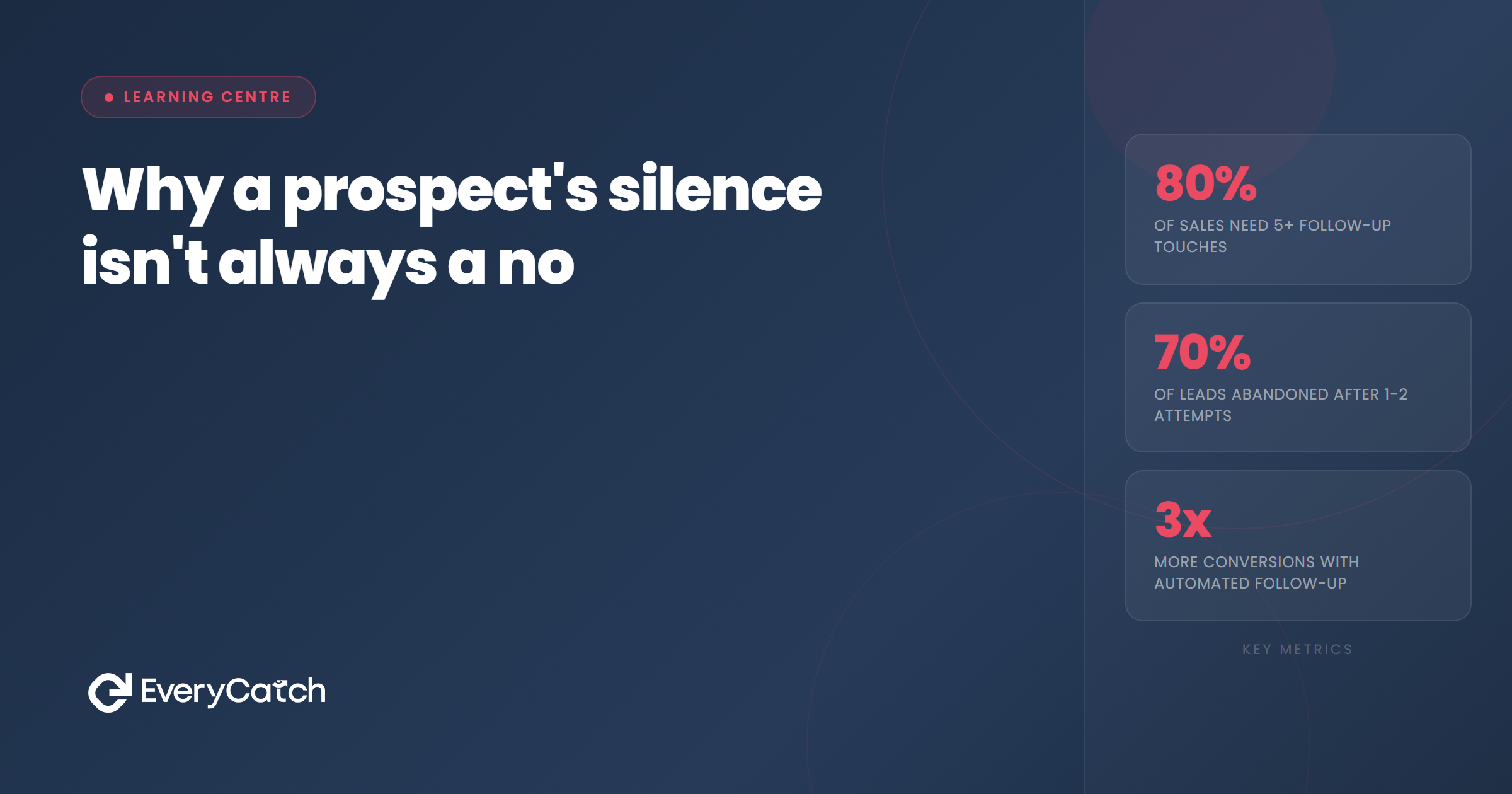

- Silence after an enquiry or quote is more often caused by life getting in the way than by a decision against you.
- Business owners tend to read silence as rejection, so they stop following up long before the prospect has actually decided.
- A genuine no has recognisable signals, and a quiet inbox is rarely one of them.
- A short, polite follow-up message reopens conversations without pressure, and most prospects welcome it.
- Automated follow-up sequences remove the guesswork and keep every quiet lead warm until they answer either way.
You sent the quote three days ago. The prospect seemed keen on the phone, asked good questions, even mentioned when they wanted the work done. Then nothing. No reply, no call, no acknowledgement. It is tempting to file that lead under lost and move on.
That instinct costs service businesses a remarkable amount of money, because silence and rejection are two very different things. Understanding the gap between them is one of the simplest ways to win more work without spending another pound on marketing.
What silence usually means
Put yourself in the prospect's position for a moment. They contacted you because they had a problem, but that problem is one item on a long list. They also have a job, children to collect, a boiler that just started making a strange noise, and forty unread messages competing for their attention. Your quote landed in the middle of all that.
In practice, silence tends to mean one of a handful of things. The prospect opened your message, meant to reply, and got distracted. They are waiting on something, perhaps a partner's opinion, a payday, or a second quote they requested from someone else. They have questions but feel awkward asking them. Or they never saw your message at all, because it sat in a spam folder or arrived while they were driving.
None of those situations is a no. Every one of them is a conversation paused rather than ended. Research on buying behaviour consistently shows that a large share of enquiries convert only after several contacts, yet most businesses stop after one or two. The prospects in the middle, the quiet ones, simply go to whichever competitor happens to follow up.
Why owners assume the worst
There is a psychological reason silence feels like rejection. When you send a quote, you have invested effort and a little bit of ego. A non-reply creates uncertainty, and the human brain resolves uncertainty by filling in a story. The story most owners write is "they went with someone else" or "my price was too high", because that explanation lets them close the loop and stop thinking about it.
The trouble is that the story is usually wrong. When businesses actually follow up with quiet prospects, a striking proportion respond warmly. They apologise for the delay, they explain what held things up, and a good number go on to book. The rejection was imagined. The only real barrier was that nobody sent a second message.
There is also a fear of seeming pushy. British customers in particular are polite, and owners worry that chasing will annoy people. Yet the data runs the other way. Prospects who took the trouble to request a quote generally see a follow-up as good service, not pressure. We cover this in more detail in our article on how to follow up without being annoying.
When silence really is a no
Honesty matters here, so let us be clear. Sometimes silence does mean the prospect has decided against you, and there are signals worth recognising. If someone has ignored four or five varied follow-ups across different channels over several weeks, the odds of a booking are low. If they told you they were getting other quotes and then went quiet immediately after yours arrived, price may genuinely have been the issue. And if they explicitly said they would be in touch if interested, continued chasing can do more harm than good.
Even then, a no today is not always a no forever. Circumstances change, chosen contractors let people down, and budgets reappear. A lead that goes cold in March can come back to life in September, which is why deleting quiet contacts is almost always a mistake. Our guide to reactivating old leads covers what to do with contacts who have gone properly cold.
How many quiet quotes are sitting in your inbox right now?
A fifteen-minute call is usually enough to work out how much unanswered follow-up is costing you each month.
Book a free discovery callHow to reopen the conversation
The best follow-up messages are short, specific and easy to answer. A single text along the lines of "Hi Sarah, just checking you received the quote for the bathroom. Happy to answer any questions" does far more work than a long email restating your pitch. It acknowledges the silence without commenting on it, and it gives the prospect a low-effort way back in.
Timing and variety both matter. A sensible rhythm looks something like this:
- A brief check-in two or three days after the quote, ideally by text because open rates are far higher than email.
- A second touch about a week later, adding something useful such as availability, a relevant photo of similar work, or the answer to a question they raised.
- A third message after another week or so that gently invites a decision, for example by mentioning that your diary for their preferred dates is filling up, provided that is true.
- A final polite message that makes it easy to say no, such as "No problem at all if you've gone another way, just let me know and I'll close the file."
That last message is surprisingly effective. Giving people permission to decline often prompts a reply either way, and a decent share of those replies are actually a yes that had simply stalled.
Build a system, not a memory test
Everything above only works if it happens consistently, and consistency is where busy owners come unstuck. On a quiet Tuesday you might remember to chase last week's quotes. In the middle of a busy fortnight, you will not, and the leads that go quiet during your busiest periods are exactly the ones that slip away.
This is why the businesses that win the quiet prospects are rarely the ones with the best memory. They are the ones with a system. An automated follow-up sequence sends each touch at the right interval, stops the moment the prospect replies, and hands the conversation back to a human. Nobody gets forgotten and nobody gets spammed.
EveryCatch builds these sequences for service businesses so that every enquiry and every quote gets followed up automatically, by text and email, until the prospect answers one way or the other. The owner does nothing except reply when a conversation comes back to life. For most of our customers, the jobs recovered from supposedly dead leads in the first month cover the cost many times over. Silence, it turns out, was never the problem. The absence of a second message was.

From the EveryCatch team
EveryCatch helps service businesses catch every lead and follow up on every enquiry automatically. We write these guides so owners can fix the leaks in their pipeline, whether they work with us or not.