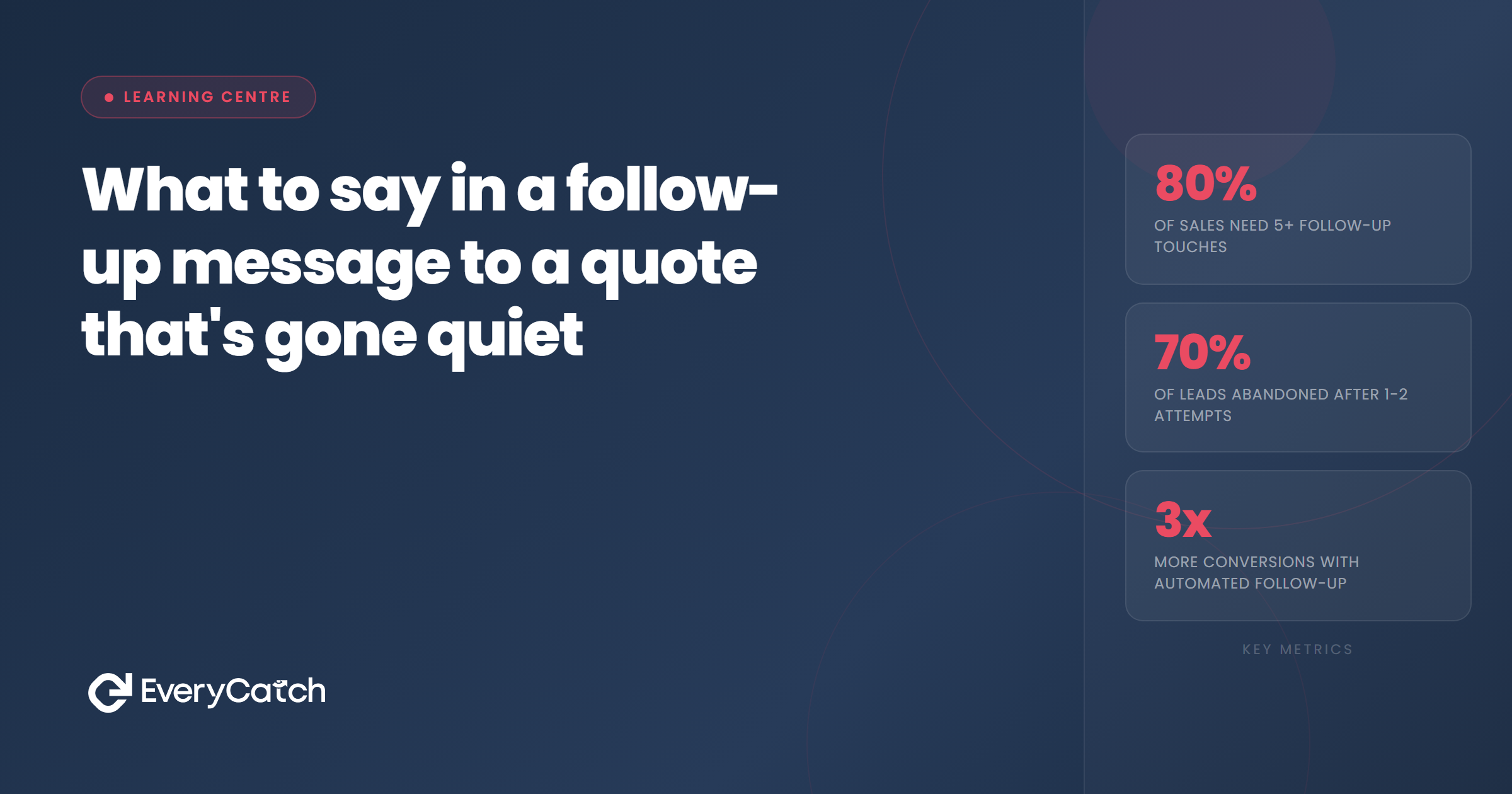

- Most quotes don't convert because of inaction, not rejection. Follow-up fills that gap.
- Your first follow-up should go out three to five days after the quote is sent, not weeks later.
- Effective messages acknowledge the silence, offer new value, and ask a low-friction question.
- Avoid generic reminders. Personalise based on what the customer enquired about.
- Automation ensures every quote gets followed up, even when you're busy or forget.
You send a quote. The customer opened it. Then nothing. No reply, no booking, no polite "thanks but no thanks." Just silence.
This is one of the most frustrating patterns in service businesses. You did the work to respond quickly, you put together a fair price, and now the lead has disappeared. The question is what you say next, if anything, to bring them back without sounding desperate or annoying.
The answer matters because most quotes that go quiet aren't lost causes. They're just stuck. The customer got busy, compared a few options, or simply forgot. A well-timed, well-worded follow-up can restart the conversation and win the job. A poorly timed or badly worded one will confirm their decision to look elsewhere.
Why quotes go quiet in the first place
Before you decide what to say, it helps to understand why customers go silent after receiving a quote. The reasons vary, but they cluster around a few patterns.
The most common is simple inaction. The customer intended to reply but got distracted by work, family, or another priority. Your quote sits in their inbox, not rejected but not acted on. They might even still want the service, but the urgency has faded.
Another reason is comparison shopping. They requested quotes from three or four businesses and haven't decided yet. Your quote is still in play, but they're waiting to see all their options before committing. If you stay quiet, you lose ground to whoever follows up first.
Price can also freeze a customer. They expected a lower figure, and now they need time to think, adjust their budget, or justify the spend to a partner or colleague. Silence doesn't always mean the price is too high. It often means they're processing it.
Finally, some customers go quiet because they didn't understand the quote. The scope was unclear, they're not sure what's included, or they don't know what happens next. Rather than ask, they wait, hoping clarity will arrive on its own. It rarely does.
When to send your follow-up
Timing determines whether your follow-up message feels helpful or intrusive. Send it too soon, and you seem pushy. Wait too long, and the customer has already booked someone else or lost interest entirely.
For most service businesses, the sweet spot is three to five days after the quote was sent. This gives the customer time to review it and compare options without letting too much time pass. If they opened the quote but didn't respond, three days is enough to assume they need a nudge.
If there's urgency attached to the job, such as an upcoming event or seasonal work, you can shorten the window to two days. If the quote is for a large or complex project where the customer needs internal approval, five to seven days is more appropriate.
The second follow-up, if needed, should go out seven to ten days after the first. By this point, you're testing whether the lead is still warm or whether it's time to move on. A third follow-up can work in some industries, but after that, you risk becoming noise.
What to say in the message
Your follow-up message needs to do three things. It should acknowledge the silence without making it awkward. It should offer new value or information, not just repeat what you already sent. And it should make it easy for the customer to respond, even if the answer is no.
Start by referencing the original quote in a way that doesn't sound like you're chasing payment. Use language that assumes they're still interested but might have questions or concerns. Phrases like "I wanted to check in" or "I thought I'd follow up" work better than "Just wondering if you saw my quote."
Next, offer something new. This could be additional information, a case study, a clarification of what's included, or a reminder of availability. The goal is to move the conversation forward, not just remind them you exist. For example, instead of saying "Let me know if you have questions," say "I've attached a breakdown of what's included in the price, in case that's helpful."
Finally, ask a low-friction question. Make it easy to reply with a yes, no, or quick update. Questions like "Does this still fit your timeline?" or "Is there anything I can clarify about the quote?" invite a response without demanding commitment.
Not sure what your follow-up process is costing you?
We'll show you what's slipping through and how automation can fix it.
Book a free discovery callFollow-up message templates that work
Here are three templates you can adapt based on your business and the situation. Each one follows the principles above: acknowledge, offer value, ask a question.
Template 1: Standard first follow-up (3–5 days)
Subject: Quick follow-up on your quote
Hi [Name],
I wanted to follow up on the quote I sent over for [service/project]. I know you're probably weighing a few options, so I thought I'd check in to see if you have any questions or need any clarification.
I've attached a quick breakdown of what's included, just in case that's helpful. If your timeline has changed or you've decided to go in a different direction, no problem at all. Just let me know either way so I can plan my schedule accordingly.
Does this still work for you?
Thanks,
[Your name]
Template 2: Price-focused follow-up
Subject: A few options for your [service] project
Hi [Name],
I realised I didn't explain all the options available for your [service]. If the original quote doesn't quite fit your budget, I can offer a scaled-back version that covers the essentials, or we can split the work into phases.
I've seen a few customers take this approach, and it works well when timing or budget is tight. Happy to talk through what makes sense for you.
Let me know if you'd like to explore that, or if you have any other questions.
Cheers,
[Your name]
Template 3: Availability reminder (for time-sensitive jobs)
Subject: Quick update on availability
Hi [Name],
Just a quick note to let you know that the slot I held for your [service] is still available, but I've had a few other enquiries this week. If you're still planning to go ahead, I'd suggest locking it in soon to avoid disappointment.
If your plans have changed, no worries. Just let me know so I can release the date.
Thanks,
[Your name]
Common mistakes that kill follow-up effectiveness
Even a well-timed follow-up can backfire if the message feels off. Here are the mistakes that undermine trust and reduce response rates.
The first is being too generic. A follow-up that says "Just checking in" or "Did you get my quote?" adds no value and feels lazy. The customer knows you're following up. What they need is a reason to respond.
Another mistake is apologising for following up. Phrases like "Sorry to bother you" or "I don't want to be pushy" signal insecurity and make the customer feel guilty for not responding. You have every right to follow up on work you quoted. Own it.
Overly formal language can also create distance. If your initial conversation was friendly and conversational, don't switch to stiff corporate-speak in your follow-up. Match the tone you used before.
Finally, avoid the passive-aggressive tone that creeps into some follow-ups. Messages that imply the customer is wasting your time or that you're doing them a favour by following up will kill any remaining goodwill. Stay professional, helpful, and neutral.
How to automate quote follow-up without losing the personal touch
The reality is that you can't manually follow up with every quote, especially if you're quoting multiple jobs a week. You'll forget some, delay others, and lose leads that could have converted with a simple nudge.
Automation solves this by ensuring every quote gets a follow-up at the right time, with the right message. The key is to make the automated message feel personal, not robotic.
Start by setting up a simple sequence that triggers when a quote is sent. The first message goes out three to five days later, the second seven to ten days after that. Each message should be written as though you're sending it manually, using the customer's name and referencing the specific service they enquired about.
You can build these sequences in most CRM systems, or use a platform like EveryCatch that automates follow-up based on customer behaviour. If the customer replies at any point, the sequence stops. If they book, it stops. If they don't respond, the system keeps the conversation alive without you having to think about it.
The result is more conversions, fewer lost quotes, and less time spent on repetitive admin. You stay focused on delivering the work, while the system handles the follow-up.

From the EveryCatch team
We help service businesses turn more enquiries into paying customers with automated follow-up, lead tracking, and reputation management. No long contracts, no technical setup, no fuss.