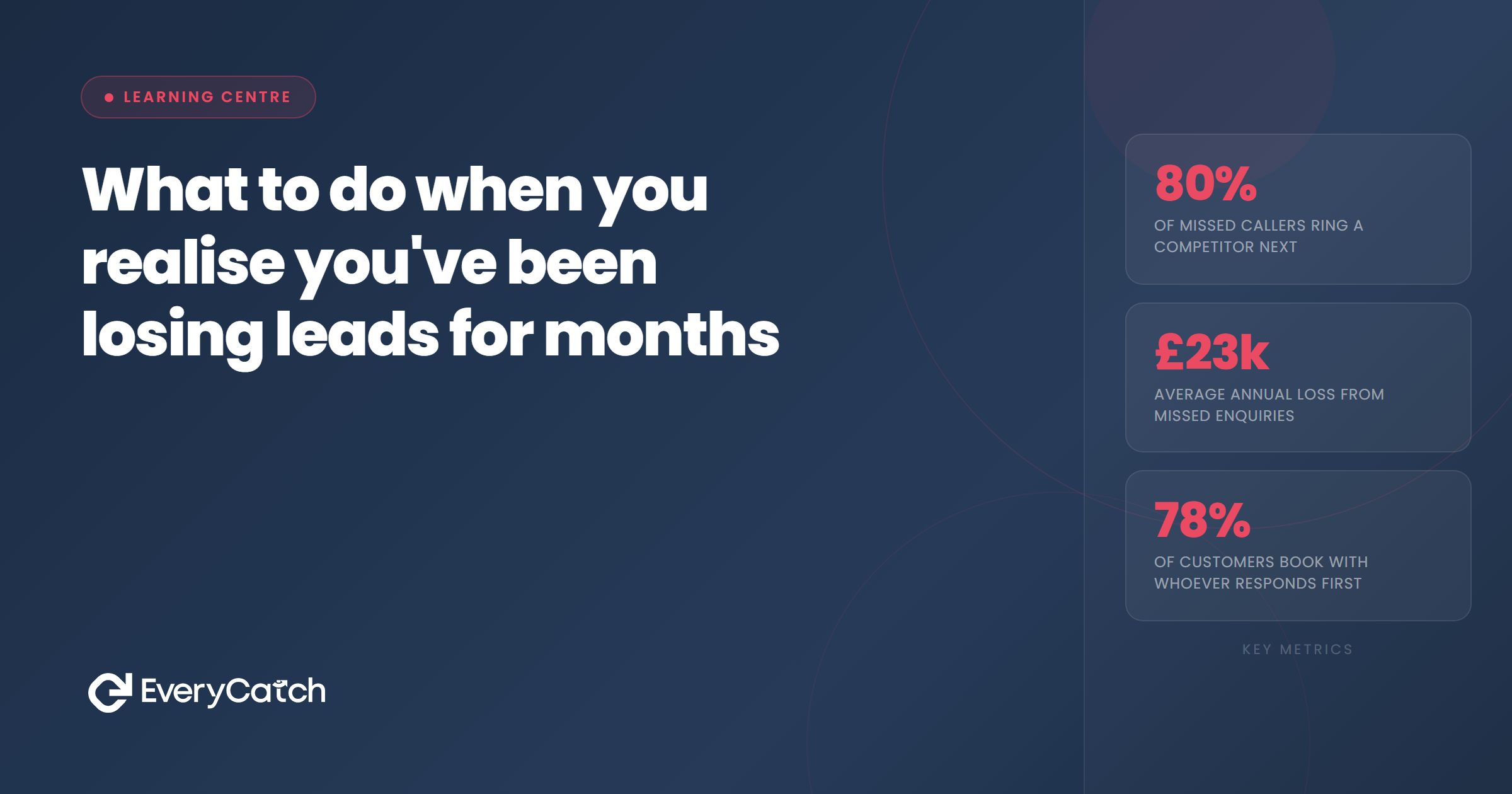

- Resist the urge to guess at the damage. Pull your call logs, form submissions and message history, and count the enquiries that never received a reply.
- Leads from the last 60 to 90 days are still worth contacting. A short, honest re-engagement message typically revives a meaningful share of them.
- Most businesses lose leads through two or three channels at most. Fix the biggest leak first rather than trying to overhaul everything at once.
- A permanent fix means every enquiry gets an automatic first response and lands in one tracked list, so nothing depends on someone remembering to check.
- The guilt fades quickly once the leak is closed. What matters is that next month's leads get answered, not that last month's were missed.
The moment usually arrives by accident. You scroll back through a voicemail inbox you rarely check, or you open the messages tab on your Facebook page, or a customer mentions they filled in your website form twice and heard nothing. Then the penny drops. This has not been happening for a week. It has been happening for months.
The first reaction is usually a mix of anger and embarrassment, and neither of those feelings fixes anything. What fixes it is a short, practical sequence: measure the damage, recover what you can, close the biggest leak, then build a system so it cannot happen again. Here is how to work through each step.
Step one: size the damage with real numbers
Guessing makes the problem feel either smaller or larger than it is, and both distortions lead to bad decisions. Instead, spend an hour gathering evidence. Export your phone's call log or ask your provider for a missed call report. Open every inbox a customer could have used, which usually means your website form notifications, Facebook and Instagram messages, WhatsApp, Google Business Profile messages and any generic email address like info@ that nobody owns. Count the enquiries that never received a reply.
Then attach money to the count. Multiply the number of unanswered enquiries by your typical conversion rate and average job value. If you missed 40 enquiries over four months, you normally win half of the leads you speak to, and your average job is worth £600, the leak has cost you roughly £12,000. That figure will sting, but it does two useful things. It tells you how much effort the fix deserves, and it gives you a baseline to measure recovery against. If you want a fuller method for this calculation, our guide to calculating the true cost of your missed leads walks through it in detail.
Step two: work out where the leads actually escaped
Lost leads rarely vanish evenly across every channel. In most service businesses, two or three specific gaps account for almost all of the damage. The common culprits are missed calls during working hours when everyone is on the tools, enquiries that arrive in the evening or at the weekend, website form submissions going to an email address nobody monitors, and social media messages that sit unread because nobody has the app notifications switched on.
Go back through the evidence you gathered and tag each lost lead by channel and by time of day. A pattern will emerge quickly. One plumbing firm we spoke to found that 70 per cent of their lost enquiries were calls made between 8am and 10am, precisely when the whole team was driving to jobs. That single insight told them exactly what to fix first. Yours will be different, but the exercise takes twenty minutes and removes all the guesswork from the next two steps.
Step three: recover what you can from the last 90 days
Not every lost lead is gone. People who enquired within the last two or three months may still need the work done, may have been let down by whoever they chose instead, or may simply have parked the project. A short re-engagement message costs you nothing and routinely revives 10 to 20 per cent of recent enquiries.
Keep the message honest and brief. Something like: "Hi Sarah, you got in touch with us a while back about your bathroom and your message slipped through the net, which is entirely our fault. If you still need the work done, we'd love to help. Would a quick call this week suit you?" Owning the mistake works better than pretending it never happened, and customers respond well to businesses that admit a slip and act on it. Send it by text where you have a mobile number, because texts get read within minutes while emails sit unopened. Work through the list oldest to newest, and track replies so you can see the recovery in pounds, not just in good intentions.
Want to know exactly how many leads you're losing right now?
We'll audit your enquiry channels on a free call and show you where the leaks are, with no obligation to do anything about them with us.
Book a free discovery callStep four: fix the biggest leak before touching anything else
The temptation after a discovery like this is to overhaul everything at once. New phone system, new CRM, new website form, a rota for checking social messages. That approach usually collapses within a fortnight because it demands too much change at the same time.
Instead, take the channel that lost you the most money and fix that one properly. If missed calls were your biggest leak, the fastest fix is an automatic text that goes to every caller you fail to answer, so the enquiry starts a conversation instead of dying in a voicemail box. If the leak was your website form, redirect notifications to a monitored inbox and add an instant auto-reply so the customer knows they have been heard. If it was social media messages, connect those channels to a single shared inbox rather than relying on personal phones. Each of these fixes takes a day or less, and closing the biggest leak on its own often recovers more revenue than a half-finished overhaul of everything.
Step five: build the safety net so this never repeats
The reason you lost leads for months without noticing is not carelessness. It is that your enquiries were scattered across six places and no single person or system was responsible for all of them. The permanent fix has two parts.
First, every enquiry needs an automatic first response within minutes, regardless of channel and regardless of the hour. That response does not close the sale, but it stops the customer moving to the next name on their list while they wait. Research on lead response consistently shows that replying within five minutes multiplies your chance of a conversation many times over compared with replying the next day.
Second, every enquiry needs to land in one visible list that shows its status at a glance. When you can see ten open enquiries and two of them have had no reply, the gap is obvious and gets fixed the same day. When the same ten enquiries are split across a voicemail box, three inboxes and someone's personal WhatsApp, the gap stays invisible for months, which is exactly how you ended up here. This is the problem EveryCatch was built to solve. It catches calls, forms and messages in one place, sends the instant first reply automatically, and follows up until the customer answers. Whether you use our system or build your own, the principle is the same. Nothing should depend on a human remembering to check an inbox. If you want to go deeper on the response side, our article on why speed to lead matters more than marketing spend covers the evidence.
One last point on mindset. The months of lost leads are a sunk cost, and dwelling on them changes nothing. The only version of this story that matters is the one where the leak is closed by the end of the week and every enquiry from Monday onwards gets an answer.

From the EveryCatch team
We help UK service businesses catch and convert every enquiry with automatic replies, follow-up sequences and a single view of every lead. Everything we publish here comes from patterns we see across hundreds of trades and service firms.