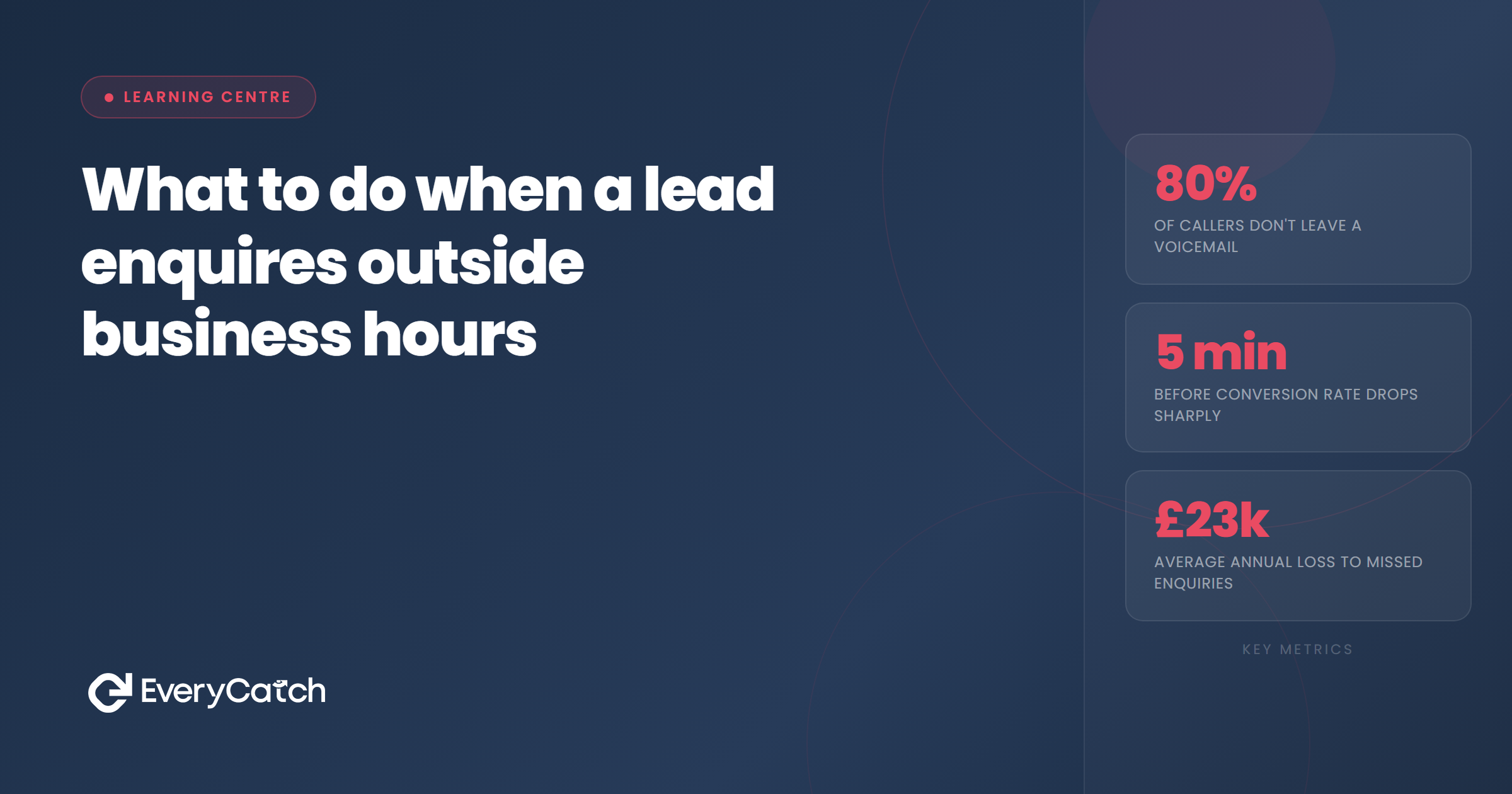

- Most service business leads now arrive outside standard business hours, often in the evening or at weekends
- Instant acknowledgement dramatically reduces the chance a lead contacts a competitor while waiting for your response
- Automated SMS or email responses should capture key details and set expectations about when you'll follow up properly
- The first call or message you send the next business morning must be personal, relevant and reference the information they provided
- Systems that handle after-hours enquiries consistently convert more leads than businesses relying on manual catch-up
People search for tradespeople, home services and local businesses when it suits them, not when you're open. That means a large proportion of your enquiries arrive in the evening after work, during lunch breaks, or at weekends. If you ignore those leads until Monday morning or the next business day, you'll lose a significant share of them to competitors who respond faster.
The question is not whether you should respond outside business hours. It's how you respond without working nights and weekends or paying staff to sit idle waiting for the occasional enquiry. You need a system that acknowledges every lead immediately, captures the information you need to quote or book, and ensures you follow up properly as soon as you're back online.
Why after-hours enquiries matter more than you think
Research shows that most consumers expect a response within an hour of submitting an enquiry, regardless of the time they sent it. That expectation is often unrealistic, but the underlying behaviour is not. When someone fills out a form or sends a message at 9pm on a Thursday, they are actively researching. They have their phone in their hand. They are comparing options. If you don't respond quickly, they will contact another business within minutes.
The businesses that win after-hours leads are the ones that acknowledge the enquiry instantly and make it easy for the lead to provide enough detail that you can give a proper quote or book an appointment the next day. You don't need to answer the phone at midnight. You need a system that keeps the lead engaged until you're available to follow up properly.
Service businesses that implement automated after-hours responses typically see conversion rates on evening and weekend enquiries rise by 30 to 50 per cent compared to businesses that wait until the next morning to reply. The difference is perception. A lead who receives an instant acknowledgement feels heard. A lead who hears nothing assumes you're not interested or too busy.
Send an instant acknowledgement every time
The first response should arrive within seconds. This can be an SMS, an email, or both, depending on the channel the lead used to contact you. The message should confirm that you've received their enquiry, thank them for getting in touch, and tell them when they can expect a proper follow-up.
A good acknowledgement message for an after-hours enquiry might read: "Thanks for your enquiry. We've received your details and will call you first thing tomorrow morning to discuss your project. If it's urgent, reply URGENT and we'll prioritise it." This sets expectations, reassures the lead, and gives them a way to escalate if needed.
Acknowledgements work best when they're specific to the type of enquiry. If someone has asked for a plumbing quote, the message should reference plumbing. If they've asked about availability for a particular date, mention that date. Generic auto-replies feel robotic. Contextual messages feel attentive.
Not sure how many leads you're missing after hours?
We'll show you exactly where enquiries are falling through and how to fix it.
Book a free discovery callCapture enough detail to follow up effectively
An acknowledgement that only says "We'll get back to you" is a wasted opportunity. Use the initial automated message to gather the information you need to quote, book or prioritise the enquiry. This can be done through a short series of SMS questions, a link to a more detailed form, or by asking the lead to reply with specific details.
For example, if you run a gardening business, your after-hours SMS might ask: "Thanks for your enquiry. To help us give you an accurate quote, can you reply with your postcode and a rough idea of the size of your garden?" This gives you enough context to prepare a relevant response the next day, and it keeps the lead engaged with your business rather than moving on to the next option.
The key is to make the request simple. Don't ask for ten pieces of information. Ask for two or three critical details that let you respond intelligently. If the lead doesn't reply, that's fine. You still follow up. But if they do reply, you've already started a conversation and qualified the lead before you've even picked up the phone.
Make after-hours leads your first priority the next morning
When you open your inbox or CRM the next business day, after-hours enquiries should be at the top of your list. These leads have already waited several hours. The longer you delay, the more likely they are to have moved on. If you respond within the first hour of your working day, you're still faster than most competitors.
Your follow-up must reference the information the lead provided. If they told you their postcode and the type of job in their initial message, mention it. "Morning, this is Tom from Greenway Gardens. You asked about hedge trimming in BS3 last night. I've got a slot free on Thursday if that works for you." That kind of response shows you were paying attention, even though the initial reply was automated.
Leads who receive a personal, relevant follow-up within a few hours of their enquiry convert at a much higher rate than leads who wait 24 hours or more. Speed matters, but so does quality. A fast, generic response is better than silence, but a fast, personalised response is what closes the deal.
Set realistic expectations in your automated messages
People understand that you're not available at 11pm on a Saturday. What frustrates them is uncertainty. If your automated message says "We'll get back to you soon," the lead has no idea whether that means ten minutes or two days. If it says "We'll call you tomorrow morning between 9 and 10," they know when to expect contact and can plan accordingly.
Be specific about your availability. If you only work Monday to Friday, say that. If you handle urgent jobs at weekends, explain how to request that. Transparency reduces anxiety and keeps leads from contacting competitors while they wait for you.
Some businesses worry that telling a lead they won't hear back until Monday will push them elsewhere. The opposite is usually true. A lead who knows when to expect a call is more patient than a lead who's left guessing. The businesses that lose after-hours enquiries are the ones that say nothing at all.
Automate after-hours responses the right way
Automation only works if it feels helpful rather than impersonal. The best after-hours systems use conditional logic to tailor responses based on the type of enquiry, the time it was received, and the information the lead has already provided. A plumbing emergency at 2am gets a different response from a quote request for garden landscaping on a Sunday afternoon.
Modern lead response platforms can detect when an enquiry arrives outside business hours and trigger a sequence of messages that acknowledge the lead, gather key details, and schedule a follow-up task for the next working day. This removes the manual work of checking messages first thing every morning and ensures nothing slips through the gap between Friday night and Monday morning.
The system should also log every interaction so that when you do follow up, you can see exactly what the lead was told and when. This avoids the awkward situation where you call a lead who was promised a message on Monday morning, and you're calling on Tuesday afternoon. Context matters, and automation should enhance it, not obscure it.

From the EveryCatch team
We've built automated after-hours response systems for hundreds of service businesses. The ones that work best are simple, specific, and always followed up by a real human the next day.