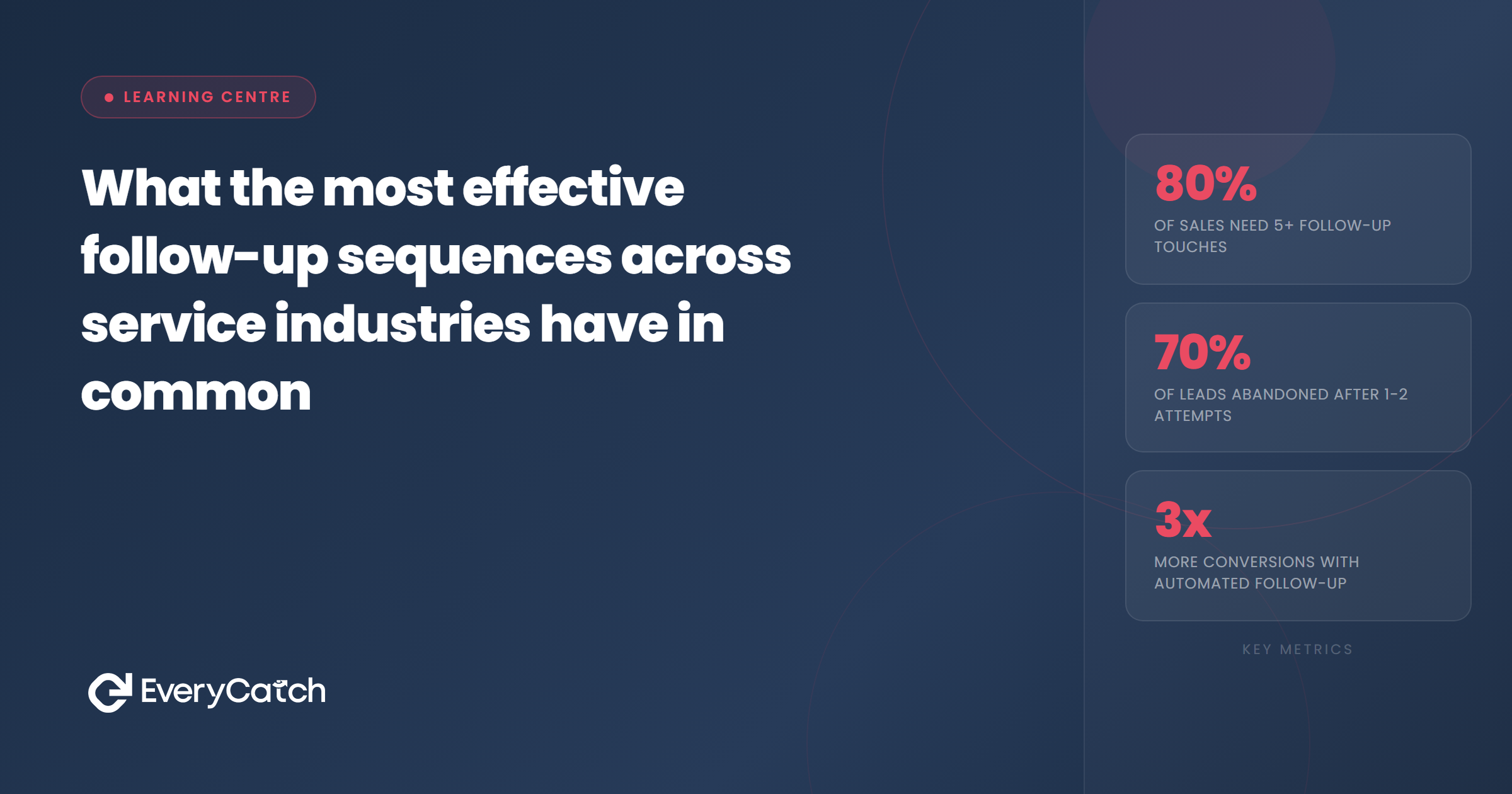

- The most effective sequences respond within five minutes, because contact speed shapes everything that follows.
- Winning sequences make seven or more contact attempts over two to three weeks, while most businesses stop after one or two.
- Text and email work together, with text carrying the urgent asks and email carrying the detail.
- Every message in a strong sequence asks for exactly one action, never a menu of options.
- Automation is what separates businesses that follow up consistently from those that follow up when they remember.
Plumbers, dentists, landscapers, solicitors, roofers, physiotherapists. The services could hardly be more different, yet when you examine the follow-up sequences that actually convert enquiries into booked jobs, the same patterns appear again and again. The messaging changes. The structure does not.
That should be encouraging if you run a service business. You do not need to invent something original for your trade. You need to copy a structure that already works everywhere else and fill it with words that sound like you. Here are the six traits the best sequences share.
They start fast, usually within five minutes
The first message in an effective sequence lands while the enquiry is still warm. Research on lead response has shown for years that contacting a lead within five minutes makes you dramatically more likely to reach them than waiting even half an hour. The lead is still sitting there, phone in hand, thinking about their problem. An hour later they are cooking dinner, and by tomorrow they have filled in three competitors' forms.
This first trait matters most because it sets up everything else. A sequence that starts a day late is fighting uphill from the first message. The businesses that win are rarely the cheapest or even the best reviewed. They are the ones that answered first. We cover this in more depth in our article on why speed to lead matters more than follow-up volume, but the summary is simple: speed buys attention, and attention is what the rest of the sequence spends.
They persist well past the point most businesses give up
Here is the uncomfortable pattern. Most service businesses make one or two contact attempts, then quietly file the lead under "not interested". The effective sequences make seven, eight, sometimes ten attempts spread across two to three weeks. The gap between those two behaviours is where most of the hidden revenue sits.
Persistence works because silence rarely means rejection. It usually means the lead got distracted, went on holiday, or is waiting on a decision from a partner. A message on day nine often converts a lead who ignored the first four purely because the timing finally landed right. The spacing matters as much as the count. Strong sequences front-load their attempts in the first 48 hours, then stretch the gaps, moving from daily contact to every few days to weekly. That rhythm feels attentive at the start and respectful at the end.
They mix channels rather than relying on one
Sequences built entirely on email underperform, and so do sequences built entirely on text. The best performers use both, with a phone call or two woven in where the enquiry value justifies it.
Each channel plays a distinct role. Text messages get opened almost immediately, so they carry the time-sensitive asks: confirming a quote visit, offering an appointment slot, checking whether the lead is still looking. Emails give you room to include photos of past work, answers to common questions, or a breakdown of what happens next. When a lead sees your name arrive through two different channels, you also stop looking like a one-line autoresponder and start looking like a real business paying attention to them.
How many of these six traits does your follow-up have?
Most service businesses score two out of six. A short call will show you exactly where the gaps are and what closing them is worth.
Book a free discovery callEvery message makes one specific ask
Weak follow-up messages hedge. They say things like "let me know if you have any questions or if you'd like to arrange a call or if you need anything else". The lead reads that and does nothing, because a menu of options is a decision, and decisions get postponed.
Effective sequences give each message a single job. One message asks the lead to pick a time for a site visit. Another asks a yes-or-no question, such as "Are you still looking to get this sorted this month?" Yes-or-no questions perform remarkably well by text because they take two seconds to answer and reopen the conversation instantly. The final message in a strong sequence is usually a polite breakup, telling the lead you will close their file unless you hear back. That message alone often produces more replies than any other in the sequence, because it introduces a deadline where none existed.
They run on automation, not memory
This is the trait that quietly explains all the others. No busy owner reliably sends message seven on day twelve to a lead who has ignored six previous messages. It is not a discipline problem, it is a maths problem. A business handling forty enquiries a month with a seven-touch sequence needs to send and track 280 messages, each at the right time, each stopping the moment someone replies. Nobody does that manually while also doing the actual work.
The effective businesses write the sequence once, load it into a system, and let every enquiry receive the same treatment automatically. That consistency is the real advantage. The lead who enquires on a chaotic Friday afternoon gets exactly the same follow-up as the lead who enquires on a quiet Tuesday morning. This is precisely what EveryCatch's follow-up sequences handle: the timing, the channel mix, and the stop conditions run in the background while you stay on the tools. If you want to build the message content yourself first, our guide to writing a follow-up sequence that converts cold leads walks through it step by step.
They stop the instant the lead responds
Nothing torches goodwill faster than an automated message arriving after the lead has already replied, or worse, after they have already booked. The best sequences treat any reply as a full stop. The automation ends and a human conversation begins.
This is also where cheap tooling shows its seams. A basic email scheduler fires messages on a timer regardless of what the lead does. A proper system watches every channel, so a text reply halts the emails and an email reply halts the texts. Leads notice the difference, even if they could not tell you why. A sequence that stops cleanly feels like a person who was paying attention. A sequence that keeps firing feels like a machine, and machines do not win £4,000 jobs.

From the EveryCatch team
We build lead response and follow-up systems for service businesses across the UK, and we write about what actually moves the numbers. Everything in the Learning Centre comes from patterns we see in real customer accounts, not theory.