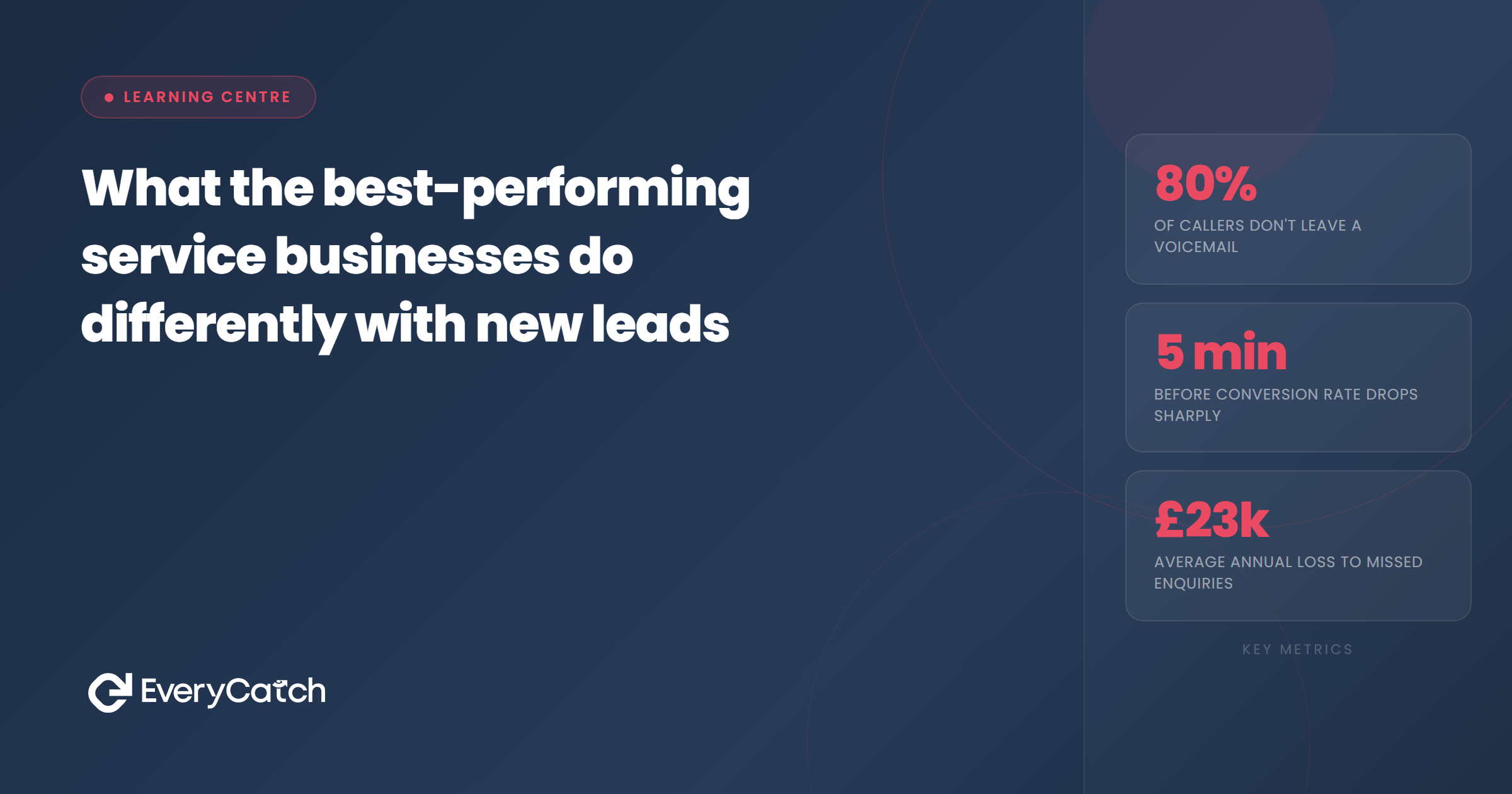

- Top performers respond to new leads within five minutes, not five hours
- They follow a structured multi-touch sequence rather than hoping one call works
- They disqualify poor-fit leads early to focus effort where it counts
- They keep warm leads engaged with automated nurture until the timing improves
- They track response time, contact rate, and conversion rate, then act on the data
Most service businesses treat new leads the same way. An enquiry comes in through the website, someone picks it up when they notice it, they give it one or two attempts, and if nothing happens they assume the lead wasn't serious. Then they wonder why conversion rates stay low.
The businesses that consistently convert more leads don't have better marketing or better prices. They have better processes. The gap between average and excellent lead conversion is not about skill or luck. It is about doing five specific things differently from the moment an enquiry arrives.
They respond immediately, not when convenient
The single biggest difference between high-converting businesses and everyone else is response speed. The best performers reply to new enquiries within five minutes. Not five hours. Not the next day. Five minutes.
This matters because leads decay fast. A person who fills in a contact form or rings your number is actively thinking about solving their problem right now. They may have enquired with three competitors at the same time. The first business to respond gets the conversation, and the conversation usually gets the job.
Studies across multiple industries consistently show the same pattern. The odds of qualifying a lead drop by over 400% if you wait more than five minutes. After an hour, you have almost no chance. The lead hasn't disappeared. They have just moved the conversation to someone faster.
Most businesses know this in theory but don't act on it in practice. They rely on someone checking the inbox regularly or returning missed calls between jobs. That creates a delay that kills conversion before you even speak to the lead. Top performers remove the delay entirely. If a form is submitted at 9pm, the lead gets an instant text confirming receipt and a promise of contact within the hour. If someone calls and you miss it, they receive a text reply within seconds asking when suits for a callback.
Speed to lead is not about working harder. It is about automating the first response so it happens every time, instantly, without relying on someone being available.
They make systematic contact attempts, not random ones
Most businesses give up on a lead after one or two attempts. They call once, maybe leave a voicemail, then move on. The lead goes cold and nobody knows why.
High-converting businesses treat contact attempts as a structured sequence, not a random guess. They know that reaching someone takes multiple touches across multiple channels. The average lead requires six to eight contact attempts before you connect, but most businesses stop at two.
A proper contact sequence looks like this. You send an instant text or email when the enquiry arrives. You follow up with a phone call within five minutes. If no answer, you send a second text an hour later. You try calling again the next morning. You follow with an email mid-afternoon. You keep this pattern going for three to five days across calls, texts, and emails until you either connect or the lead explicitly declines.
This is not harassment. It is professionalism. A lead who enquired but didn't answer the first call may have been driving, in a meeting, or simply missed the notification. The business that stays visible and makes it easy to connect wins the conversation. The one that gives up after one attempt loses by default.
The best businesses automate this sequence. When a lead enters the system, the contact attempts happen automatically at set intervals without manual effort. Every lead gets the same consistent follow-up, whether they arrived on a Tuesday morning or a Sunday evening.
How many leads slip through because you didn't call back fast enough?
We will show you what's happening, and how to fix it.
Book a free discovery callThey qualify ruthlessly and disqualify fast
High performers do not waste time on poor-fit leads. They ask qualifying questions early and disqualify hard when the fit is wrong. This sounds counterintuitive, but it dramatically improves conversion rates on the leads that matter.
Qualification starts with the first conversation. Within two minutes, a good operator knows if the lead has budget, authority, need, and timeline. If any of those pieces are missing, they either solve it or end the conversation politely. There is no value in chasing someone who cannot afford the service, has no decision-making power, or is collecting quotes for a job six months away.
Average businesses treat every lead as equal and invest the same amount of effort regardless of fit. They spend an hour quoting for a job that will never convert, then complain about tyre-kickers. Top businesses identify tyre-kickers in the first three questions and either move them into a nurture sequence or politely decline to quote.
The effect of this is twofold. First, it frees up time to focus on high-quality leads that are ready to buy. Second, it improves your reputation because you only engage deeply with people you can genuinely help. A lead that gets disqualified early often refers someone who is a better fit, because you treated them respectfully rather than wasting their time.
Qualification is not about being difficult. It is about being efficient. The businesses that convert the most leads are also the fastest at recognising which leads not to chase.
They nurture leads that aren't ready yet, rather than losing them
Not every lead is ready to buy today. Some are comparing options, some have budget approval pending, some are still researching. Most businesses lose these leads because they do nothing after the initial contact fails.
High-converting businesses put these leads into a nurture sequence. The lead receives automated emails or texts over the coming weeks that keep the business visible without being pushy. These messages are not sales pitches. They are value content: tips, case studies, reminders of availability, or seasonal prompts that match the service you provide.
A plumber might send a pre-winter boiler maintenance reminder. An electrician might share safety tips for older homes. A landscaper might send a spring planning guide in February. The goal is to stay top of mind so that when the lead is ready to move, you are the obvious call.
This process converts leads that would otherwise have gone to a competitor simply because that competitor stayed visible longer. It also separates the serious enquiries from the casual ones. A lead who opens three nurture emails and clicks through is showing intent. A lead who never engages was never serious.
Nurture sequences work because they respect timing. Not every lead converts immediately, but many convert eventually if you remain present without pressure. The businesses that do this consistently see 15% to 20% of nurtured leads convert within three months, leads they would have lost entirely without a system in place.
They measure what matters, and act on it
The final difference is measurement. Top-performing businesses track their lead response process and adjust based on data, not guesswork. They know their average response time, their contact rate, their qualification rate, and their overall conversion rate. When one metric slips, they fix it.
Most businesses have no visibility into these numbers. They know how many enquiries they received and how many became jobs, but they have no idea what happened in between. They don't know how many leads they never contacted, how many they contacted too late, or how many slipped through because they stopped following up too soon.
Measuring lead response is simple when the process is structured. You track time to first response, number of contact attempts, time to first conversation, qualification outcome, and conversion outcome. These five metrics tell you where the process is working and where it is breaking.
If your response time is slow, you know to automate the first reply. If your contact rate is low, you know to extend the follow-up sequence. If qualification is inconsistent, you know to tighten the script. If conversion is poor despite good contact rates, you know the problem is in the sales conversation, not the process.
The businesses that measure their lead response process improve it continuously. The ones that don't measure it repeat the same mistakes indefinitely and wonder why results never change.

From the EveryCatch team
We build lead response systems for service businesses that convert more enquiries without adding workload. If your current process relies on someone remembering to call back, it's time we talked.