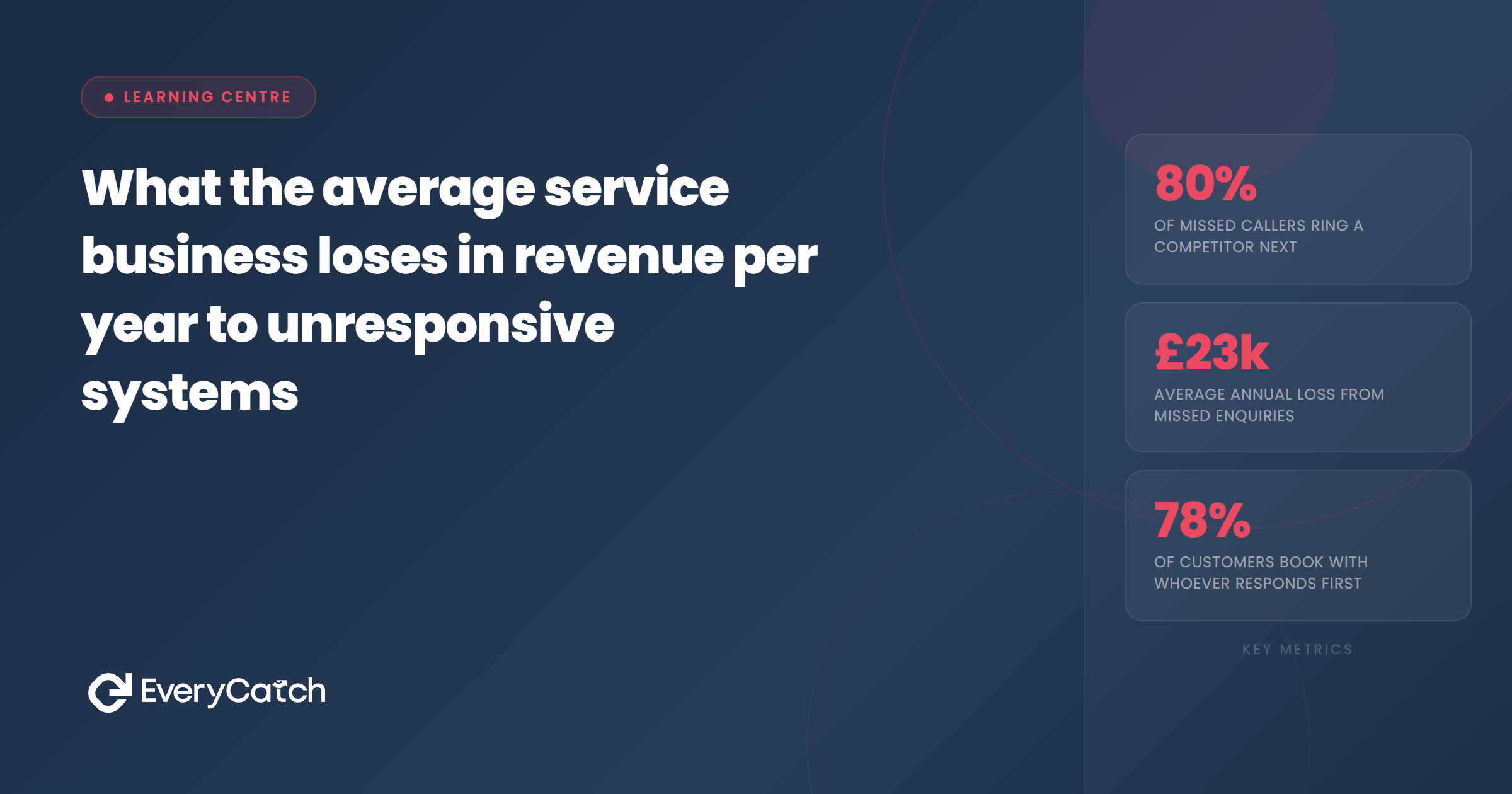

- A small service business handling 30 to 50 enquiries a month typically loses £15,000 to £50,000 a year to unresponsive systems.
- The loss comes from three leaks: missed calls, slow replies to web and social enquiries, and quotes that are never chased.
- Roughly 62 per cent of calls to small businesses go unanswered, and around 85 per cent of those callers never ring back.
- You can calculate your own figure with three numbers: monthly enquiries, average job value and your close rate.
- Most of the loss is invisible in your accounts, which is why owners consistently underestimate it.
Ask a service business owner how much revenue they lose to slow or absent responses and most will guess a few thousand pounds a year. The honest answer, once you count missed calls, unanswered form fills and quotes that were sent and forgotten, usually sits somewhere between £15,000 and £50,000 for a business handling 30 to 50 enquiries a month. Businesses with higher job values, such as builders, landscapers and installers, can lose double that.
That range is wide because businesses differ, but it is not a scare figure plucked from thin air. It falls out of a small set of well-documented behaviours: how often calls go unanswered, how quickly buyers move on when they hear nothing, and how rarely enquiries receive more than one attempt at contact. Put those together with your own job values and the number stops being abstract.
The headline number, and where it comes from
Research into small business call handling consistently finds that around 62 per cent of inbound calls go unanswered. Studies of buyer behaviour add a second uncomfortable finding: roughly 85 per cent of people whose call is not picked up do not try again. They ring the next name on their list instead. So a business receiving 40 calls a month may only ever speak to 15 of those callers, and the other 25 quietly become someone else's customers.
Speed matters just as much for written enquiries. The widely cited Harvard Business Review study on lead response found that firms replying within an hour were roughly seven times more likely to qualify a lead than those replying an hour later, and more than 60 times more likely than those taking 24 hours. Most small service businesses take hours, and often days, to reply to a website form. By then the enquirer has usually booked with a competitor who answered first.
Take a modest example. A plumber with an average job value of £280 receives 40 enquiries a month across phone, web forms and Facebook. If unresponsiveness costs just eight of those enquiries a month, and the plumber normally wins half of the enquiries he actually speaks to, that is four lost jobs a month. Four jobs at £280 is £1,120 a month, or £13,440 a year, and that assumes no repeat work or referrals from those lost customers. For a trade with a £2,000 average job, the same leak costs nearly £100,000. Our article on what a single missed lead actually costs works through the lifetime value side of this in more detail.
The three leaks that make up the loss
Unresponsive systems is a broad phrase, so it helps to break the loss into its three components.
Missed calls are the largest leak for most trades. You are on a roof, under a sink or driving between jobs, and the phone rings out. Voicemail does not save you, because fewer than one in five callers leave a message. The rest simply move on.
Slow replies to written enquiries come second. Website forms, Google Business messages, Facebook enquiries and emails all carry an expectation of a fast answer. A form fill answered the next morning has usually gone cold, and the sender rarely tells you why they went quiet.
Absent follow-up is the leak nobody measures. Quotes get sent and never chased. Enquirers who did not answer the first call never receive a second. Studies suggest around 80 per cent of sales require five or more follow-up touches, yet most small businesses make one attempt and stop. We cover this pattern in why most service businesses only follow up once.
Want to know your own number?
We will walk through your enquiry volume, job values and response gaps on a free call and show you what unresponsiveness is costing your business each year.
Book a free discovery callHow to calculate your own figure in five minutes
You need three numbers. First, count your monthly enquiries across every channel: calls, forms, social messages and walk-ins. Check your phone log for missed calls, because that figure surprises almost everyone who looks at it. Second, work out your average job value. Third, estimate your close rate on enquiries you actually engage with promptly, which for most trades sits between 40 and 60 per cent.
Then apply a conservative leak rate. If 20 per cent of your enquiries either go unanswered or wait more than a few hours for a reply, multiply that number by your close rate and your job value. A business with 45 enquiries a month, a £450 average job and a 50 per cent close rate loses nine enquiries, and therefore about four and a half jobs, each month. That is roughly £2,000 a month and £24,000 a year, and 20 per cent is a gentle assumption when the average missed-call rate is three times higher.
Why owners consistently underestimate the loss
Lost revenue from unresponsiveness never appears in your accounts. There is no line item for the job you did not know you missed. The customer who rang out at 2pm on a Tuesday leaves no record beyond a number in a call log nobody reviews, and the form fill that waited overnight simply stops replying. Because the loss is invisible, the brain fills the gap with an optimistic guess.
There is also a survivorship problem. The enquiries you do handle turn into jobs, invoices and reviews, so the business feels busy and healthy. Being busy is precisely why calls get missed, which means the leak grows fastest during your best months. The businesses losing the most are often the ones that feel least like anything is wrong.
Closing the gap without hiring anyone
The fix is not answering every call personally, because that is impossible for anyone who does the actual work. The fix is making sure every enquiry gets an immediate response even when you cannot give one. Missed call text-back sends an automatic message the moment a call rings out, which keeps the caller engaged instead of dialling your competitor. Instant replies to forms and social messages do the same for written enquiries. Automated follow-up sequences then chase quotes and unresponsive leads so nothing dies from silence.
None of this requires new staff or a receptionist. It requires a system that treats speed as non-negotiable. EveryCatch sets this up for service businesses as standard, but whether you use us or build it yourself, the arithmetic above is the same. Recovering even half of a £24,000 annual leak pays for almost any solution many times over, and the businesses that plug the leak first tend to be the ones that grow while their competitors wonder where the quiet weeks came from.

From the EveryCatch team
EveryCatch helps service businesses respond to every enquiry instantly and follow up automatically, so no lead slips through the cracks. We publish honest, practical answers to the questions business owners actually search for.