
- Businesses lose 20-40% of potential revenue through inconsistent follow-up alone
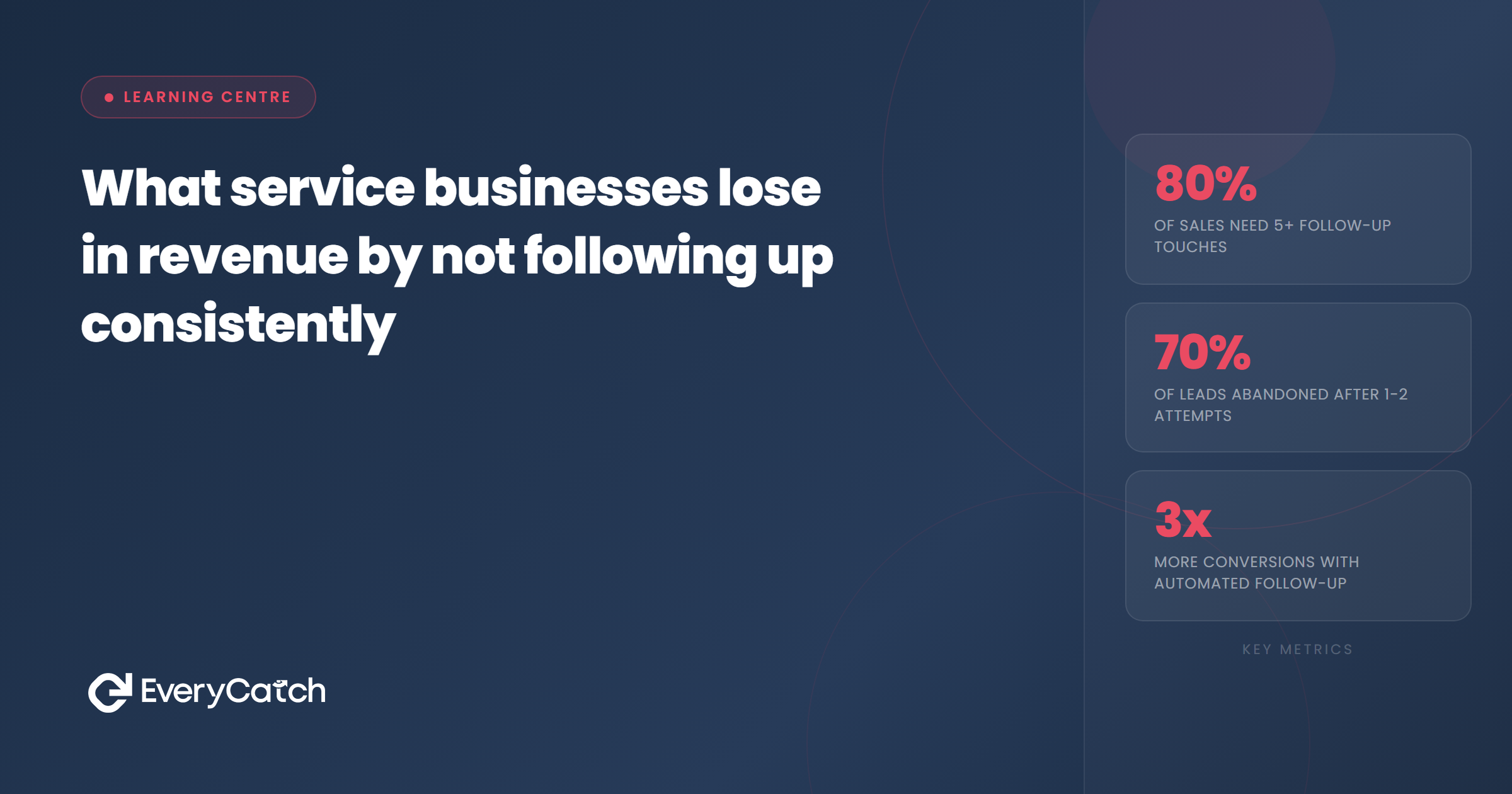
- Research shows 80% of sales require five follow-up calls after initial contact, yet 44% of salespeople give up after one attempt
- Each missed follow-up costs you the full customer lifetime value, not just a single job
- Lead acquisition costs stay the same whether you convert the lead or not
- The compounding effect means businesses leave six-figure sums on the table annually without realising it
Service businesses spend money acquiring leads every month. They pay for Google Ads, directories, van graphics, website work. Then a percentage of those leads fall through cracks in the follow-up process, and the acquisition cost vanishes with them.
The loss is not immediately visible. You still do work. You still invoice customers. But the gap between what comes in and what should have come in widens every month you operate without consistent follow-up. After a year, that gap is often larger than the owner's annual salary.
The revenue maths most ignore
A plumber receives 60 leads per month. Average job value is £450. If the business converts 35% of those leads, monthly revenue sits at £9,450. That number feels acceptable until you calculate what happens at a 50% conversion rate with identical lead volume: £13,500.
The difference is £4,050 per month. Over twelve months, that adds £48,600. The work required to earn that additional revenue already exists in the lead pool. The only variable is whether someone follows up consistently enough to convert it.
Research from InsideSales shows that 35-50% of sales go to the vendor who responds first. Speed matters, but consistency matters more. The same research found that 80% of sales require five follow-up calls after the initial meeting, yet 44% of salespeople give up after one follow-up attempt.
Most service business owners believe they follow up adequately. They remember the conversations, the quotes sent, the texts exchanged. What they don't track is the number of leads that receive zero, one, or two touch points when eight to twelve are needed.
Where the money actually goes
When a lead does not convert, three financial losses occur simultaneously. First, you lose the immediate job value. Second, you lose the customer lifetime value. Third, you've already paid the acquisition cost.
For a heating engineer, a typical boiler installation might be worth £3,200. If that customer stays with the business for servicing and eventual replacement, lifetime value might reach £15,000 over a decade. When that customer goes to a competitor because you didn't follow up on day three, you've lost £15,000, not £3,200.
The acquisition cost compounds the loss. If you're paying £45 per lead through Google Ads, every unconverted lead represents £45 spent with zero return. At 60 leads per month with a 35% conversion rate, you're burning £1,755 monthly on wasted acquisition cost alone.
Business owners who track lead-to-customer conversion see this clearly. Those who don't assume the problem is lead quality. They ask their marketing agency for "better leads" when the real issue is that good leads are being mishandled after arrival.
The volume problem
Follow-up breaks down when volume exceeds manual capacity. A business receiving four leads per week can usually follow up adequately through personal effort. At fifteen leads per week, the system starts to fracture. At thirty leads per week, it collapses entirely unless automated systems are in place.
The pattern is predictable. Leads come in during work hours while you're on site. You intend to call back at lunch or after the last job. Other priorities intervene. By the time you return to your list, sixteen hours have passed and the lead has contacted two other businesses.
This is not a failure of intention. It's a structural problem that manual effort cannot solve at scale. The business either grows lead volume and sacrifices conversion rate, or keeps volume low to maintain conversion rate, which caps revenue growth.
Want to know what you're actually losing?
We'll audit your current follow-up system and calculate your real conversion gap.
Book a free discovery callWhat the real numbers look like
A landscape gardener with £280,000 annual turnover analysed their lead flow over six months. They discovered they were receiving 140 qualified leads per year but converting only 42 of them. Average project value was £4,200.
At a 50% conversion rate, those same leads would have generated £294,000, an additional £118,000 in revenue with identical marketing spend and lead volume. The lost revenue exceeded the owner's salary and profit combined.
When they examined why leads weren't converting, the reasons were mundane: quotes sent but never followed up, phone calls not returned within 24 hours, estimates promised but delayed. Nothing dramatic. Just the accumulated effect of inconsistent process across 140 opportunities.
A bathroom fitter running a similar exercise found they were losing £67,000 annually. An electrician found £43,000. The pattern holds across service categories. The businesses with the highest growth rates are not the ones with the most leads. They're the ones converting the highest percentage of the leads they already have.
The lost multipliers
Revenue loss from poor follow-up multiplies in ways that are not immediately obvious. A customer who books a single job today might refer two other customers next year. They might leave a review that influences ten future leads. They might become a repeat customer worth ten times the initial job value.
When you lose a customer through inadequate follow-up, you lose all of those future multipliers. The £450 job that didn't convert might have been worth £3,000 in downstream value. You'll never know because the customer doesn't exist in your system.
Referrals create the highest-converting leads in service businesses. Word-of-mouth customers convert at 60-70% compared to 30-40% for paid leads. Every customer you fail to win through poor follow-up removes future high-probability leads from your pipeline.
The compounding effect explains why some businesses experience sudden growth after implementing consistent follow-up. They're not just converting more of the current lead pool. They're creating more referrals, improving their reputation, and building a customer base that generates its own momentum.
Service businesses operate in an environment where small improvements in conversion rate produce disproportionate results. A move from 35% to 45% conversion feels modest. The revenue impact over twelve months often exceeds £50,000. Over three years, it can represent £150,000 or more in revenue that would not have existed otherwise.
The cost of inconsistent follow-up is not a single lost job. It's the accumulated value of dozens or hundreds of lost customers, multiplied by lifetime value, multiplied by referral potential, minus wasted acquisition cost. For most service businesses, that figure sits somewhere between one-fifth and two-fifths of current revenue. It's the business they could be running if every lead received the attention it deserved.

From the EveryCatch team
We built EveryCatch to solve this exact problem for service businesses. We've watched companies double revenue by fixing follow-up before spending another pound on marketing.