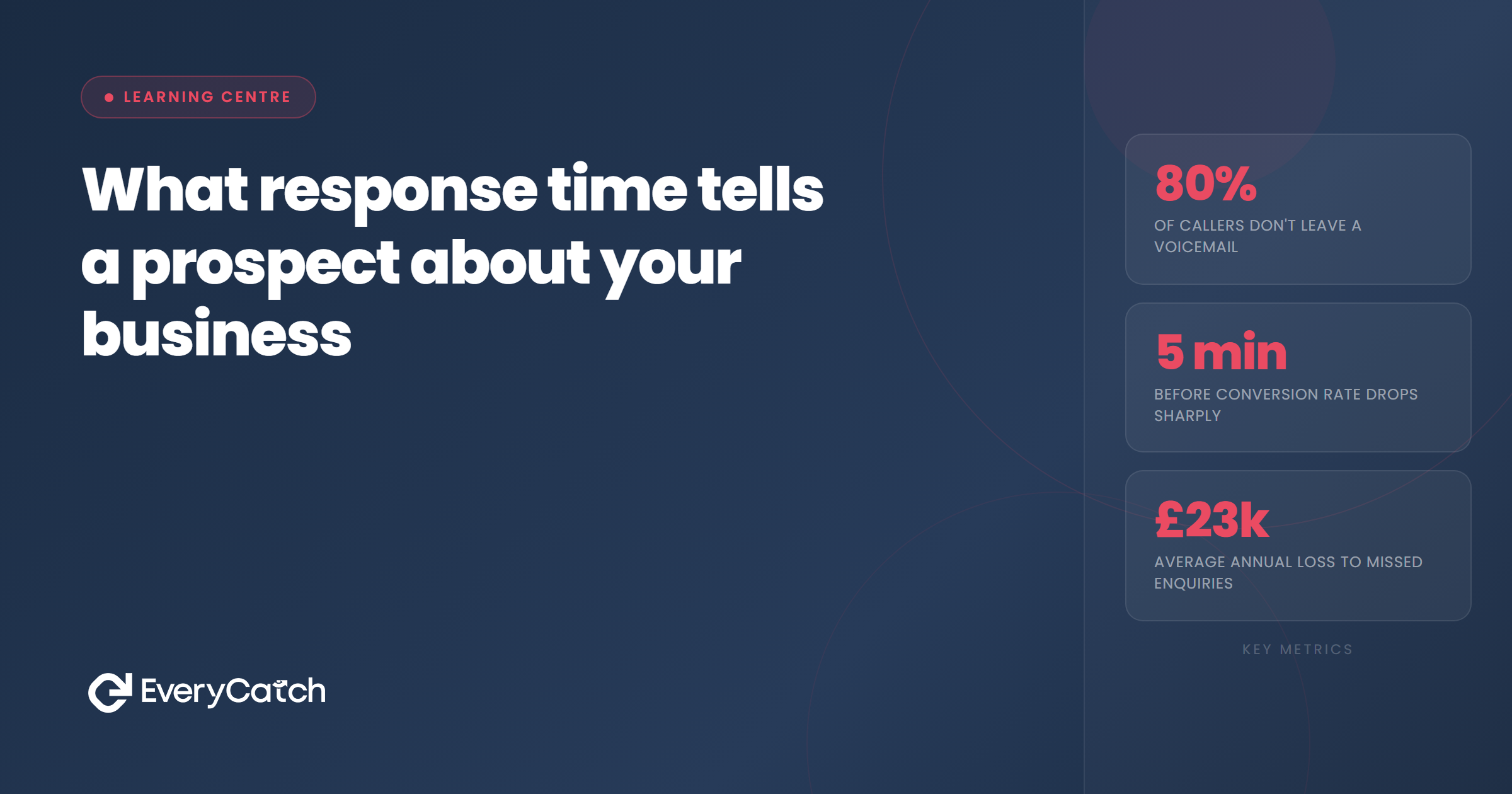

- Response time shapes perception of your entire business before any conversation starts
- Slow responses signal mismanagement, disinterest, or resource problems to prospects
- Prospects use speed as a proxy for reliability, expertise, and customer care standards
- Competitors set the pace, and prospects compare you directly against them
- Every delay gives prospects time to doubt, research alternatives, or move on entirely
Response time is the first thing a prospect learns about how you run your business. You have not spoken yet. They have not seen your work. But they already know whether they matter to you, based solely on how long it took you to acknowledge their enquiry.
This is not about politeness. It is about the immediate judgement prospects make when they fill out a form, send an email, or leave a message. That timer starts the moment they hit send, and what they infer from your delay is far more damaging than most business owners realise.
A quick response says one thing. A slow response says a dozen, and none of them help you win the work. The gap between enquiry and reply becomes the lens through which every other part of your business gets evaluated.
Urgency and priority: what delay communicates
When someone reaches out, they are making a choice. They are prioritising you above every other option in that moment. They have looked at your website, considered your offering, and decided you are worth contacting. Then they wait.
If hours pass, the message is clear. You did not reciprocate the urgency. The prospect interpreted their need as immediate, but you have signalled that it is not. That asymmetry matters because it tells them where they sit in your queue. Somewhere near the bottom.
This is particularly damaging in trades, home services, and any business where responsiveness is part of the product. If you cannot manage a fast reply to an enquiry, prospects assume you will be equally slow when they need support, updates, or rescheduling. The response time becomes a preview of the entire customer experience.
Prospects also know you are running a business. They expect you to have systems in place to manage incoming leads. When you do not respond quickly, it suggests either chaos or indifference. Both interpretations push them toward competitors who appear more organised.
Capability signal: response time as a proxy for competence
Prospects cannot assess your technical ability from a contact form. They do not yet know if you are good at what you do. But they can measure how long it took you to reply, and they use that as a proxy for everything else.
A fast response implies systems, capacity, and control. It suggests you have enough staff, enough organisation, and enough bandwidth to manage new business without letting things slip. Slow responses imply the opposite. Too busy, too disorganised, or too small to keep up with demand.
This matters because prospects are making a bet. They are committing money, time, and trust. If you struggle to reply to an email, they wonder what else you struggle with. Project timelines. Quality control. Communication during the work itself. The delay becomes evidence of deeper operational weakness.
For high-value services, this perception cuts even deeper. A prospect spending thousands expects white-glove treatment. A delayed response tells them they will be chasing you for updates, waiting for quotes, and dealing with missed deadlines. They assume the experience starts now, and it has already started poorly.
First impression formation: the disproportionate weight of initial contact
First impressions are sticky. Once formed, they shape how every subsequent interaction gets interpreted. A fast response creates a halo effect. The prospect assumes you are professional, attentive, and capable. A slow response creates the opposite, and recovering from that is hard.
This is not about fairness. Prospects form judgements quickly because they have to. They are comparing multiple options, often under time pressure. The business that replies first gets the advantage of setting the tone. The business that replies last gets judged against a standard they did not set.
The timing gap also affects memory. If you reply the same day, you are still top of mind. If you reply three days later, the prospect has already spoken to someone else, researched alternatives, or lost interest entirely. Even if your response is excellent, you are now fighting to reclaim attention that has moved on.
Prospects remember how you made them feel in that first moment. Did you make them feel valued, or did you make them wait? That emotional response sticks around long after the facts of the conversation fade. Speed matters because it changes the frame through which everything else gets viewed.
How many leads are slipping through while you wait?
See how instant response automation can change your conversion rate in the first week.
Book a free discovery callAttention expectations: what prospects assume about customer care
Response time sets expectations for every interaction that follows. If it takes you two days to reply to an enquiry, prospects assume it will take two days to get an invoice, a progress update, or an answer to a problem during the project. You have established the baseline.
This is particularly problematic in service businesses where ongoing communication is part of the value. Plumbers, electricians, contractors, and consultants all rely on client trust. That trust begins with responsiveness. If you are slow before the work starts, prospects expect you to be slow throughout.
Prospects also use response time to gauge how much they will have to chase you. Nobody wants to be the client who has to follow up repeatedly. A delayed initial response signals that this will be the norm, not the exception. That alone can be enough to disqualify you, even if your quote is competitive.
The inverse is also true. A fast response reassures prospects that they will not be ignored once the deposit is paid. It tells them you have systems in place, you value communication, and you will be easy to work with. That reassurance is worth more than most business owners realise.
Competitive context: speed as the default comparison point
Prospects rarely contact just one business. They compare. And one of the easiest things to compare is response time. It requires no technical knowledge, no research, and no experience. It is just a clock.
If a competitor replies in 10 minutes and you reply in 10 hours, you have already lost ground. The prospect now has a benchmark, and you are on the wrong side of it. Even if your service is better, you are starting the conversation from a position of weakness.
This dynamic is worse when prospects are time-sensitive. Emergency repairs, urgent projects, or seasonal demand all create pressure to move fast. The business that replies first does not just win attention. They win the job, because the prospect cannot afford to wait for everyone else to catch up.
Competitors who automate initial responses exploit this gap ruthlessly. While you are manually checking emails or waiting until office hours, they have already sent a confirmation, set expectations, and started building rapport. By the time you reply, the race is over.
Trust and reliability: what delay says about future performance
Trust is hard to build and easy to lose. Prospects are looking for reasons to trust you, but they are also looking for red flags. Slow response time is a red flag. It suggests unreliability, and unreliability is expensive.
If you cannot manage a timely response to an enquiry, prospects assume you cannot manage deadlines, budgets, or quality standards either. The logic is simple. If something as basic as replying to an email is hard for you, what else will be hard?
This perception is amplified when prospects have been burned before. Anyone who has dealt with a flaky tradesperson, a slow contractor, or a consultant who ghosts after the deposit will see delayed responses as a warning sign. They will choose the business that feels safer, even if it costs more.
Trust is not just about what you say. It is about what you do when nobody is watching. A fast response shows you follow through. It demonstrates that you do what you say you will do, even when the task is small. That consistency builds confidence in a way that marketing copy never can.

From the EveryCatch team
We help service businesses turn every lead into a conversation before competitors get there first. Our systems answer instantly, follow up automatically, and make sure no enquiry ever waits in silence.