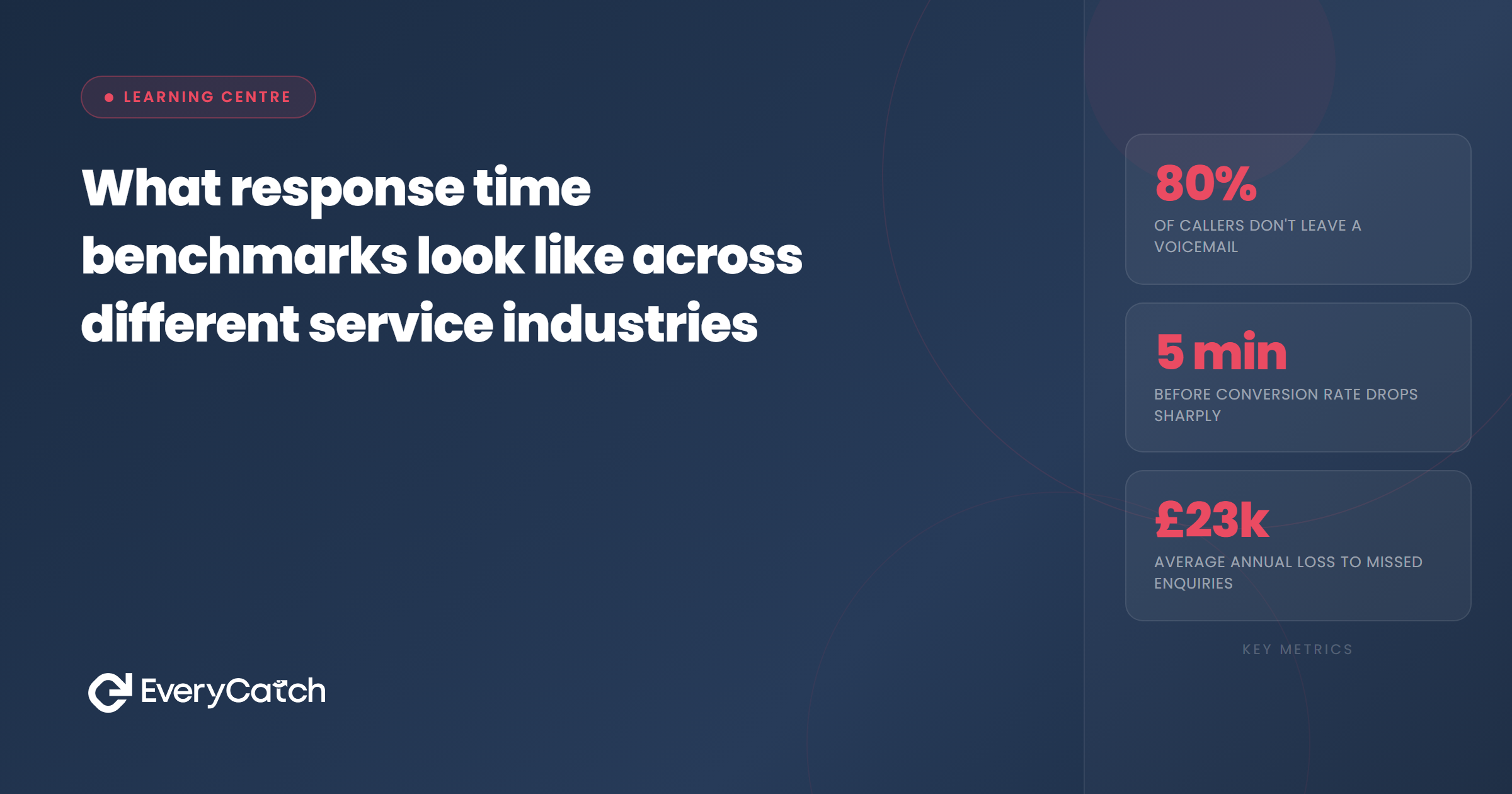

- Emergency service trades like plumbing and HVAC need sub-15-minute response times to stay competitive
- Scheduled services such as landscaping and cleaning maintain strong conversion with responses under 90 minutes
- Professional services can respond within two hours and still capture most leads effectively
- Home improvement projects allow longer response windows, but faster replies still win more business
- Understanding your industry's urgency profile helps you set realistic performance targets
Response time benchmarks tell you how fast other businesses in your industry are moving. They also show you what customers have learned to expect based on how your competitors behave. If plumbers in your area typically call back within 10 minutes, a 40-minute delay makes you look slow even if you think that's reasonable.
Different service industries operate with fundamentally different urgency levels. A burst pipe demands immediate attention. A quote for new gutters can wait a day without consequence. The question becomes whether your response speed matches the natural urgency of the service you provide.
These benchmarks come from analysing millions of service enquiries across multiple industries. They represent what actually happens in the market, not theoretical ideals. When your response time sits above your industry's typical range, you lose leads to faster competitors. When it sits below, you capture enquiries that slower businesses miss.
Emergency trades: the 15-minute window
Plumbing, HVAC, electrical work and locksmith services share a common characteristic. The customer has a problem right now. Water is leaking. The heating has failed. The power is out. They cannot afford to wait.
In these industries, the first business to respond typically wins the job. Analysis of emergency trade enquiries shows that 67% of customers hire the first person who calls them back. That number drops to 34% for the second responder and below 15% for anyone who arrives third or later.
The practical benchmark for emergency trades sits around 10 to 15 minutes from initial contact. Businesses that consistently respond within this window convert roughly 45% of their leads. Those taking 30 to 60 minutes see conversion rates around 22%. Delays beyond two hours reduce conversion to single digits.
This creates a significant operational challenge. Emergency trade businesses need systems that route enquiries immediately, trigger instant notifications, and allow technicians to respond from wherever they happen to be working. Missed calls become particularly expensive because the customer has usually moved on to the next provider within minutes.
Scheduled services: the 90-minute target
Landscaping, cleaning services, pest control, and similar scheduled maintenance businesses operate with slightly more breathing room. The customer wants to book something in the future rather than solve an immediate crisis. This shifts the urgency profile meaningfully.
For scheduled services, the benchmark response window extends to 60 to 90 minutes. Businesses hitting this target convert approximately 38% of enquiries. Those responding within four hours still capture around 28% of leads. Once you cross the six-hour mark, conversion rates drop below 15%.
The key difference here relates to how customers shop. Someone looking for regular cleaning services might contact three or four providers, expecting to compare quotes. But they still prefer dealing with businesses that respond quickly because fast replies signal reliability and professionalism. A cleaning company that takes two days to return a call creates doubt about whether they'll show up reliably for the actual job.
Scheduled service businesses benefit from setting clear expectations. An automated text message acknowledging the enquiry and promising a call within two hours buys significant goodwill. Customers understand that you're not dropping everything to respond immediately, but they appreciate knowing their enquiry hasn't disappeared into a void.
Professional services: the two-hour standard
Accountants, solicitors, financial advisers, and other professional service providers work with longer decision cycles. Customers recognise that these services involve complexity and significant cost. They expect a more measured approach.
The benchmark for professional services typically falls between one and two hours for initial response. Businesses responding within this window convert approximately 32% of enquiries. Those taking four to six hours see conversion around 24%. Even responses within the same business day maintain conversion rates above 18%.
How fast is your response time really?
Find out what you're losing to slow replies and see how automation closes the gap.
Book a free discovery callThese longer acceptable windows reflect several factors. Professional service enquiries often arrive via email or contact forms rather than phone calls, setting different expectations. The services themselves require detailed discussion and formal proposals, making instant responses less practical. And customers often contact multiple providers simultaneously, planning to evaluate their options carefully rather than hiring the first person who calls.
However, faster response times still provide competitive advantage in professional services. A solicitor who calls back within 30 minutes while competitors take four hours creates a positive first impression. The lead may not make an immediate decision, but the responsive firm earns preference when decision time arrives.
Home improvement: balancing speed with detail
Renovation contractors, kitchen fitters, bathroom installers, and similar home improvement businesses face a unique challenge. Projects involve significant investment and require detailed quotes. Customers expect thorough consultation. But they also contact multiple providers and start forming opinions based on initial responsiveness.
The benchmark for home improvement sits around two to four hours for initial contact. Businesses reaching out within this window convert approximately 28% of enquiries. Those responding within eight hours maintain conversion around 20%. Delays beyond 24 hours reduce conversion to 12% or less.
The initial contact doesn't need to be comprehensive. A quick phone call acknowledging the enquiry, asking a few qualifying questions, and scheduling a proper consultation works effectively. This approach balances the need for speed with the reality that these projects require site visits and detailed proposals.
Home improvement businesses that respond quickly but then take days to provide quotes lose much of their advantage. The full process matters. Fast initial contact combined with prompt follow-through after site visits creates the best conversion rates. Each step that takes longer than the customer expects chips away at their confidence.
Health and wellness: urgency depends on the service
Healthcare, dental practices, physiotherapy, and wellness services span a wide range of urgency levels. An emergency dental situation demands immediate response. Booking a routine massage allows more flexibility. Understanding where your specific service sits on this spectrum determines appropriate benchmarks.
For urgent healthcare needs, response times similar to emergency trades apply. Dental practices offering emergency appointments need to respond within 15 to 20 minutes. Conversion rates drop dramatically with longer delays because patients contact multiple providers and accept the first available appointment.
For routine appointments and wellness services, benchmarks closer to scheduled services make sense. Responding within 90 minutes maintains strong conversion. Even same-day responses work reasonably well because customers understand these services involve appointment scheduling rather than immediate service delivery.
The challenge for healthcare providers comes from mixed enquiry types. A practice receiving both emergency and routine booking requests needs systems that triage effectively. Automated response tools can acknowledge all enquiries immediately while flagging urgent cases for prioritised handling.
What drives these differences
Several underlying factors explain why benchmark response times vary so dramatically across industries. Understanding these factors helps you position your business appropriately rather than blindly copying what works in other sectors.
Problem urgency represents the most obvious factor. Customers with immediate problems contact multiple providers quickly and accept the first viable solution. Those planning future services move more deliberately. Your response speed needs to match the customer's timeline.
Purchase complexity plays a significant role. Simple services with transparent pricing allow faster decisions. Complex services requiring detailed quotes naturally involve longer sales cycles. But even complex services benefit from fast initial contact because it establishes your business as responsive and professional.
Competitive intensity matters considerably. In crowded markets where customers receive multiple callbacks within minutes, you cannot afford to lag. In less competitive niches, you have more breathing room, but fast response still provides advantage.
Customer expectations reflect what they've learned from previous experiences. Industries where most providers respond quickly train customers to expect that speed everywhere. If your competitors are slow, you can win business simply by being reasonably fast. If they're quick, you need systems that help you move even faster.
The key insight is that benchmarks represent competitive realities, not arbitrary standards. You're competing for attention against other businesses in your industry. When most plumbers call back within 10 minutes, taking 45 minutes means you're usually too late regardless of whether 45 minutes seems perfectly reasonable to you.

From the EveryCatch team
We built EveryCatch specifically for service businesses that need to respond faster than their competitors. Our systems capture every enquiry, send instant acknowledgements, and route urgent leads to the right people immediately.