- Local SEO is specifically about visibility in geographically-based searches — not general search rankings
- Google ranks local businesses on three factors: relevance, distance, and prominence — not tricks
- The Google Business Profile is the single most important factor for appearing in the Local Pack, and most businesses leave it incomplete
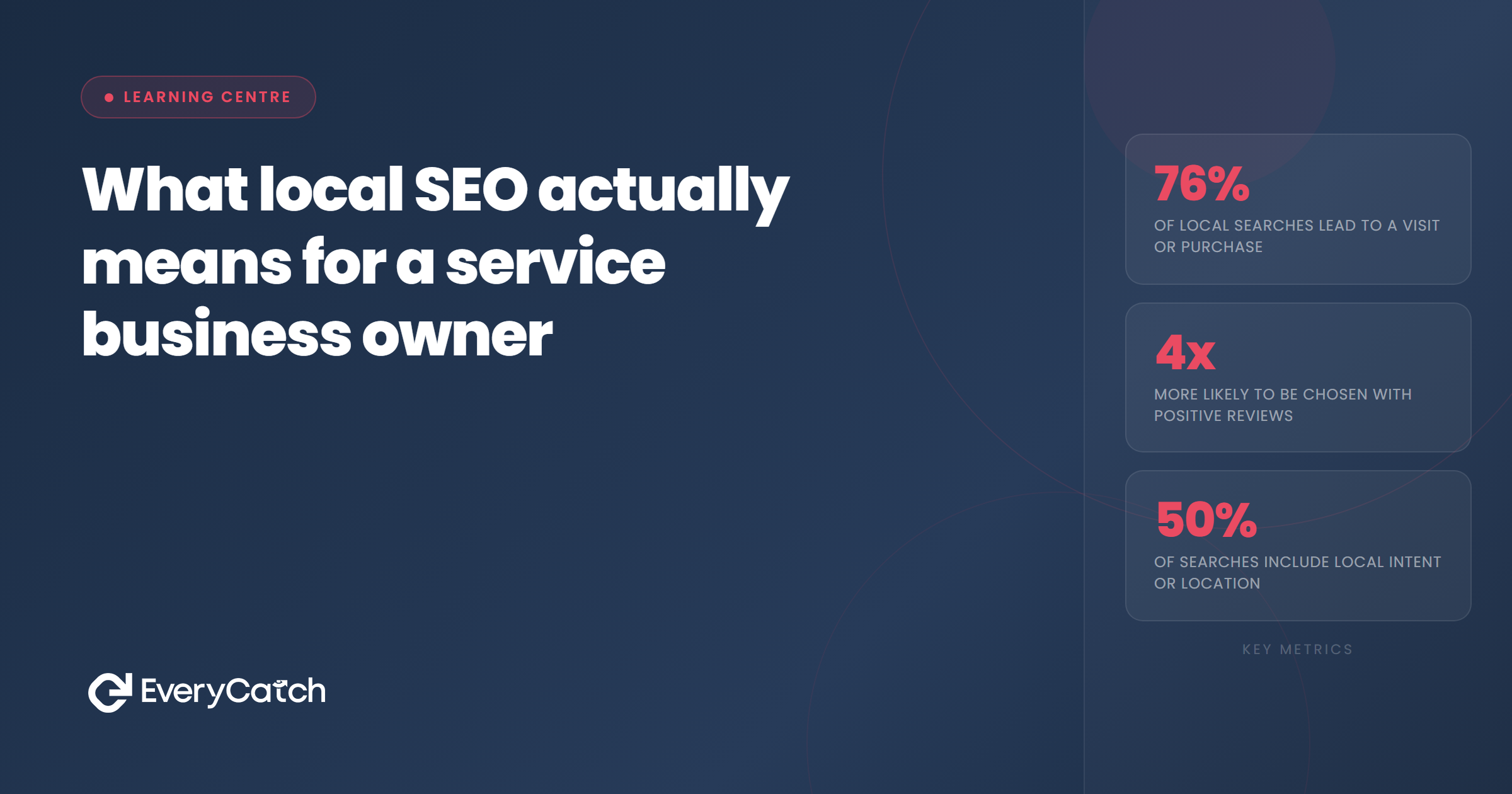
- Review volume and recency consistently outweigh perfect ratings — 80 reviews at 4.6 stars beats 12 at 4.9
- Local SEO is a long-term compounding asset, not a short-term campaign — consistency matters more than intensity
What Local SEO Is and What It Is Not
Local SEO is the set of practices that affect how often and how prominently a business appears in geographically-based search results. For a service business, that typically means appearing when someone nearby searches for the type of service being offered: plumber near me, physiotherapy in Bristol, accountant in Leeds. The search intent is specific and the buyer is close — which makes local search traffic some of the highest-quality a service business can attract.
It is not the same as general SEO, which is primarily about ranking web pages for informational or national queries. Local SEO is specifically concerned with visibility to people in a defined geographic area who are actively looking for what the business provides. The tactics, priorities, and timescales involved are quite different, and most of the general SEO advice that circulates online is not particularly relevant to a local service business trying to rank in their town or city.
Google's local search results are driven by three core factors: relevance (how closely the business matches what was searched), distance (how close the business is to the searcher's location), and prominence (how well-known and trusted the business appears to be based on external signals). Understanding those three factors is the foundation of everything else in local SEO. Most of what works comes back to influencing one or more of them.
How Local Search Actually Works
When someone searches for a local service on Google, they typically see two distinct sets of results: the Local Pack (the map and three business listings that appear near the top of the results page), and the organic results below them (ranked web pages).
The Local Pack is driven primarily by the Google Business Profile. A well-completed, actively maintained GBP with consistent Name, Address and Phone information, a good volume of recent reviews, and regular posts and updates will rank more prominently in the Local Pack than a profile that has been claimed but left largely empty or out of date. For most service businesses, the Local Pack is where the most valuable clicks come from.
The organic results below the Local Pack are driven by the website: its content, its technical structure, the authority of external sites linking to it, and how clearly it signals what the business does and where it operates. Ranking in the organic results takes longer and is generally more competitive than ranking in the Local Pack, which is why most local service businesses should prioritise their GBP before investing heavily in website SEO.
Appearing in search but not converting those visitors?
EveryCatch helps service businesses capture and convert the local search traffic they have already earned, with automatic response to every new enquiry.
Book a free discovery callWhat Actually Moves the Needle for a Service Business
In practical terms, the activities that consistently improve local search visibility for a service business are:
Google Business Profile — complete, verified, with accurate categories, services, hours, and location information. Regular posting, responding to reviews (both positive and negative), uploading photos of completed work, and keeping information current all contribute to a more prominent Local Pack placement. An incomplete or neglected GBP is one of the most common reasons a business ranks below less capable competitors.
Reviews — both volume and recency matter significantly. A business with 80 reviews and a 4.6 rating will typically rank above a similar business with 12 reviews and a 4.9 rating. Getting more reviews from real customers, consistently, is one of the highest-return activities in local SEO. Making a review request part of the standard post-job process is more effective than any tool or platform.
Local citations — consistent Name, Address, and Phone information across directories such as Yell, Bing Places, Apple Maps, and relevant trade directories reduces confusion and builds the prominence signals Google uses when deciding how prominently to feature a business.
Website — location-relevant content, service pages that clearly describe what is offered and where, and correct structured data markup (LocalBusiness, Service) give Google the context it needs to understand what the business does and match it to relevant local searches.
Local links — mentions and links from local news sites, community organisations, chambers of commerce, and industry directories increase the site's authority in the local context and directly influence prominence.
What to Ignore and What Not to Waste Time On
A significant proportion of what is sold as local SEO is either low-priority or actively counterproductive.
Keyword stuffing — including the town or city name in every sentence, in every heading, or on every page reads as spam to both Google and human visitors. Natural, location-relevant language in the right places is more effective than forced repetition.
Fake reviews — Google's ability to detect and remove inauthentic reviews has improved considerably. The risk to a business's GBP from a review removal action, or worse a suspension, far outweighs any short-term ranking benefit from inflated review counts.
Bulk citation submissions — submitting to hundreds of low-quality directories provides minimal ranking benefit and can create inconsistent NAP data across the web, which undermines rather than builds the signals Google uses for local prominence.
Guaranteed ranking promises — local search rankings are influenced by the searcher's exact location, device, and search history as much as by the business's own optimisation. No agency or tool can guarantee specific positions in local results. Focus on the fundamentals. Done consistently, they outperform most paid interventions.
Local SEO as a Long-Term Asset
Local SEO is not a campaign with a defined start and end point. It is an ongoing asset that compounds over time. A Google Business Profile that has been consistently maintained for two or three years, with a steady accumulation of reviews and regular updates, will rank more reliably than a newer profile that has been aggressively optimised for a few months and then left to go stale.
The same is true of the website. A service page that has been live, gradually accumulating mentions and links, and kept current over a sustained period will rank more reliably than one built for SEO purposes and left unchanged.
For most service business owners, the practical implication is to integrate local SEO activities into the regular running of the business — asking for reviews as part of the post-job workflow, updating the GBP when hours or services change, posting when there is a new project or service to highlight — rather than treating it as a separate, periodic task to hand off to a third party. The business that shows up consistently in local search is almost always the one that treats local visibility as an ongoing operational habit rather than a marketing campaign.

From the EveryCatch team
EveryCatch helps service businesses capture and convert the local search traffic they have already earned. The Learning Centre covers local visibility without the jargon — practical steps that actually move the needle.