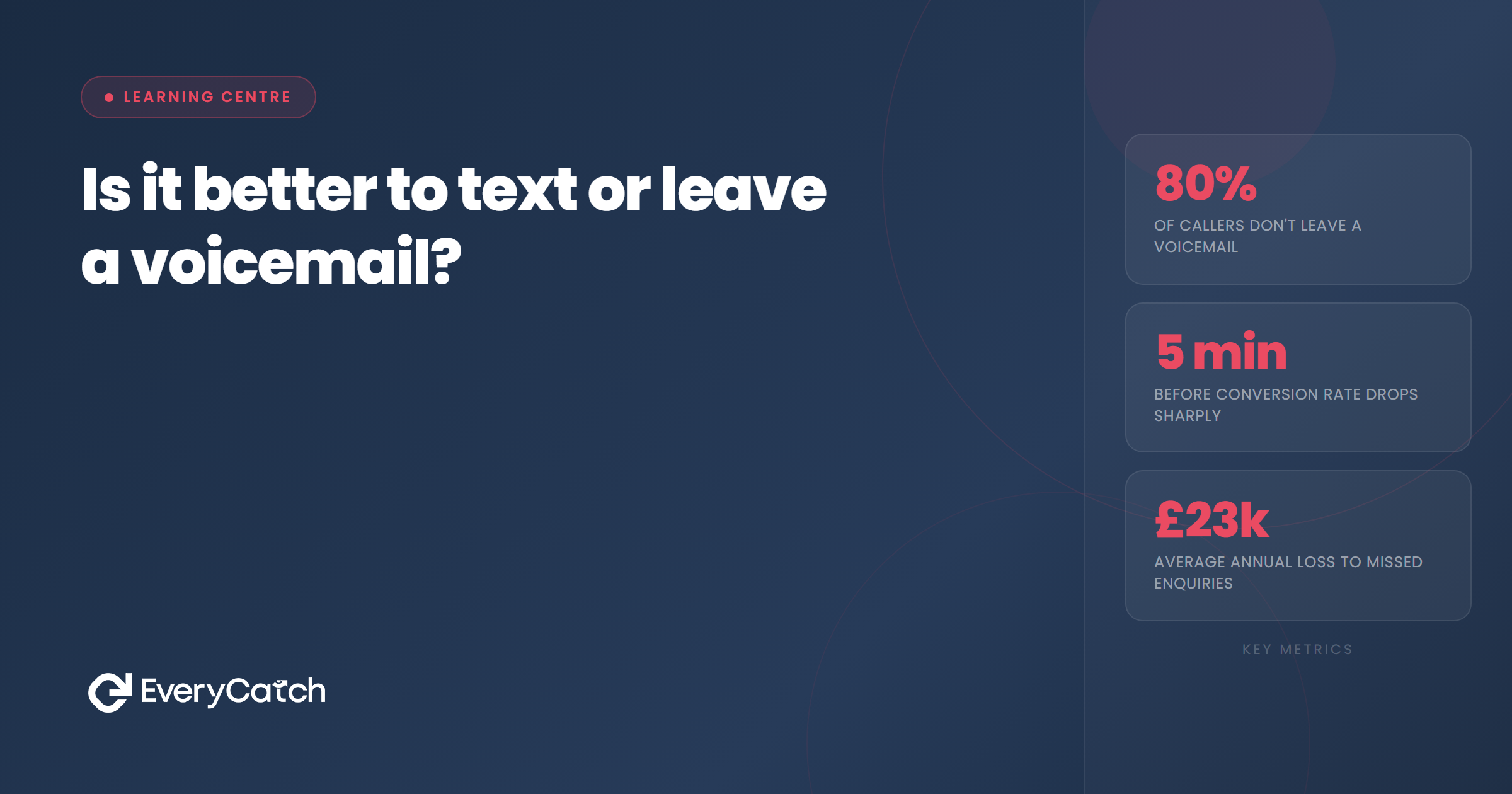
The honest answer is within five minutes of the enquiry arriving, not a particular hour of the day. Speed to first contact matters more than the clock time of the call for almost every service business, because a lead that enquires at 9am and gets called at 9.04am converts at a far higher rate than one called back at 2pm the same day, regardless of what the 2pm slot looks like on a general best-practice chart.
That said, once speed is covered, time of day does make a real secondary difference, particularly for leads where the first call is missed and a second attempt is needed.
Why speed beats time of day when calling leads
A lead who fills in a form or misses a call is actively thinking about the problem right now. An hour later, they are often back to whatever they were doing before, and a call that would have been welcome immediately now feels like an interruption. Several independent studies on lead response have found conversion rates drop sharply after the first five to ten minutes and keep falling from there, which is why response speed is treated as the single biggest lever in lead handling, well ahead of script quality or time of day.
This is also why automated speed-to-lead systems exist: most businesses cannot staff a phone to answer within five minutes every time a lead comes in, particularly outside normal hours, so the practical goal becomes closing that gap as tightly as the business realistically can rather than chasing an unreachable instant response every time.
The best time of day to call a lead, when speed is not the deciding factor
For leads that could not be reached immediately and need a scheduled callback, research from sales-dialling platforms consistently points to two windows: mid-morning, roughly 10am to 11am, and late afternoon, roughly 4pm to 5pm. Both sit after the start-of-day and lunch rushes, when people are more likely to actually pick up rather than let it go to voicemail.
Mondays tend to perform worse than other weekdays, since most people are catching up after the weekend. Tuesday through Thursday generally outperform Monday and Friday for scheduled callback attempts. None of this overrides the five-minute rule for a fresh enquiry; it only applies once a lead has already gone cold enough that a scheduled second or third attempt is the realistic option.
How many attempts before giving up
Most leads that convert do so within the first three contact attempts, spread across different times and, where possible, different channels such as a call followed by a text. Attempts five and beyond add diminishing returns and start to feel like pursuit rather than service. A sensible pattern is: call immediately, follow up by text within the hour if no answer, then try a second call attempt in the next good calling window (late morning or late afternoon) rather than repeatedly redialling the same number minutes apart.
What this means in practice for a service business
Build the response process around two separate rules rather than one. Rule one: every fresh enquiry gets a call or text attempt within five minutes, every time, regardless of what time of day it is. Rule two: any lead that was not reached on the first attempt gets a scheduled second attempt in a genuinely better calling window, rather than an immediate redial that is likely to be missed again for the same reason the first one was.
Businesses that track this find the real bottleneck is almost always rule one, not rule two. A missed call at an awkward time is recoverable with a good follow-up process. A fresh enquiry that sits unanswered for two hours because nobody saw it is usually lost before a callback window ever becomes relevant, which is why slow response to new leads is one of the most common and most fixable reasons service businesses lose work they were otherwise well placed to win.
Does this change by industry?
The five-minute rule holds across trades, clinics, and most other appointment-based service businesses, since the underlying behaviour, a person actively deciding who to use right now, is the same regardless of sector. The secondary time-of-day guidance shifts slightly by audience. Businesses whose customers mostly call during their own working day, such as commercial cleaning or office-based trades work, see stronger results calling back in the standard mid-morning and late-afternoon windows. Businesses whose customers are often enquiring in the evening or at weekends, such as home improvement or personal services, see better pickup rates calling back in early evening instead, roughly 6pm to 7.30pm, since that is when their typical customer is actually free and near their phone.
The practical takeaway is the same either way: look at when a business's own leads tend to come in, not a generic chart, and schedule second-attempt calls for the next realistic window after that, rather than assuming office hours apply to every type of customer.
Frequently asked questions
Is there a single best time of day to call a lead?
Not for a fresh enquiry. The best time to call a new lead is as soon as possible after they enquire. Time-of-day guidance only applies to scheduled follow-up attempts after the first call was missed.
What is the best time to call leads who did not answer the first attempt?
Mid-morning (around 10 to 11am) and late afternoon (around 4 to 5pm) tend to get picked up more often than early morning, lunchtime, or end-of-day slots.
Is Monday a bad day to call leads?
Monday tends to underperform Tuesday through Thursday for scheduled callback attempts, since people are often catching up after the weekend. It is still better to call on a Monday than not to call at all.
How many times should a lead be called before giving up?
Three attempts across different times, ideally mixing a call with a text, covers most recoverable leads. Beyond five attempts, returns drop off sharply and the contact pattern starts to feel like pursuit rather than service.
Does the five-minute rule apply to every type of enquiry?
It applies most strongly to phone calls and web form enquiries, where the person is actively waiting for a response. It matters slightly less for enquiries that are clearly research-stage, such as someone downloading a general price guide, but responding quickly is rarely the wrong choice either way.
Should weekend calls be avoided?
Not if the business's own customers enquire at weekends. Many home services and personal-service businesses get a large share of enquiries on Saturday and Sunday, and a callback that waits until Monday morning gives a competitor two full days to get there first.
Does calling late in the evening hurt the relationship?
A call after roughly 8pm risks feeling intrusive for most types of enquiry, even if the lead came in around that time. A same-evening text followed by a call the next morning in a good window is usually the better balance between speed and good manners.