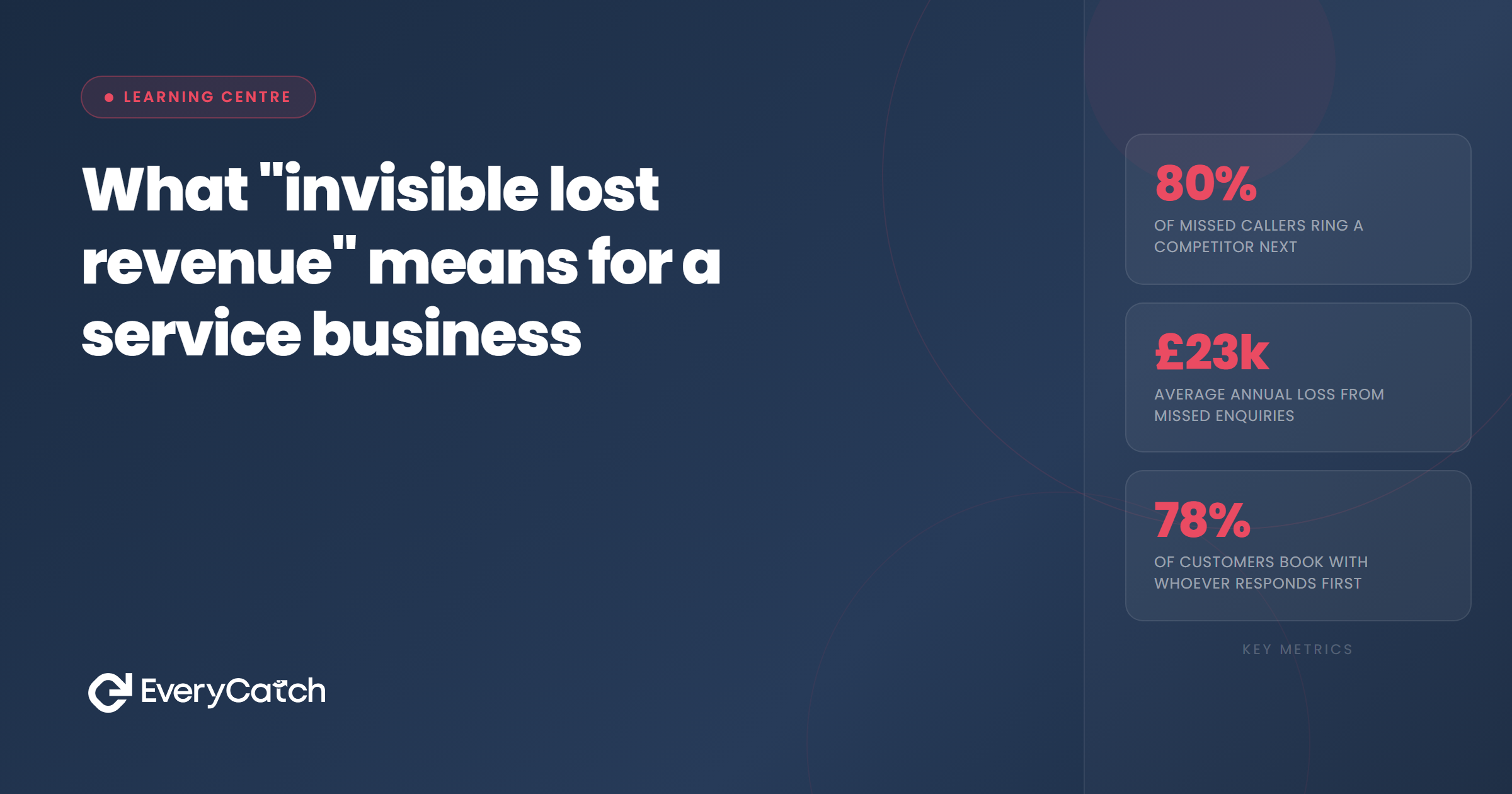

- Invisible lost revenue is income you never earn because enquiries slip away before anyone records them.
- The loss never appears in your accounts, which is why most owners underestimate it or dismiss it entirely.
- The most common hiding places are missed calls, slow replies to web enquiries, and follow-up that stops after one attempt.
- A modest miss rate on a typical job value can add up to tens of thousands of pounds a year for a small firm.
- You cannot fix what you cannot see, so the first step is tracking every enquiry from every channel in one place.
Every service business owner knows what a visible loss looks like. A customer cancels a job, an invoice goes unpaid, a supplier puts prices up. Those losses land in the accounts and demand attention. Invisible lost revenue is different. It is the money you never earned because an enquiry arrived and nobody caught it, and because nobody caught it, nobody counted it either.
What the phrase actually means
Invisible lost revenue is the total value of work you would have won if every enquiry had been answered promptly and followed up properly. It is invisible because the loss happens before the enquiry ever becomes a record. A phone rings out while you are on a roof or under a sink. A website form submission sits in an inbox until the evening, by which time the customer has booked someone else. A quote goes out and nobody chases it. In every case the potential customer simply moves on, and your business carries on as if nothing happened.
That last part matters. Nothing did happen, as far as your systems are concerned. There is no cancelled booking to review, no complaint to handle, no refund to process. The customer disappears without leaving evidence, which is why this category of loss is so persistent. Owners who would chase a £200 unpaid invoice for weeks will lose a £2,000 job to a missed call and never know it occurred.
Why the loss stays hidden
Three things keep this revenue invisible. The first is measurement. Most small service businesses measure what came in, not what got away. Turnover, jobs completed and invoices raised all get tracked. Calls that rang out and forms that went unanswered rarely do. If you have never counted your missed enquiries, you have no baseline, and the problem defaults to zero in your head.
The second is timing. Research on lead response consistently shows that the chance of connecting with an enquiry drops sharply within the first hour, and today's customers behave accordingly. Someone with a burst pipe or a broken boiler contacts three firms and books whoever answers first. By the time you call back at 6pm, the decision was made at 2pm. The loss happened hours before you even saw the message.
The third is attribution. When a quiet month arrives, owners blame the market, the weather or the competition. Nobody blames the fourteen calls that went to voicemail, because nobody knows they exist. The visible explanation always wins over the invisible one. We cover the scale of the problem in more detail in how many leads the average service business misses.
Where invisible revenue hides in a service business
The loss concentrates in a few predictable places. Missed calls sit at the top of the list. Trades and service firms miss a meaningful share of inbound calls simply because the people who answer the phone are also the people doing the work. Calls that arrive during jobs, at lunchtime, in the evening or at weekends have the worst pick-up rates, and many callers who reach voicemail will not leave a message or try again.
Slow responses to web enquiries come next. A form submission feels less urgent than a ringing phone, so it waits. But the customer who filled in your form probably filled in two others at the same time, and the fastest reply usually wins the job.
Then there is follow-up, or the absence of it. A quote sent without a chase is often a quote wasted. Plenty of customers intend to say yes but get distracted, and one polite reminder recovers many of them. When follow-up stops after a single attempt, the remaining value quietly evaporates. Our article on why one follow-up is never enough goes deeper on this point.
Want to know what your business is losing right now?
We will walk through your enquiry channels with you and show you where leads are slipping away, free and without obligation.
Book a free discovery callPutting a number on it
The maths is uncomfortable but simple. Suppose your average job is worth £400 and you miss five enquiries a week across calls, forms and messages. If you would normally convert half of the enquiries you answer, those five misses represent roughly two and a half lost jobs, or about £1,000 a week. Over a year that is around £50,000 that never touched your accounts. Even if you halve every assumption, the figure remains larger than most owners' marketing budgets.
The comparison with marketing spend is the sharpest way to see it. Many firms pay hundreds of pounds a month to generate enquiries through ads, directories and SEO, then lose a portion of those same enquiries to an unanswered phone. Paying to attract a lead and then failing to catch it is the most expensive mistake in the building. If you want to run the calculation with your own figures, use our guide on how to calculate the cost of a missed lead.
How to make invisible revenue visible
You cannot recover a loss you cannot see, so visibility comes first. Start by getting every enquiry channel into one place. Calls, missed calls, web forms, emails, Facebook messages and Google Business Profile enquiries should all land in a single list, timestamped, so you can see what arrived and what happened to it. Most owners who do this for the first time find the missed-enquiry count genuinely surprising.
Next, close the fastest leak. An instant text back to every missed call keeps the customer engaged in the seconds when they would otherwise dial your competitor. It is a small mechanism with an outsized effect, because it converts your worst moments, the times you physically cannot answer, into a response anyway.
Finally, put follow-up on rails rather than in your head. Automatic reminders for unanswered enquiries and unchased quotes recover the second layer of hidden value, the leads you did catch but let go cold. This is exactly the job EveryCatch was built for. It gathers every enquiry into one pipeline, texts back missed calls within seconds, and runs the follow-up sequences that busy owners never quite get to. Once the losses become visible, they stop being inevitable.

From the EveryCatch team
We help service businesses catch every enquiry, respond in seconds and follow up automatically, so paid-for leads stop leaking away. Everything we publish in the Learning Centre comes from the patterns we see across the businesses we work with every day.