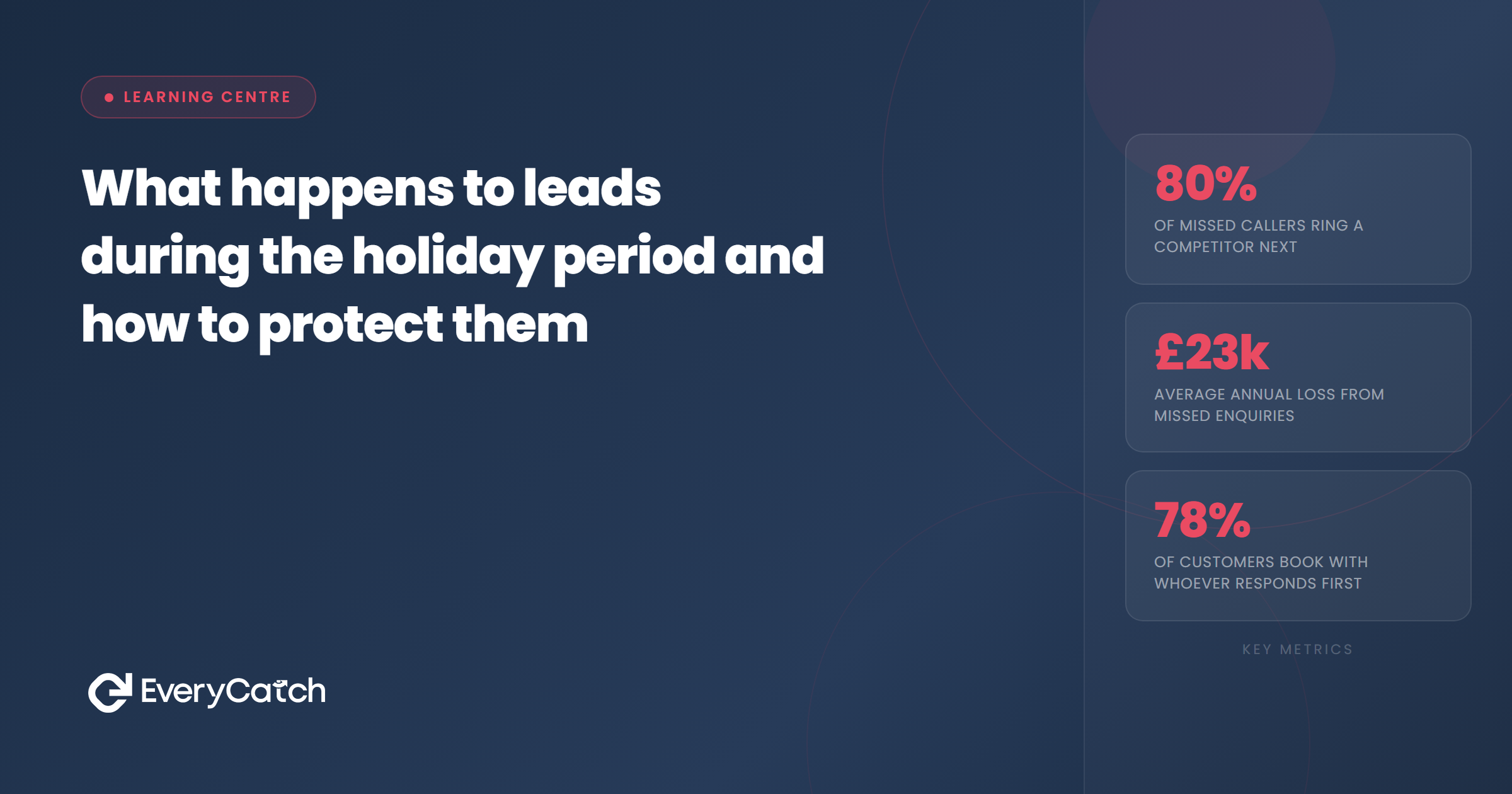

- Leads that arrive during a shutdown rarely wait. Most people contact more than one business and go with whoever replies first.
- Holiday enquiries are often high-intent. People plan renovations, repairs and bookings when they finally have time to think.
- An instant automated acknowledgement keeps a lead warm for days, even if a human cannot reply until reopening.
- Voicemail alone does not protect leads. Around eight in ten callers who reach voicemail hang up without leaving a message.
- A planned first-day-back routine, working through leads in order and by value, recovers far more than replying whenever you get round to it.
What actually happens to a lead while you are closed
Picture the enquiry itself. Someone fills in your contact form on 27 December asking for a quote on a bathroom refit. They get no reply, because nobody is checking the inbox until 6 January. So they do what almost everyone does. They open the next tab and contact two or three of your competitors as well.
One of those competitors has an automated reply set up. Within a minute, the customer receives a text confirming the enquiry arrived and promising a call on a named date. That business has now made the only impression that matters. When phones start ringing again in January, the customer already feels like they are in that firm's diary.
The same pattern plays out with calls. A missed call during a shutdown usually hits voicemail, and most callers will not leave a message. Industry research consistently puts the figure at around 80 per cent hanging up rather than speaking to a machine. That caller leaves no trace beyond a number in your call log, and by the time you check it, they have often stopped shopping because someone else answered.
The lead does not die on day one. It cools. Interest is highest at the moment of enquiry and decays steadily from there. A message answered within an hour converts many times more often than one answered days later, which is why the gap between Christmas and New Year is so expensive. It is not one missed day. It is ten of them, stacked.
Why the holiday period hits harder than a normal weekend
Two things collide over holidays. Your availability drops to zero, and for many trades and service businesses, demand rises.
People make buying decisions when they finally have breathing space. Over Christmas they sit in the kitchen they have hated all year and decide it is time. Boilers fail in the coldest weeks. Guests visit and the dodgy shower gets noticed. In-laws recommend a landscaper for spring. Search volume for many home services climbs between Boxing Day and mid January precisely because people have time to plan.
These are also better leads than average. A person enquiring on 29 December is not idly browsing. They have thought about the project enough to act on it during their time off, and many arrive with a budget already in mind because they have agreed it as a household over the break.
A normal weekend gives a lead 48 hours to cool before you respond on Monday. A festive shutdown can give it ten to fourteen days. No lead survives that untouched, and the businesses that reply first in January are usually not the ones the customer contacted first. They are the ones that acknowledged the enquiry while everyone else stayed silent.
The real cost, in numbers you can check
You can estimate your own exposure in five minutes. Count the enquiries you received during last year's shutdown across calls, forms, emails and social messages. Include the missed calls with no voicemail, because each of those was a real person. Multiply that count by your average job value, then by your normal conversion rate.
A plumbing firm averaging £450 per job, converting one enquiry in three, that received fifteen enquiries over a two-week closure was sitting on roughly £2,250 of expected revenue. If cold leads convert at a third of the normal rate, which is a generous assumption after two weeks of silence, around £1,500 of that quietly evaporated. Larger-ticket trades lose multiples of that from a single missed enquiry. We break the full calculation down in our guide to calculating the cost of your missed leads.
There is a second cost that never shows in the numbers. The customer who heard nothing from you does not just take this job elsewhere. They remember which local firm ignored them, and they tell people.
Want to know what last Christmas actually cost you?
We will walk through your enquiry channels with you and show where leads leaked over your last shutdown, free and without obligation.
Book a free discovery callHow to protect leads before you switch off
The goal is not to work through your holiday. It is to make sure every lead gets acknowledged instantly, held warm, and queued for a proper response when you return. Four things achieve that.
Set up instant acknowledgement on every channel
Every enquiry should trigger an immediate reply that does three things: confirms the message arrived, states the exact date you reopen, and tells the customer they are in the queue. A text or email that says "Thanks for getting in touch. We're closed until Monday 6 January and you're first on our list, we'll call you that morning" changes the psychology completely. The customer now has a commitment and a date, so shopping around feels less urgent.
Add missed-call text-back for phone enquiries
Since most callers will not leave a voicemail, the fix is to text them instead. A missed-call text-back system sends an automatic message the moment a call goes unanswered, capturing the caller before they dial a competitor. This matters year-round, and we cover it in more depth in why missed calls cost more than you think, but over a shutdown it is the difference between a call log full of dead numbers and a queue of warm contacts.
Keep leads warm with light follow-up
One acknowledgement holds a lead for a few days, not two weeks. A short automated sequence, perhaps a second message a few days in with a useful nudge such as a link to your gallery or a note about January availability, keeps you present without anyone lifting a finger.
Offer self-service booking where you can
If your automated reply includes a link to book a slot in your January diary, motivated customers will commit while you are still on the sofa. A booked appointment is the strongest protection a lead can have, because the customer has invested in you and stops looking.
Your first day back decides how much you recover
Reopening with fifty untouched enquiries and no plan is how businesses lose the leads they technically captured. Block out the first morning back for lead recovery before anything else, including new jobs.
Work through the queue in a deliberate order. Contact anyone who booked or replied during the break first, because they are hottest. Then take the rest oldest first, since those leads have cooled longest. Call rather than email where you have a number, and reference their original enquiry so they know they were never forgotten. If your acknowledgement promised a call on reopening day, keep that promise to the day. That single kept commitment often wins the job outright, because it is more reliability than the customer got from anyone else over the break.
Anyone who does not answer goes into follow-up, not the bin. Most sales conversations take several touches, and a lead from December can still close in late January if someone keeps politely turning up. Our article on following up with old leads without being annoying covers the cadence that works.
EveryCatch was built to handle the capture side of this automatically, instant text-back on missed calls, acknowledgement and follow-up on every enquiry, and a pipeline that shows you exactly who came in while you were away and in what order to work them. However you do it, the principle stands. Leads that arrive during a shutdown are not lost by default. They are lost by silence.

From the EveryCatch team
EveryCatch helps service businesses catch, respond to and convert every enquiry, including the ones that arrive when nobody is at the desk. We write these guides so you can fix the leaks whether you use our platform or not.