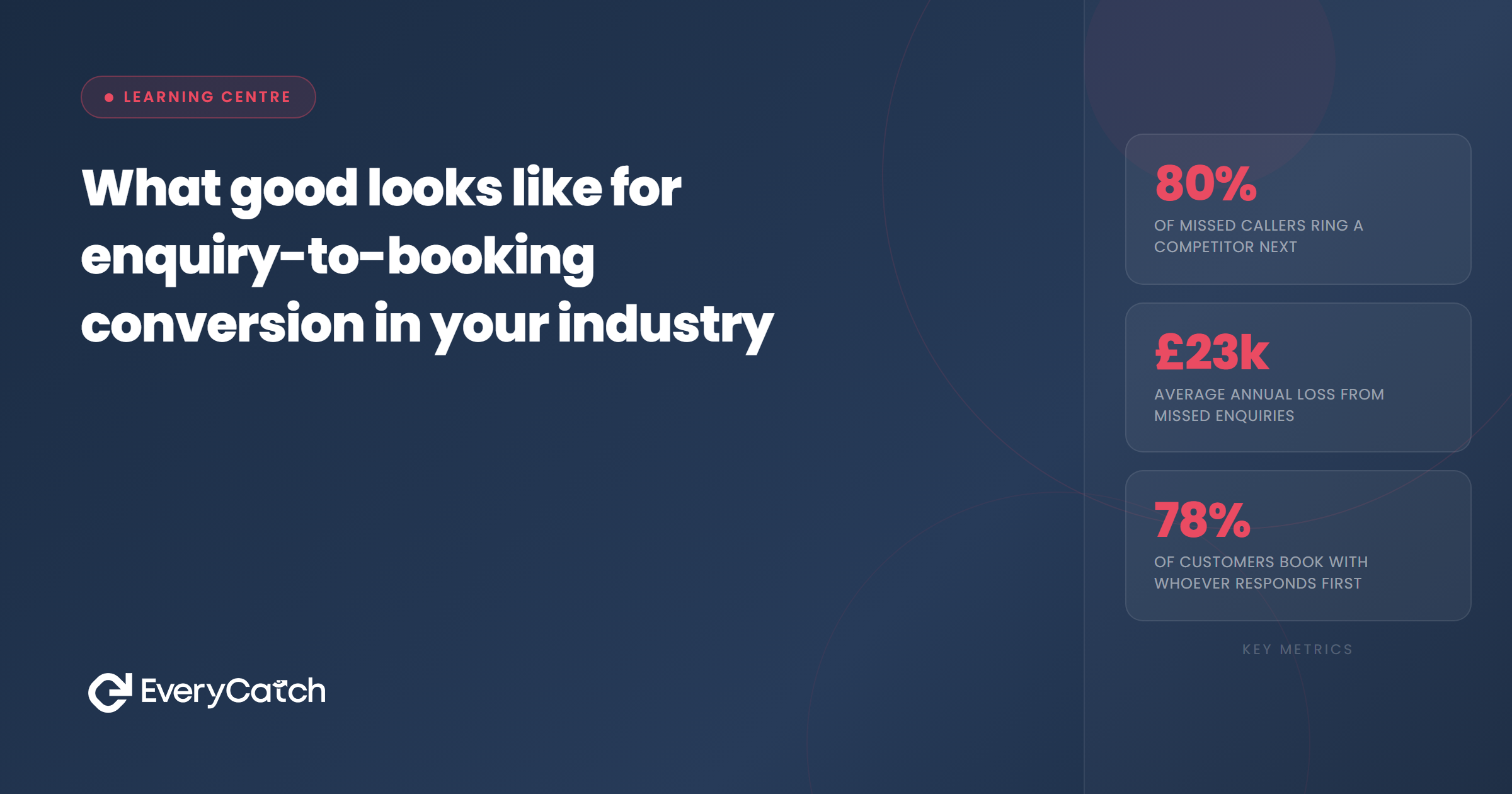

- A typical service business converts 20% to 40% of enquiries into bookings, while well-run businesses in the same trades reach 50% to 70%.
- Trades and emergency services should aim higher than considered-purchase industries, because urgency does most of the selling for you.
- Response speed is the single biggest lever. Enquiries answered within five minutes convert several times more often than enquiries answered after an hour.
- Most businesses overstate their conversion rate because they never count the enquiries that were missed or dropped before anyone logged them.
- You can usually add 10 to 20 percentage points without changing your prices, your marketing or your sales pitch.
Ask ten business owners what their enquiry-to-booking conversion rate is and most will guess. A few will say "pretty good, we win most of what we quote", which is a different metric entirely. The honest answer for the majority of service businesses is that they do not know, and when they finally measure it properly, the number is lower than they expected.
This article gives you the actual benchmarks, explains why they vary by industry, and shows you where the gap between average and good usually hides.
What enquiry-to-booking conversion actually measures
The metric is simple. Take every enquiry that reached your business in a given period, whether by phone, web form, email, WhatsApp or social message, and divide the number that turned into a confirmed booking by that total. An enquiry counts even if you missed the call, even if the form sat unread over a weekend, and even if the person never replied to your quote.
That last point matters. Many businesses only count the enquiries they responded to, which inflates the figure and hides the real problem. If you took 60 calls last month but missed another 25, those 25 belong in the denominator. Research across UK trades consistently finds that businesses miss between a quarter and half of inbound calls, so the true baseline is often far lower than the one on the whiteboard. We cover how to find that hidden number in our guide to calculating what missed leads cost your business.
Measured honestly, the metric tells you how well your whole intake system works, from the first ring to the confirmed slot in the diary. It is not a measure of sales talent. It is a measure of operational discipline.
Benchmarks by industry: average versus good
Conversion rates vary widely by sector, mostly because the buying context differs. Someone with a burst pipe books the first plumber who answers. Someone planning a loft conversion gathers three quotes and thinks for a month. Here is what the ranges look like in practice.
Emergency and urgent trades
Plumbers, electricians, locksmiths, drainage firms and emergency glaziers should expect the highest conversion rates of any service category. An average operator converts around 30% to 40% of all enquiries. A good operator, meaning one who answers or texts back within minutes at all hours, converts 60% to 75%. Urgency does the selling. The only way to lose an urgent enquiry is to be unreachable, which is exactly how most of them are lost.
Home services and general trades
Builders, roofers, decorators, landscapers, cleaners and pest control sit in the middle. Average performance is 20% to 35% of enquiries becoming booked jobs or confirmed site visits. Good performance is 45% to 60%. Homeowners in this category typically contact two to four businesses, and the first one to respond properly wins the work more than half the time.
Clinics, salons and appointment-based services
Dentists, physiotherapists, beauty salons, vets and similar businesses should convert 35% to 50% on average, because the person enquiring has usually already decided to buy the service. Good performance here is 60% to 75%. The main leak is not competition, it is friction. Enquiries die when booking requires a call back during working hours rather than an instant confirmed slot.
High-ticket considered purchases
Kitchen fitters, driveway installers, solar companies and firms selling projects worth five figures see lower raw numbers, typically 10% to 20% converting on average, with strong operators reaching 25% to 40%. Longer decision cycles mean follow-up matters more than speed alone, though speed still shapes who makes the shortlist.
Not sure where your business sits against these numbers?
We will walk through your enquiry channels with you and show you exactly where bookings are leaking, free and without obligation.
Book a free discovery callWhy most businesses sit below the benchmark
When a business converts 25% and a competitor converts 55%, the difference is rarely price, reputation or charm. It is almost always three mechanical failures stacked on top of each other.
The first is missed contact. Calls ring out while you are on the tools, in a treatment room or driving. Forms arrive at 9pm and get read at lunchtime the next day. Every one of these is a zero in your conversion figure before any selling happens. Our article on where missed leads hide in a service business maps the usual leak points.
The second is slow response. The often-quoted research on lead response holds up in the real world. Reply within five minutes and you speak to the buyer while they are still motivated and before they ring anyone else. Reply after an hour and the odds of a meaningful conversation drop dramatically. Reply the next day and, in urgent trades, the job is already booked elsewhere.
The third is absent follow-up. Most businesses make one attempt to reach an enquirer, then move on. Buyers are busy too. A single missed connection kills the enquiry unless something nudges it back to life. Businesses that follow up three to five times over several days recover a surprising share of enquiries that looked dead, often 20% to 30% of them.
How to move your own number
Start by measuring properly for one month. Log every enquiry from every channel, including the missed ones, then count confirmed bookings. That gives you a real baseline instead of a flattering guess.
Then attack the leaks in order of size. If you miss a meaningful share of calls, put an instant text-back in place so a missed call gets a message within seconds rather than silence. If web enquiries wait hours for a reply, automate an immediate acknowledgement that asks a qualifying question and keeps the conversation alive. If quotes go quiet, build a short follow-up sequence that chases them without you having to remember.
None of this requires hiring, discounting or working longer hours. It requires the gaps between enquiry and booking to be closed systematically. This is the exact problem EveryCatch was built for, catching every enquiry the moment it arrives, replying instantly across every channel, and following up until the person books or clearly says no. Businesses that fix these three leaks typically move from the average band into the good band within a couple of months, which for most means 10 to 20 extra percentage points of conversion from enquiries they were already paying to generate.
One final point on interpretation. If your conversion rate is already at the top of your industry's range, the constraint is enquiry volume, and marketing deserves your next pound. If it is below the middle of the range, spending more on marketing pours water into a leaking bucket. Fix the bucket first.

From the EveryCatch team
EveryCatch helps service businesses catch and convert every enquiry with instant responses, automated follow-up and simple booking across every channel. We write these guides to answer the questions our customers ask us most, honestly and without the sales gloss.