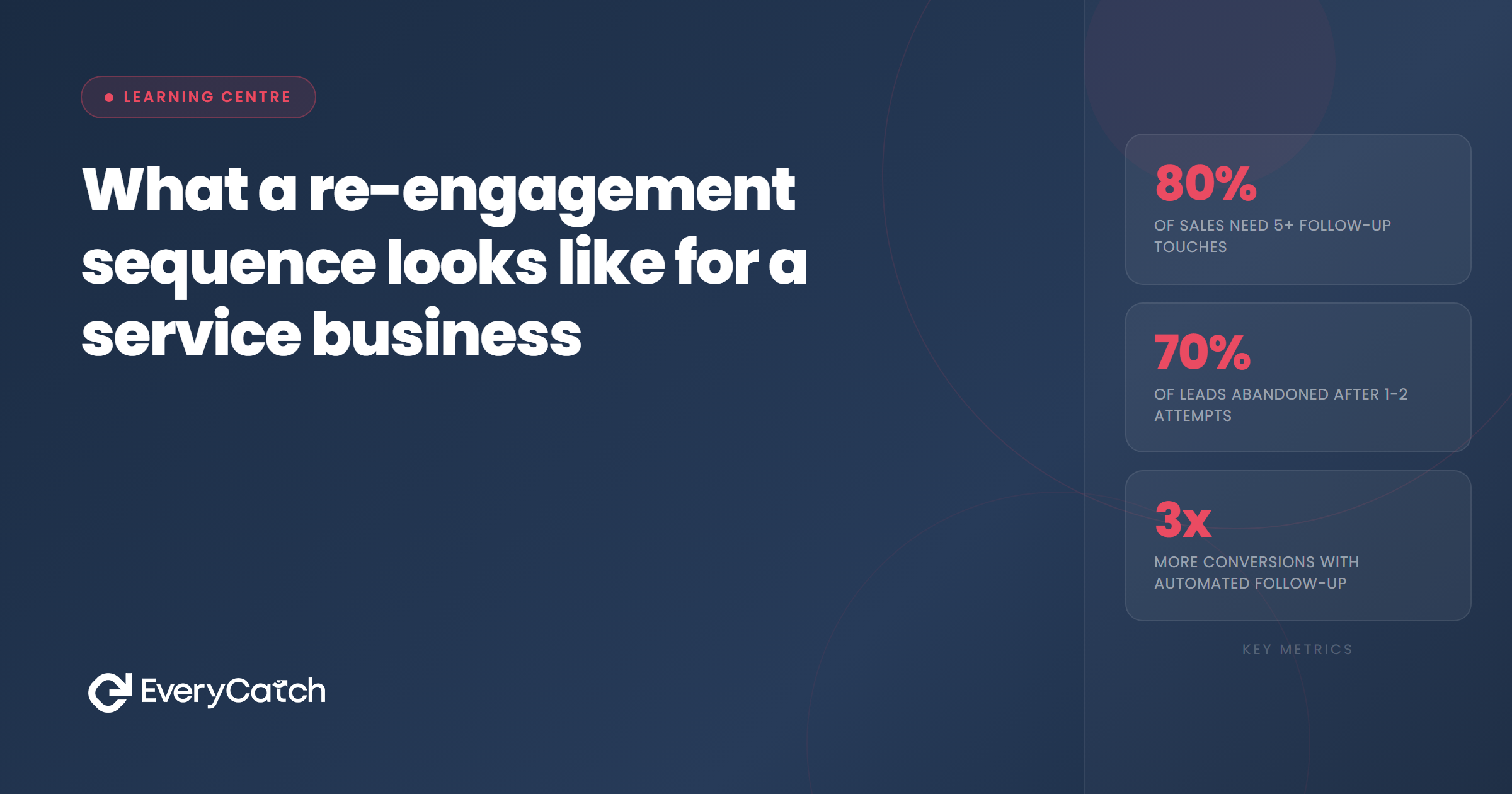
- Re-engagement sequences target enquiries that went quiet or customers who haven't rebooked after a reasonable period
- The typical sequence runs four messages over 10 to 21 days, using escalating value propositions
- The final message should give a clear ending to the sequence and permission to stop
- Mixing SMS and email increases open rates and response rates compared to single-channel sequences
- Automated sequences outperform manual re-engagement because they fire consistently and reach people at defined intervals
Re-engagement sequences sit in a different category to initial follow-up. These messages go to people who once showed interest but never converted, or past customers who have gone quiet after completing a job. The objective is to bring them back into the conversation without being pushy or tone-deaf.
Service businesses lose potential revenue in two ways. First, they lose enquiries that never received adequate follow-up. Second, they lose repeat business because past customers drift away and forget the company exists. A re-engagement sequence solves both problems with the same structure.
Who should receive it
The sequence applies to two groups. The first includes enquiries who engaged initially but stopped responding before booking. The second covers past customers who completed a job but have not returned after a timeframe typical for your service category.
For the first group, re-engagement begins after the initial follow-up sequence ends. If your standard follow-up runs seven days and the enquiry still has not responded, a re-engagement sequence can fire 30, 60, or 90 days later depending on your service cycle. Heating engineers might trigger it at 90 days. Event services might use 180 days.
For past customers, timing depends on service frequency. A pest control company might re-engage customers six months after their last visit. A landscape gardener might wait 12 months. The point is to contact them before they've already rebooked with a competitor.
Sequence structure
A re-engagement sequence typically includes four messages. Each one escalates the value proposition or urgency, and the fourth message signals closure. This structure respects the recipient's attention and sets a clear boundary for the business.
The first message is light and checks whether the person still has a need. The second message reminds them of your service's value or shares a useful piece of content. The third message introduces an incentive or limited-time element. The fourth message closes the loop and offers a polite exit.
This progression works because it gives multiple opportunities to respond while gradually raising the stakes. People who were on the fence often respond to the incentive message. People who genuinely have no need appreciate the breakup message and sometimes reply to say they'll be in touch later.
Message one: The check-in
The first message should feel conversational and low-pressure. You're not pushing for a sale. You're checking whether the person's situation has changed since the last contact.
A good format opens with a reference to the previous conversation, acknowledges time has passed, and asks a simple yes-or-no question. For example: "Hi Sarah, it's been a few months since we last spoke about your bathroom renovation. Are you still planning to go ahead this year?"
This message works because it doesn't assume interest. It gives the recipient permission to say no, which lowers resistance. If they reply at all, you have a live conversation again. If they don't reply, you still have three more chances.
Message two: The value reminder
The second message shifts the focus from checking in to reminding the recipient why your service matters. This works well when you share a relevant piece of content, a seasonal tip, or a brief case study.
For a gardening business, this might read: "Hi Mark, we're heading into the best planting season for hedges. We helped a customer in your area last month and the results were excellent. Let me know if you'd like to see before-and-after photos."
The key is to offer value without requiring a commitment. You're not asking them to book. You're reminding them you exist and that you solve a problem they once cared about. This keeps your business top of mind while positioning you as helpful rather than desperate.
Want to see how automated sequences work in practice?
We'll show you exactly how re-engagement sequences fit into a complete follow-up system.
Book a free discovery callMessage three: The incentive
The third message introduces urgency or a tangible incentive. This is where you make an offer that gives people a reason to act now rather than later.
The offer does not have to be a discount. It could be priority scheduling, a free consultation, or a bundled service. For example: "Hi Claire, we have a few openings this month and I wanted to check if you'd like to book your installation before our calendar fills up. We can also include a free maintenance visit if you book this week."
This message works because it introduces scarcity without sounding manipulative. The deadline is real, the offer has value, and the recipient understands they need to decide. Many people who have been sitting on the fence convert at this stage.
Message four: The breakup
The final message closes the sequence. It acknowledges that the recipient may not be interested right now and gives them a clean exit. This message often generates replies from people who appreciate the honesty and want to stay in touch for later.
A typical breakup message reads like this: "Hi Tom, I haven't heard back so I'm guessing the timing isn't right for you at the moment. I'll leave you in peace, but if anything changes feel free to get in touch. All the best."
This message matters for two reasons. First, it ends the sequence gracefully and avoids annoying the recipient. Second, it often prompts a response because people feel obliged to acknowledge your courtesy. Some will say they're no longer interested, which lets you remove them from future sequences. Others will say they're still interested but the timing is off, which gives you permission to follow up later.
Timing between messages
The intervals between messages need to be long enough to avoid harassment but short enough to maintain continuity. Most service businesses space re-engagement messages three to five days apart.
A typical sequence runs over 10 to 14 days. Message one fires on day one. Message two fires on day four. Message three fires on day eight. Message four fires on day 12. This cadence keeps you present without overwhelming the recipient.
Longer gaps work for high-value services or customers with longer decision cycles. Shorter gaps work for time-sensitive services or seasonal offers. The key is to test and adjust based on response rates.
Channel mixing
Re-engagement sequences perform better when you mix channels. Sending all four messages by email reduces visibility because many people ignore promotional emails. Sending all four by SMS can feel intrusive. Alternating between the two increases your chances of being seen.
A common pattern sends message one by SMS, message two by email, message three by SMS, and message four by email. This ensures the urgent messages land in the recipient's text inbox, while the value-focused messages arrive in email where they can include links or images.
You can also introduce a phone call at message three if your business model supports it. A quick call after the second message gives you a chance to answer questions and overcome objections directly. Not every business has the capacity for this, but when it works, it converts better than text alone.

From the EveryCatch team
We help service businesses build and automate re-engagement sequences that bring back lost enquiries and dormant customers. Every sequence is customised to your service category, timeline, and tone of voice.