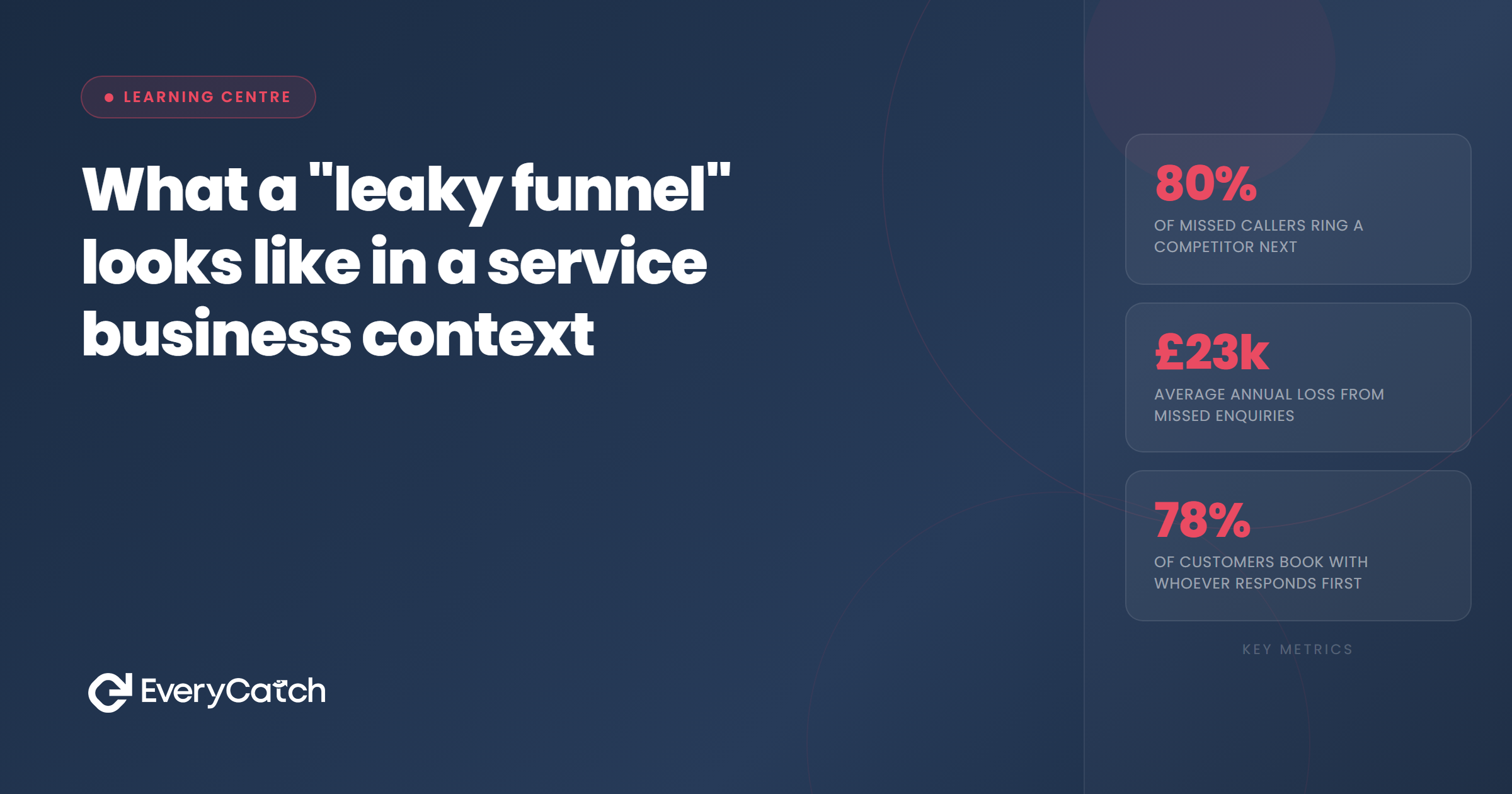

- A leaky funnel is not a marketing problem. It is the loss of enquiries you have already paid to generate, somewhere between first contact and a booked job.
- Service businesses leak leads at five predictable points: missed calls, slow responses, dropped follow-up, unchased quotes, and unconfirmed appointments.
- Most owners overestimate their conversion rate because they only count the leads they remember, not the ones that never got logged.
- You can find your leaks in under an hour by tracing every enquiry from the past fortnight to its final outcome.
- Fixing the funnel usually beats buying more leads, because the same marketing spend suddenly produces more booked work.
The phrase "leaky funnel" gets thrown around in marketing circles, usually alongside diagrams that mean nothing to someone who fits boilers or cleans gutters for a living. Strip away the jargon and the idea is simple. Your funnel is the journey a customer takes from first hearing about you to paying an invoice. A leaky funnel means people are dropping out of that journey at points where they should not, and you are losing work you had already won the right to quote for.
For a plumber, an electrician, a landscaper or a cleaning firm, the funnel is short. Someone finds you, contacts you, gets a response, receives a quote or a booking, and the job happens. Five steps, maybe six. The problem is that each step is a place where a lead can quietly disappear, and in most service businesses several of those steps have holes in them right now.
What a leaky funnel actually means for a service business
A corporate sales team talks about funnels in terms of awareness, consideration and decision. That model does not map cleanly onto a trade or local service business, because your buyers move fast. Someone with a leaking tap does not spend three weeks in a "consideration phase". They ring three plumbers on a Tuesday afternoon and book whoever responds first.
So in your context, a leaky funnel means something more concrete. It means enquiries arrived and never became jobs, for reasons that had nothing to do with your price or your quality. The customer wanted the work done. You could have done it. The lead still escaped. That distinction matters, because a lost lead you never competed for is pure waste. You paid for the advert, the website, the Google Business Profile and the reputation that generated the enquiry, and then the enquiry evaporated before you got a chance to sell anything.
The frustrating part is that leaks are almost invisible from inside the business. A missed call while you are on a roof does not feel like lost revenue. It feels like a normal Tuesday. The caller who hangs up and rings your competitor never tells you they existed, which is why so many owners believe their conversion rate is far better than it really is. We have written before about how many leads the average service business actually misses, and the numbers surprise almost everyone who counts properly for the first time.
The five points where service businesses leak leads
Leaks cluster at five specific points, and it is worth checking each one against your own business honestly.
1. The missed call
This is the biggest hole in almost every trade business. Research consistently shows that a large share of calls to small service firms go unanswered, and most callers who reach voicemail do not leave a message. They simply ring the next name on the list. If you are on the tools all day, the phone rings while your hands are full, and the lead is gone within ninety seconds.
2. The slow response
Web form submissions, Facebook messages and emails that sit for a day before anyone replies are leads on borrowed time. The odds of converting an enquiry drop sharply within the first hour, because the customer keeps shopping until someone answers. A reply on Thursday to a message sent on Monday is often a reply to someone who booked elsewhere on Tuesday.
3. The follow-up that never happens
You answered, had a good conversation, and the customer said they would "have a think". Then nobody chased them. Most service businesses follow up once at best, yet a meaningful share of jobs are won on the second, third or fourth touch. Silence gets read as disinterest, and the lead drifts away.
4. The unchased quote
Quotes are expensive to produce. You visited the site, measured up, priced the materials and wrote it all down. Sending it and then never mentioning it again is like fishing, hooking something, and cutting the line. Customers delay for ordinary human reasons, and a polite nudge a few days later frequently closes the job.
5. The unconfirmed appointment
Bookings that are never confirmed or reminded produce no-shows, and every no-show is a slot you could have sold to someone else. A survey visit the customer forgot about is a leak at the very bottom of the funnel, which makes it the most expensive one of all.
Want to know exactly where your funnel is leaking?
We will walk through your enquiry channels with you and show you where leads are escaping, free and without obligation.
Book a free discovery callHow to find your own leaks in under an hour
You do not need software to diagnose the problem, only honesty and a recent record. Pull up the last two weeks of activity across every channel: your call log, your inbox, your Facebook and WhatsApp messages, and your web form submissions. Then trace each enquiry to its final outcome. Did it get a response? How quickly? Did it become a quote? Did the quote get chased? Did the job happen?
Most owners who do this exercise find two uncomfortable things. First, the number of enquiries was higher than they thought, because missed calls and ignored messages had never been counted as leads. Second, the drop-off between "enquiry received" and "job booked" was steeper than they assumed. If ten people contacted you and three became customers, seven leads leaked somewhere, and the calls log will usually tell you where. If you want to put a monetary figure on it, our guide to calculating what missed leads cost your business gives you the simple maths.
Plugging the leaks beats buying more leads
The instinctive response to slow months is to spend more on marketing. That works, but it is the expensive fix, because pouring more water into a leaky bucket mostly produces more leakage. The cheaper fix is to seal the holes, so the enquiries you already generate convert at a higher rate.
Each leak has a known repair. Missed calls can trigger an automatic text back within seconds, so the caller knows you exist and stops dialling competitors. New enquiries from any channel can receive an instant acknowledgement rather than waiting for you to finish a job. Follow-up sequences can nudge quiet leads and unanswered quotes automatically, at the intervals that win work rather than the intervals you happen to remember. Appointment reminders can cut no-shows without anyone lifting a finger. This is exactly the set of problems EveryCatch was built to solve, and it is why customers often see more booked jobs without changing their marketing spend at all. Whether you use our tools or build your own process, the principle is the same. Every enquiry deserves a fast response, persistent follow-up and a confirmed booking, every single time, regardless of how busy the day gets.

From the EveryCatch team
EveryCatch helps service businesses catch every enquiry with instant lead response, automated follow-up and booking tools that work while you are on the job. We write the Learning Centre to answer the questions owners actually search for, honestly and without the fluff.