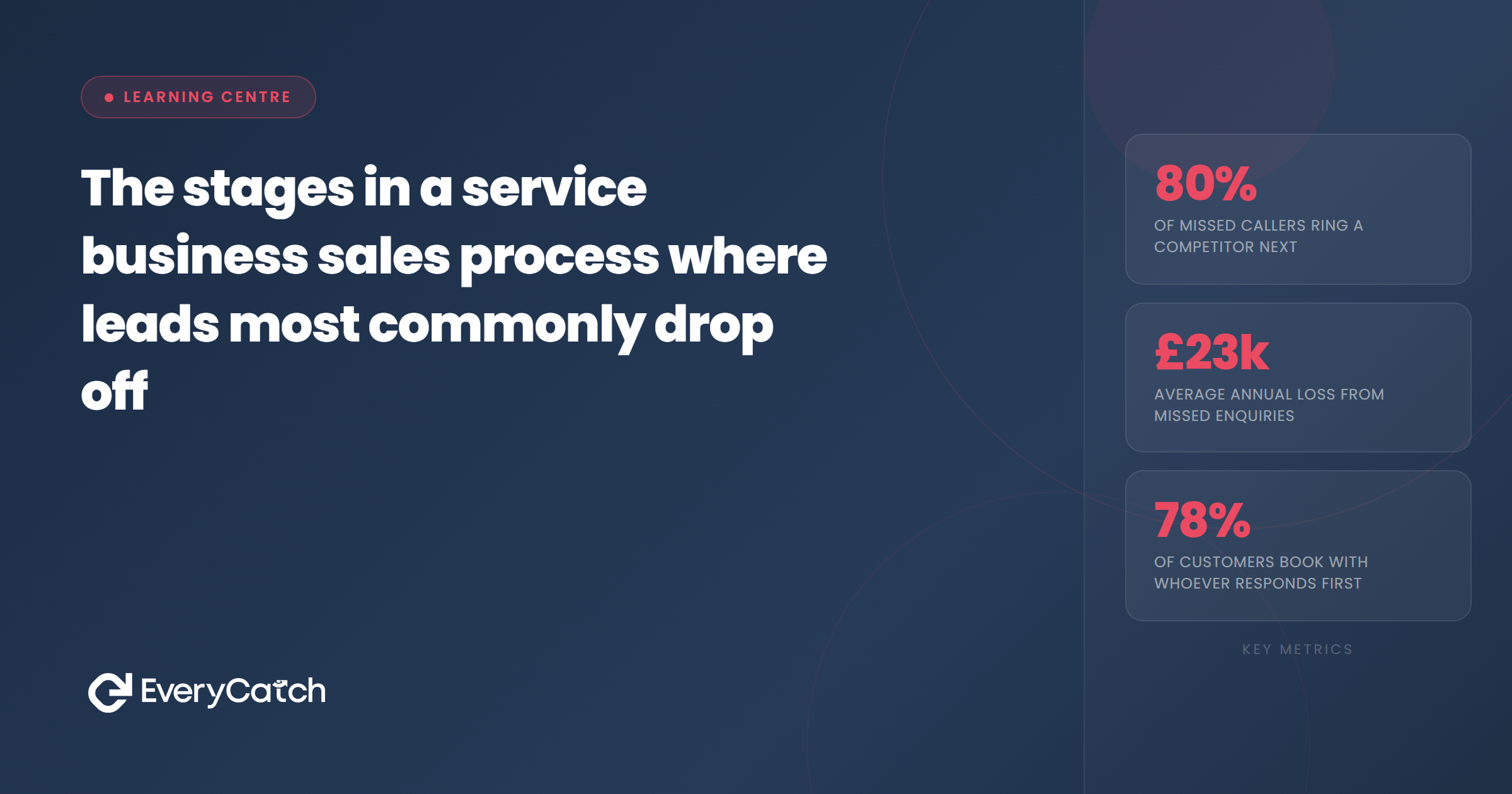

- Around half of all lost leads disappear at first contact, usually because a call went unanswered or a form sat unread.
- Leads who wait more than an hour for a reply are far more likely to have already spoken to a competitor.
- The gap between sending a quote and hearing back is the single biggest silent leak in most service businesses.
- Most drop-offs are caused by delay and inconsistency, not price. The business that responds first and follows up wins a disproportionate share of work.
- Fixing drop-offs starts with measuring them. You cannot plug a leak you have never located.
Most service business owners assume they lose work on price. Ask them where leads go and they will tell you a competitor undercut them, or the customer decided not to bother. The data tells a different story. When you map the journey from first enquiry to booked job, leads fall out at five specific stages, and the majority of those losses have nothing to do with cost. They happen because nobody answered, nobody replied, or nobody followed up.
This article walks through each stage in order, explains why leads leave at that point, and shows what closing each gap looks like in practice.
Stage one: first contact, where leads vanish before you know they exist
The earliest drop-off point is also the most invisible. A homeowner calls a plumber and the call rings out. A prospect fills in a website form on a Saturday and nothing acknowledges it. A Facebook message arrives while the owner is on a roof. In every case, the lead has raised a hand and received silence.
Research into small service businesses consistently finds that a third or more of inbound calls go unanswered during working hours, and the figure climbs sharply on evenings and weekends. What makes this stage so costly is that the person calling has active intent. They have a leaking tap or a broken boiler right now, so they simply call the next name on the list. Very few voicemail messages get left, and fewer get returned in time. If you want a sense of the scale of this problem, our article on what missed calls really cost a service business puts numbers against it.
The fix at this stage is not answering every call personally, which is impossible for anyone who does the actual work. The fix is making sure every missed contact gets an immediate automated acknowledgement, ideally a text within seconds, so the lead knows a real business has received their enquiry.
Stage two: the response wait, where speed decides the winner
The second drop-off happens when a lead does get through, or does submit a form, and then waits. This stage kills leads quietly. The customer is not angry, they are just gone. Studies on lead response have shown for years that contacting an enquiry within five minutes makes you many times more likely to qualify them than contacting them after half an hour. Wait a day and the odds collapse.
The reason is simple. A person researching a service rarely contacts one business. They contact three or four. The first one to hold a proper conversation frames the whole decision, sets expectations on price, and often books the job before the others have even opened the email. Being second to respond usually means competing against a quote that already exists.
Service businesses lose here because response depends on whoever happens to see the message. There is no owner, no timer, and no system. The enquiry sits in an inbox until the evening, and by then the moment has passed.
Stage three: the quote, where friction does the damage
Leads that survive to the quoting stage have shown real commitment, which makes losses here especially painful. Drop-offs at this point usually come from friction rather than price. The site visit takes a week to arrange. The quote takes another week to arrive. The document is vague, or arrives as a figure in a text with no context. Every extra day and every unclear line item gives the customer a reason to hesitate or to keep shopping.
A slow quote also signals something about the job itself. Customers reasonably assume that a business too disorganised to send a quote promptly will be disorganised on site. Speed at the quote stage is a trust signal, not just a convenience.
Not sure where your own leads are leaking out?
We will walk through your enquiry-to-booking journey with you and show you exactly which stages are costing you jobs.
Book a free discovery callStage four: the decision gap, the biggest silent leak of all
The quote goes out, and then nothing happens. This gap between quote and decision is where most service businesses lose the largest share of winnable work, and almost none of them realise it because no rejection ever arrives. The lead does not say no. They just stop replying.
Sometimes they chose a competitor. Far more often, life got in the way. They meant to reply, a week passed, the quote slipped down their inbox, and eventually contacting you again felt awkward. One or two well-timed follow-up messages recover a surprising proportion of these leads, yet most businesses send zero. The owner feels that chasing looks desperate, or simply forgets, because follow-up lives in their head rather than in a system.
The maths here is stark. If you quote twenty jobs a month and a structured follow-up sequence converts even three quotes that would otherwise have gone quiet, that is often tens of thousands of pounds a year recovered from leads you already paid to generate. We cover how to build this properly in our guide to following up with leads who go quiet after a quote.
Stage five: booking, where yes still fails to become a job
The final drop-off point catches people out because the sale feels done. The customer has said yes, and then the booking itself falls apart. Scheduling turns into a back-and-forth of missed calls and half-answered texts. The proposed date is three weeks away and the customer cools off. Nobody confirms the appointment, the customer forgets, and the slot is wasted anyway.
Losses at this stage are pure process failure. A verbal yes needs to be converted into a confirmed, diarised booking within the same conversation wherever possible, with an automatic confirmation and a reminder before the appointment. Every hour between agreement and confirmation is an hour in which second thoughts, competing quotes, or plain forgetfulness can undo the sale.
Once you see the five stages laid out, a pattern emerges. Price appears nowhere on the list. The common thread is time, and specifically the dead time between a customer acting and the business responding. Compressing those gaps, with instant acknowledgements at first contact, fast structured responses, prompt quotes, automatic follow-up, and same-conversation booking, is how service businesses convert more of the demand they already have. Tools like EveryCatch exist to run those steps automatically, but even a manual checklist beats hoping that memory and goodwill will hold the pipeline together.

From the EveryCatch team
EveryCatch helps service businesses catch every enquiry, respond in seconds, and follow up automatically until a lead books or says no. We write these guides based on what we see working across the trades and service businesses we support every day.