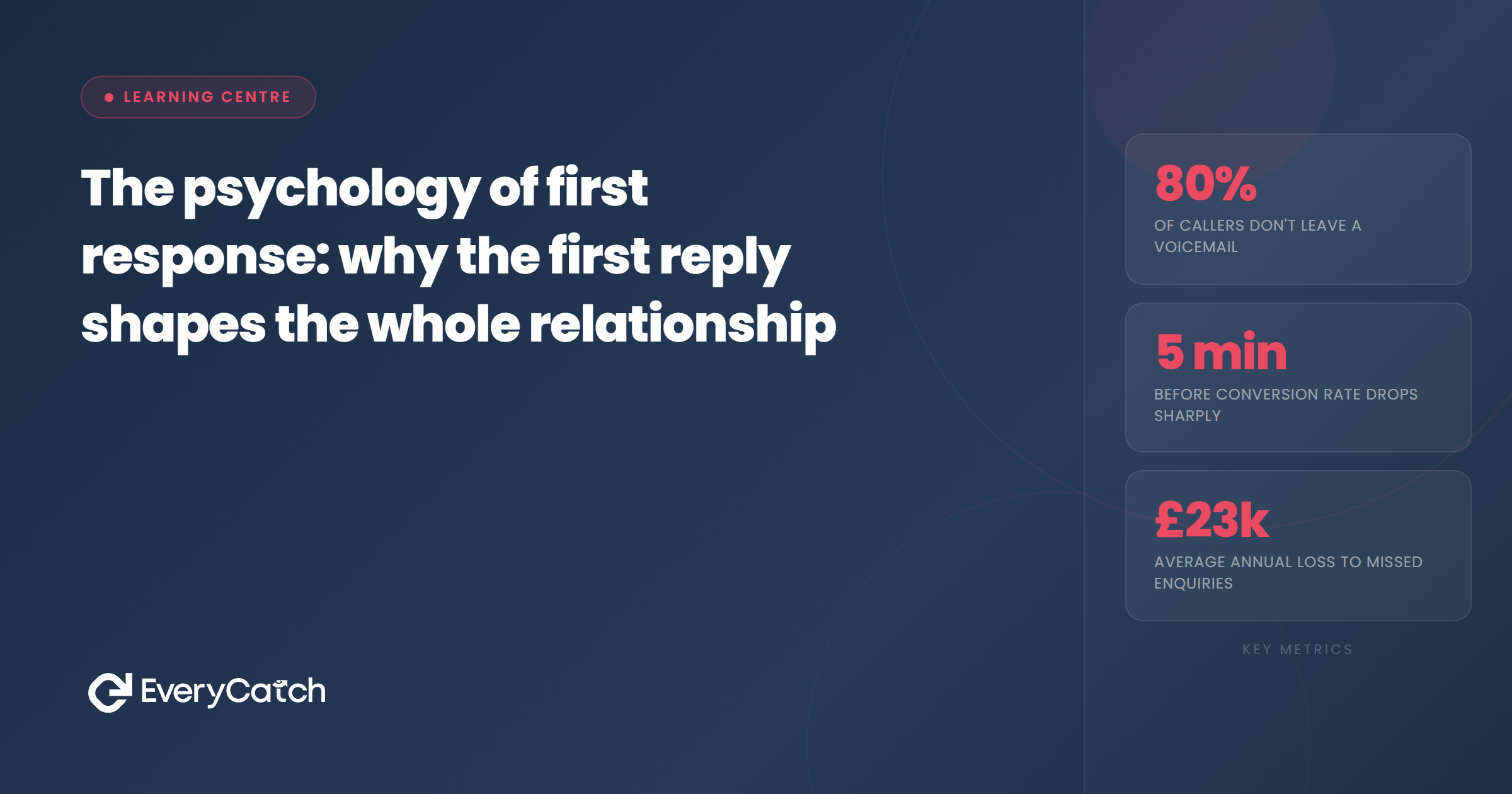
- People form lasting judgements about your business within the first few minutes of contact, driven by the primacy effect
- Response speed doesn't just affect conversion, it shapes customer expectations for the entire relationship
- A fast first reply signals competence and respect, while delays are interpreted as indifference or disorganisation
- Once a negative impression forms, it takes multiple positive experiences to shift perception
- Automated acknowledgements can protect the first impression while you prepare a proper response
The first time someone hears from your business after making contact, their brain makes a series of rapid calculations. Are you organised? Do you value them? Will this be easy or painful? Can they trust you? These judgements happen fast, often within seconds, and they carry enormous weight.
This isn't about opinion or guesswork. The way human memory and decision-making work means that the first impression shapes how every subsequent interaction is interpreted. A slow response doesn't just delay the conversation. It creates a psychological frame that follows you through the relationship, making every misstep seem predictable and every positive action seem like an exception.
Understanding why this happens explains why lead response speed matters more than most businesses recognise. It's not about being pushy or desperate. It's about working with, rather than against, the way people naturally form judgements and make decisions.
The primacy effect in customer relationships
The primacy effect describes the tendency for people to remember and weigh early information more heavily than information encountered later. In psychology studies, this pattern appears consistently. When people are shown a list of traits describing a person, the traits presented first have a stronger influence on overall impression than those presented later, even when the later traits contradict the early ones.
This phenomenon transfers directly to business relationships. When someone contacts you, the first interaction sets the frame. If your initial response is fast and helpful, later interactions are interpreted through that lens. A small delay on a second email feels like an anomaly. If your first response is slow or confusing, later interactions confirm the pattern. Even when you respond quickly later, it's seen as out of character.
The effect is particularly strong when someone is actively comparing options. If a potential customer contacts three businesses at the same time, the first to respond gains an immediate psychological advantage. They appear more eager, more capable, more present. The comparison isn't neutral. The fast responder becomes the baseline, and everyone else is judged relative to them.
This isn't about being liked. It's about establishing credibility and reliability from the start. The primacy effect means that your first action carries more interpretive weight than almost anything you do later. You're not just answering a question. You're demonstrating who you are.
The five-minute window and decision making
Research into online lead behaviour shows a dramatic spike in conversion when contact happens within the first five minutes. The common explanation focuses on availability. People are more likely to answer the phone or engage with a reply when they're still at their computer or phone, fresh from submitting the enquiry.
But there's a deeper psychological factor. When someone reaches out, they're in a state of active decision-making. They have intent. They're weighing options, considering next steps, and emotionally primed to move forward. That state doesn't last. Five minutes later, they've moved on to something else. The urgency fades. The moment passes.
A fast response catches people in that window. It feels immediate, it matches their energy, and it makes progression feel natural. A slow response forces them to rebuild that intent. They have to remember why they contacted you, re-engage with the problem, and summon the motivation to continue. That's friction, and friction kills momentum.
This isn't about manipulation. It's about respecting the natural rhythm of decision-making. When someone is ready to act, responding quickly feels helpful. Waiting feels dismissive, even if the delay is unintentional. The timing of your reply sends a message about whether you're aligned with their needs or indifferent to them.
How response speed signals trustworthiness
Speed alone isn't inherently valuable, but in context, it serves as a signal. When someone contacts a business, they're looking for cues about reliability. Can this company deliver? Will they follow through? Are they organised enough to handle my project?
A fast response answers those questions indirectly. If you can respond quickly to an enquiry, it suggests you have systems in place, you're paying attention, and you take commitments seriously. It's a proxy for competence. Conversely, a slow response raises doubt. If you can't manage a simple reply, what does that say about your ability to manage the actual work?
This perception isn't always fair, but it's consistent. People use response time as a heuristic for quality. They assume a correlation between how quickly you reply and how well you'll perform. A 48-hour delay might have nothing to do with your work quality, but the customer doesn't know that. They only have the delay, and they fill in the blanks.
The effect amplifies when the stakes are high. If someone is dealing with an urgent problem, a blocked drain or a broken boiler, slow response time reads as indifference to their situation. They're stressed, they're looking for reassurance, and silence communicates the opposite. Speed becomes a proxy for care.
How many leads slip through because your first reply is too slow?
We'll show you how to close the gap without adding to your workload.
Book a free discovery callWhy it's so hard to recover from a slow start
Once a negative first impression forms, changing it requires disproportionate effort. This is partly due to confirmation bias, the tendency to interpret new information in ways that support existing beliefs. If someone has decided you're unreliable based on a slow first response, later positive interactions are explained away as exceptions or lucky timing.
The challenge is compounded by the fact that customer relationships often lack repeated contact points. In a friendship or long-term working relationship, you might have dozens of opportunities to shift someone's perception. In a transactional service business, you might only have three or four meaningful interactions before the job is done. If the first one goes poorly, there simply isn't enough time to rebuild trust.
Studies in social psychology show that it typically takes five to seven positive interactions to counteract the effect of one negative interaction. In a business context, where interactions are sparse and often functional, reaching that threshold is difficult. The first response doesn't just influence perception, it often determines the outcome of the relationship entirely.
This is why optimising for the first reply isn't about perfectionism. It's about recognising that you rarely get a second chance to set the tone. The cost of recovery is so high that prevention becomes the only realistic strategy.
Quality and speed aren't opposites
There's a common misconception that fast responses must be shallow or generic. The assumption is that quality takes time, and therefore speed compromises substance. In reality, the two are independent. A fast response can be thoughtful, and a slow response can be vague.
What matters is preparation. If you know the most common questions, concerns and objections your customers have, you can craft responses in advance. Speed comes from having the answer ready, not from cutting corners. Automation and templates get criticised as impersonal, but the opposite is often true. A well-designed automated reply can feel more relevant than a hastily written manual response because it's been refined over time.
The key is to separate acknowledgement from resolution. You don't need to solve the problem in the first reply. You need to confirm that you've received the enquiry, set expectations about next steps, and demonstrate that the person matters. That can happen in seconds. The detailed answer can follow later, but only after you've protected the first impression.
Speed shows respect. It says you were paying attention, and you value their time enough to respond promptly. That perception creates goodwill, which buys patience. A fast acknowledgement followed by a slightly longer wait for a detailed answer feels very different from silence followed by a detailed answer. The total time might be the same, but the psychological experience is completely different.
The role of automation in first response
Manual response processes create variability. One enquiry gets answered in ten minutes, another in four hours, depending on whether you happened to see it. That inconsistency doesn't just affect conversion, it creates an unpredictable customer experience. Automation removes the variability.
The objection is usually about authenticity. People worry that automated replies feel cold or robotic. That concern is valid when automation is done poorly, but the alternative, radio silence, is worse. A well-written automated acknowledgement feels responsive and professional. It confirms receipt, sets expectations, and invites further engagement. That's better than waiting hours for a manual reply that might say essentially the same thing.
Automation also scales in ways that manual processes can't. If you receive five enquiries at once, a manual process means four people wait while you respond to the first. An automated system handles all five simultaneously. The psychological benefit is enormous. Every person feels attended to immediately.
The best approach combines automation with personalisation. The initial reply is instant and automated, protecting the first impression. The follow-up is manual, detailed and specific to the enquiry. This structure respects both speed and quality. You don't sacrifice one for the other. You optimise both.
EveryCatch's lead response system automates the acknowledgement while keeping the detailed reply in your control. It closes the gap between enquiry and response, ensuring the first impression is always strong, then hands the conversation to you when context and detail matter most.

From the EveryCatch team
We work with service businesses every day, helping them close the gap between enquiry and response. The patterns are consistent. The businesses that protect the first impression win more work, build stronger relationships, and spend less time chasing lost opportunities.