
- Fast responders capture customers who need work done urgently and are willing to pay more for immediate availability
- Longer response delays give price-conscious customers time to shop around and compare multiple quotes
- Speed signals professionalism, which attracts customers who associate quick responses with quality service
- Responding within five minutes means you book better calendar slots, which tend to be higher-value appointments
- You can track the link between response speed and job value by segmenting converted leads by initial response time
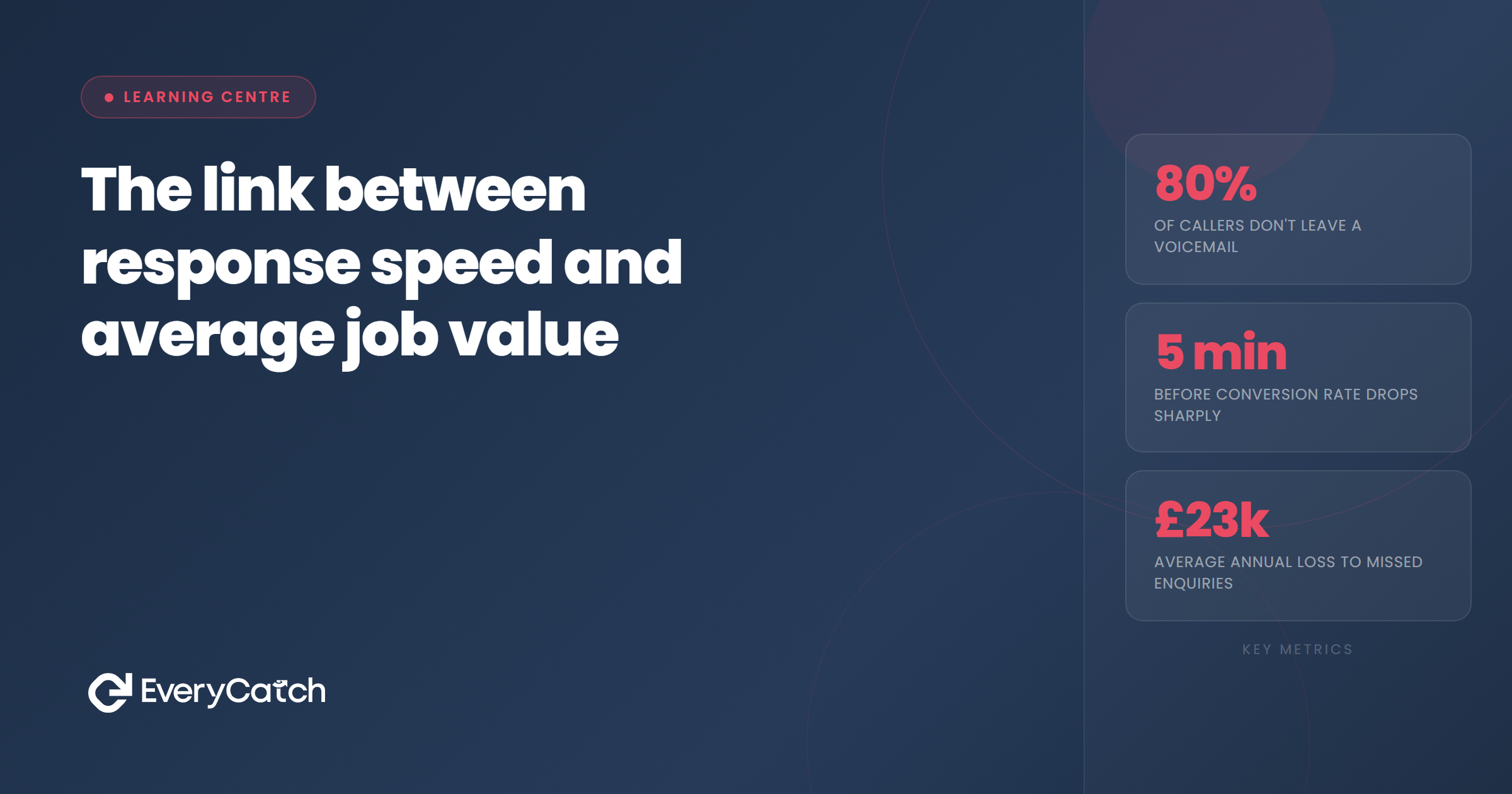
Most service businesses measure conversion rates, but few analyse how response speed affects the average value of jobs they win. The relationship is stronger than many expect. When you respond to a lead within five minutes instead of five hours, you do not just convert more often. You convert different customers entirely.
The customers you reach quickly tend to value speed and availability over price. They are contacting you because they have a problem that needs solving now, not because they are gathering quotes for a project that might happen in three months. This difference in urgency changes everything about the job, including what they are willing to pay.
Urgency drives value
A homeowner who calls six plumbers on Monday morning and waits to see who gets back first is showing you something. They are telling you that speed matters more to them than finding the cheapest quote. That mindset applies to the entire transaction, not just the initial contact.
These customers are looking for someone available this week, not next month. They care about the problem being fixed well and quickly. Price still matters, but it sits lower on their list of priorities. When you respond in minutes, you are speaking to someone who is ready to make a decision and prepared to pay for the convenience of getting the work done now.
The opposite is also true. A customer who submits a form and does not hear back for eight hours will move on to the next business. If they do eventually respond when you call them back later, they have already received two or three other quotes. Now they are comparing price more carefully because urgency has faded. The job has become a shopping exercise rather than an immediate need.
Time to compare eliminates premium work
When response time stretches beyond an hour, you give the customer time to think, research and compare. That process naturally shifts focus towards cost. Someone who receives four quotes over the course of two days will almost certainly choose based on price unless one business stands out for a compelling reason.
Fast responders remove that comparison window. When you call a lead three minutes after they enquire, you are the first and often the only business they speak to in detail. You control the conversation. You can explain your process, set expectations and book the job before they have spoken to anyone else.
This does not mean you ignore competitive pricing. It means you are not competing purely on price because the customer has not had time to turn this into a tender process. They are reacting to the immediate experience of your responsiveness, which positions you as the professional choice rather than the budget option.
Wondering how much revenue slow responses are costing you?
We will show you exactly what faster response times could add to your bottom line.
Book a free discovery callSpeed signals quality to higher-value customers
Customers who are willing to pay more for quality service look for signals that indicate professionalism. Response speed is one of the clearest signals. A business that answers the phone immediately or calls back within minutes demonstrates organisation, systems and attentiveness.
Higher-value customers notice these signals because they are looking for them. They have been burned by unreliable tradespeople before, or they simply want to work with someone who takes the work seriously. When you respond quickly, you are telling them you are reliable before you have even visited the property.
This works in both directions. Slow response times signal disorganisation or indifference. A customer who waits three hours for a callback starts to wonder whether you will be equally slow to turn up for the job, return their calls or finish the work. That doubt makes them more likely to choose a competitor, even if your price is competitive.
For premium-focused businesses, this matters enormously. If you position yourself as a high-quality service provider, slow responses undermine that positioning. Customers expect fast, professional communication to match the premium you charge. If your response time does not align with your brand promise, they will look elsewhere.
Faster responses book better slots, which convert at higher values
There is a calendar effect that few businesses connect to response speed. When you respond within minutes, you have first pick of appointment slots. The customer books you into their preferred time, which is usually sooner rather than later. That early slot means you arrive while the problem is still fresh and urgent.
When you respond hours later, the best slots are gone. The customer has already booked another tradesperson for Tuesday morning, so now you are being offered Thursday afternoon or next week. That delay cools the urgency. The problem might still need fixing, but it is no longer immediate. The customer has more time to think, compare and potentially find a cheaper option.
Early slots also convert better because the customer is still emotionally engaged with solving the problem. They want it dealt with. When you turn up on Tuesday, they are ready to move forward. When you turn up the following week, they have had time to reconsider whether the work is necessary, or whether they can delay it until finances improve.
This calendar effect compounds over time. Businesses that consistently respond quickly fill their diaries with higher-urgency, higher-value work. Slower businesses find themselves competing for the leftover calendar slots, which tend to attract more price-sensitive customers who are willing to wait.
How to measure the link between speed and job value
You can measure this relationship directly if you track two data points: initial response time and final job value. Most CRM systems let you log when a lead came in and when you first made contact. You can then compare average job values for leads contacted within five minutes versus those contacted after an hour or more.
The pattern shows up quickly. Leads contacted within five minutes convert at higher rates and generate higher average invoices. The effect is not always dramatic, but it is consistent. Even a 10% increase in average job value across all converted leads adds up significantly over a year.
Some businesses worry that this approach skews towards cherry-picking urgent, high-value work. That is exactly the point. Fast response times let you capture the work that other businesses miss because they are too slow to react. You are not excluding lower-value work, you are simply winning more of the profitable jobs that slower competitors never get to quote on.
To test this in your business, segment your converted leads by response time over the past three months. Calculate the average job value for each segment. If you see a clear correlation between faster responses and higher job values, you have found a straightforward way to increase revenue without changing your pricing or capacity.

From the EveryCatch team
We built EveryCatch specifically to help service businesses capture these higher-value leads by responding in under a minute. Our automated systems ensure you never miss the profitable work that comes from being first.