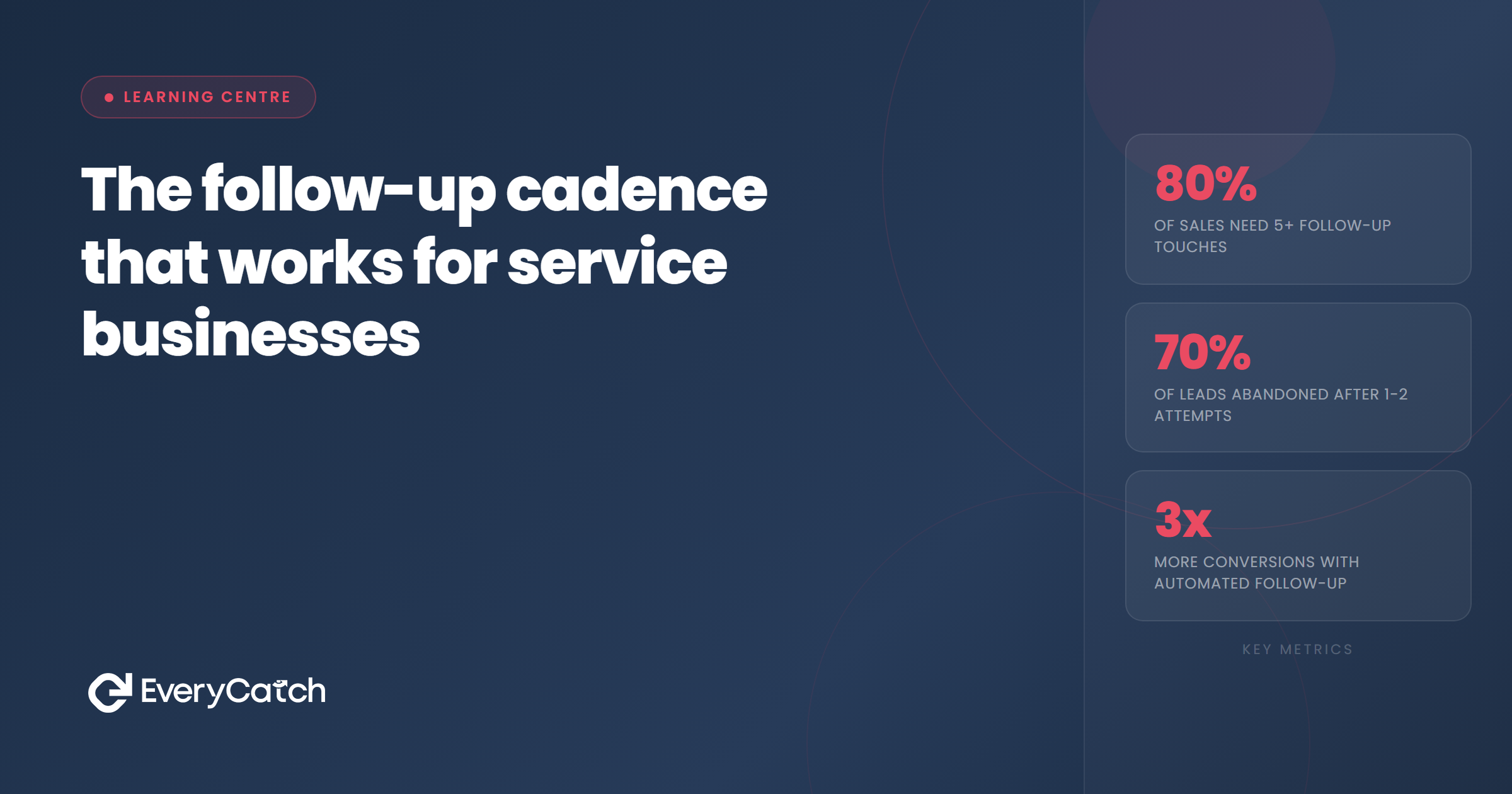

- The first 24 hours demand an immediate response plus at least one additional touchpoint before the end of the day
- Week one requires three to five total contacts across SMS, email, and voice to secure a booking
- Alternating channels keeps you present without feeling repetitive or intrusive to the prospect
- Each follow-up must provide value or new information, not just repeat your availability
- Automated cadences outperform manual follow-up because consistency matters more than perfect wording
Most service businesses lose leads between initial contact and booking because they follow up once, wait days for a reply, then assume the person isn't interested. The truth is simpler. People get busy, forget, or need more time to decide. A structured follow-up cadence solves this by keeping you visible without requiring guesswork or manual reminders.
A cadence is not the same as nagging. It's a pre-planned sequence of touchpoints, spread across different communication channels, designed to match how people actually make buying decisions. Service purchases rarely happen in a single conversation. The plumber who answers your Saturday morning call still needs to quote the job. The accountant who replies to your email still needs to book a discovery call. Each step takes time, and most people need gentle prompting to complete the process.
The best cadences reflect this reality. They acknowledge that booking a service involves friction: checking calendars, getting partner approval, comparing quotes. Your job is to reduce that friction by staying present at the exact moments when people are ready to take the next step.
What cadence actually means in practice
Cadence refers to the timing and rhythm of your follow-up attempts. It answers three questions: how many times do you follow up, when do you follow up, and which channel do you use each time. Without a cadence, most people default to following up whenever they remember, using whichever method feels easiest in the moment. This creates inconsistency, which directly harms conversion rates.
A proper cadence removes decision fatigue. You know in advance that every new lead receives a text within five minutes, a phone call within an hour, an email that evening, and a second text the following afternoon. You stop wondering whether you've followed up enough or waiting too long between attempts. The system decides for you.
Service businesses benefit from cadences more than most industries because your leads are often at the exact moment of need. Someone searching for an emergency electrician or a last-minute cleaner cannot wait three days for a response. Even less urgent jobs, like garden design or tax advice, lose momentum quickly. The person who filled out your contact form on Monday afternoon is far less motivated by Thursday morning, especially if three competitors have already replied.
The first 24 hours: where most conversions happen
Research on service industry leads shows that 78% of customers book with the first business that responds. This statistic shapes your entire approach. Speed is not a nice-to-have. It's the primary determinant of whether you win or lose the job.
Your first response should happen within five minutes. Not five minutes of business hours. Five minutes, full stop. This means either you answer your phone when it rings, you use an automated text-back system, or you lose a significant portion of your inbound leads. People interpret a fast reply as a signal of reliability. If you respond quickly during the sales process, they assume you'll show up on time and finish jobs promptly. If you're slow to reply, they assume the opposite.
After the initial response, you need at least two more touchpoints within the first 24 hours. One should be a phone call, ideally within the first hour. The other can be an email or a second text message, sent later the same day if you haven't yet connected. This structure ensures that even if the person misses your call or doesn't reply to your text, they see your name multiple times before the day ends.
The combination matters. A text confirms you received their enquiry and provides immediate reassurance. A phone call adds a human voice and allows you to qualify the lead. An email gives detail, often including pricing, testimonials, or case studies that help the person decide. Together, these three touchpoints make it nearly impossible for someone to forget about you or assume you're not interested.
Days two to seven: maintaining presence without pressure
If you haven't secured a booking within the first 24 hours, the person is either genuinely busy, comparing options, or not quite ready to commit. Your goal during days two to seven is to stay on their radar without creating annoyance. This is where channel rotation becomes essential.
On day two, send a text. Keep it short, friendly, and low-pressure. Something like "Hi Sarah, just checking you got my email yesterday. Happy to answer any questions. Andrew." This reminds them you exist without demanding an immediate decision.
On day four, try calling again. If they don't answer, leave a voicemail that references your previous attempts and offers a specific next step. For example: "Hi Sarah, it's Andrew from EveryCatch. I've sent over some info by email but thought I'd try you on the phone. If now's not a good time, just reply to my text and let me know when suits. Cheers."
On day six or seven, send a final email for this sequence. This one should introduce something new: a case study, a limited-time offer, or a piece of content that demonstrates your expertise. The goal is to provide value, not just repeat "Are you still interested?" This approach respects their time while making it clear that you're still available.
Are your leads slipping through the cracks?
We'll show you exactly where you're losing people and help you build a cadence that converts.
Book a free discovery callWeek two onwards: long-term nurture for high-value leads
Not every lead converts in the first week. Some service enquiries, particularly for large or complex jobs, require weeks or months of consideration. The mistake most businesses make is abandoning these leads entirely once the first week passes.
A long-term nurture cadence keeps you connected without requiring daily effort. After the initial seven-day sequence, shift to a fortnightly or monthly rhythm. These touchpoints should focus on education and relationship-building rather than direct selling.
Send a helpful article, share a recent project, or offer a seasonal tip relevant to your industry. For example, a landscaper might send an email in early spring titled "Three things to do now for a better summer garden." A bookkeeper might share a guide on tax deadlines six weeks before the end of the financial year. These messages remind the lead that you exist while positioning you as the expert they'll turn to when they're ready to buy.
Automated email sequences handle this work efficiently. You set up the content once, tag the lead as "long-term nurture," and let the system deliver each message at the right interval. The lead receives consistent value. You spend zero ongoing time managing the process.
Channel sequencing: why variety matters
Using the same communication method repeatedly reduces effectiveness. If you send five emails in a row, the person starts ignoring them. If you call three times in two days, they feel harassed. Alternating channels solves this problem while increasing your chances of connecting.
Different people prefer different channels. Some respond instantly to text messages but never check email. Others ignore phone calls but read every message in their inbox. By using all three methods, you meet people where they are rather than hoping they adapt to your preference.
A balanced cadence might look like this: text, call, email, text, call, email. Each method appears twice within the first week, giving every lead multiple opportunities to engage on their preferred channel. This variety also makes each touchpoint feel fresh rather than repetitive.
Text messages work best for short, timely updates. "Can you do Tuesday at 2pm?" fits perfectly in a text. A detailed quote with terms and conditions does not. Phone calls suit complex conversations: qualifying needs, handling objections, or explaining pricing. Emails work well for longer content, attachments, and anything the person might need to reference later.
When you match the message to the medium, people respond more often. A text asking for a quick yes or no gets higher reply rates than an email asking the same question. An email with a detailed project proposal gets more engagement than a voicemail trying to explain the same information.
What to say at each touchpoint
Content matters as much as timing. A well-structured cadence with poor messaging still fails. Each touchpoint needs a clear purpose and a reason for the person to engage.
Your first text should acknowledge their enquiry and set expectations. "Hi James, thanks for getting in touch about your kitchen renovation. I'll give you a call in the next hour to discuss your plans. Andrew." This message confirms receipt, promises a next step, and uses their name. It feels personal even though it's automated.
Your first call should focus on understanding their needs rather than selling. Ask questions, listen carefully, and take notes. If you don't reach them, leave a voicemail that feels conversational, not scripted. "Hi James, it's Andrew from EveryCatch. I got your message about the kitchen. I'll try you again later, but if you want to chat before then just reply to my text or give me a call back. Cheers."
Your follow-up email should provide something useful. Include pricing if you can, testimonials from similar projects, and a clear call to action. "Hi James, great to speak earlier. As discussed, I've attached a rough quote based on what you described. I've also included a couple of photos from a kitchen we finished last month that sounds similar to yours. Let me know if you have any questions. Andrew."
Subsequent messages should introduce new angles. Day two might reference availability: "Just wanted to mention I've got a gap in my schedule next Thursday if you'd like to lock that in." Day four might address common objections: "A quick note on timing, most kitchen projects like yours take around six weeks start to finish." Day seven might add urgency without being pushy: "I'm finalising my schedule for next month, so if you're keen to get started soon just let me know."
Every message should make it easy to respond. Include a question, offer two clear options, or suggest a specific next step. "Does Tuesday or Wednesday work better?" gets more replies than "Let me know when you're free."

From the EveryCatch team
We've spent years helping service businesses turn more leads into customers. The cadences we build are based on real conversion data from electricians, plumbers, cleaners, accountants, and dozens of other trades. If you'd like help setting yours up, we'll do it for you.