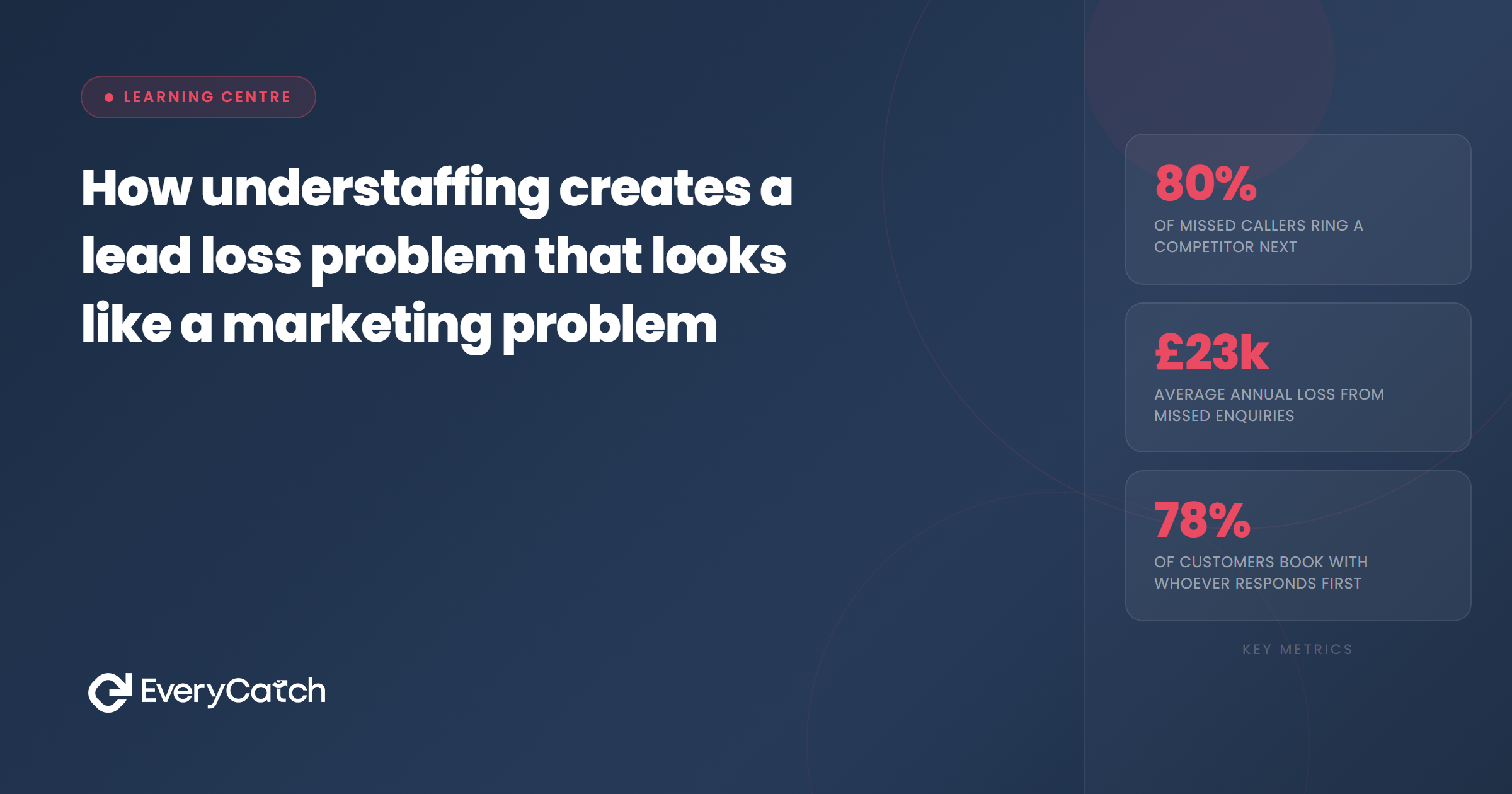

- Understaffing and weak marketing produce identical symptoms at the bank account, so most owners blame the wrong one.
- The difference shows up in one place only: the gap between enquiries received and enquiries answered.
- Businesses that answer under half their inbound calls often conclude their ads have stopped working, when the ads are performing fine.
- Spending more on marketing while understaffed makes the problem worse, because it increases the volume of leads nobody answers.
- You can close most of the gap with automated response systems long before you can afford another member of staff.
A plumber spends £800 a month on Google Ads. Six months ago the phone rang constantly and the diary was full. Now the diary has gaps, so he calls his marketing agency and asks what changed. The agency shows him the numbers. Clicks are up, calls generated are up, and cost per lead is down. The marketing is working better than ever. What changed is that he lost an office manager in March, and since then nobody answers the phone when he is under a sink.
This pattern repeats across trades, clinics, salons and agencies. The business feels quieter, so the owner concludes the marketing has weakened. The real fault sits further down the pipeline, at the point where a lead tries to make contact and nobody responds. Understaffing does not announce itself as understaffing. It announces itself as fewer jobs, and fewer jobs looks exactly like a marketing problem.
Why understaffing wears a marketing disguise
Most owners only measure the two ends of the funnel. They know roughly what they spend on marketing, and they know what lands in the bank. Everything in between is invisible. When revenue dips, the only lever they can see is the marketing spend, so that is where the blame lands.
The middle of the funnel is where understaffing does its damage. A lead clicks your ad, likes your website, and calls. If the call rings out because your one office person is on lunch, on another call, or no longer employed, that lead vanishes. Your marketing report records a successful conversion. Your bank account records nothing. The marketing did its job and the business dropped the baton, but from the owner's seat both failures look the same.
There is a second layer to the disguise. Understaffed teams do not just miss calls. They reply to web enquiries a day late, forget to send quotes, and stop chasing the people who said "let me think about it". Each of those failures shaves conversion a little further, and none of them appear in any report the owner reads. We covered the raw numbers in how to calculate what missed leads cost your business, and the totals surprise almost everyone who runs them.
The three ways understaffing actually loses leads
The first is unanswered contact. Calls ring out, voicemails go unheard, and web forms sit in an inbox. Industry studies consistently find that a large share of callers who reach voicemail simply hang up and ring the next business on the list. They are not being disloyal. They have a leak, a toothache or a deadline, and they want whoever answers first.
The second is slow response. An understaffed business does eventually reply, often that evening or the next morning. By then the lead has spoken to two competitors and may have already booked. Speed matters more than most owners believe, and the drop-off between a five minute response and a next-day response is steep. Leads contacted within minutes convert at several times the rate of leads contacted the following day.
The third is abandoned follow-up. Following up with warm leads is the first task that dies when a team is stretched, because nothing breaks visibly when you skip it. The quote that never got chased does not send an error message. It just quietly becomes someone else's customer. We explore this failure mode in more detail in why warm leads go cold when nobody follows up.
Not sure if it's your marketing or your response?
We will look at where your enquiries come from and where they die, then show you exactly what a response system would catch.
Book a free discovery callHow to diagnose which problem you actually have
The test is straightforward. For two weeks, count every enquiry that reaches your business through any channel: calls, missed calls, voicemails, web forms, emails, WhatsApp messages and social enquiries. Then count how many of those received a reply within one hour, and how many were never answered at all.
If total enquiries have genuinely fallen compared with six months ago, you may have a marketing problem, and your agency or your ad account deserves the scrutiny. If enquiries are steady but your answered-within-the-hour figure is poor, you have a capacity problem, and no amount of marketing spend will fix it. Most understaffed businesses that run this exercise discover they are answering fewer than half of their inbound calls on the first attempt.
Your phone system makes part of this easy. Most providers show missed call counts, and the number is usually higher than the owner guesses. If you want a fuller picture, auditing where your leads are leaking walks through the whole exercise channel by channel.
What misdiagnosis costs you
The obvious cost is the lost jobs themselves. If you generate forty enquiries a month, answer half promptly, and your average job is worth £400, the leak is worth several thousand pounds a month before you count repeat business or referrals.
The less obvious cost comes from the wrong fix. An owner who misreads understaffing as weak marketing typically increases ad spend, switches agencies, or commissions a new website. Each of those pours more leads into a funnel that cannot process the leads it already has. The cost per acquired customer climbs, the owner grows more frustrated, and the agency gets fired for a problem it never caused. Some businesses cycle through three agencies before anyone counts the missed calls.
There is also a quieter reputational cost. Every unanswered enquiry is a person who now believes your business is unresponsive, and people talk. In small local markets that impression compounds.
Fixing the leak without hiring anyone
Hiring is the obvious answer and often the right long-term one, but a full-time office hire costs £22,000 or more a year, and many businesses in this position cannot fund one yet. Partly because they keep losing the leads that would pay for it.
The good news is that most of the leak can be closed with systems rather than salaries. An automatic text back to every missed call keeps the lead engaged in the seconds when they would otherwise ring a competitor, and something as simple as "Sorry we missed you, we're on a job. What do you need?" holds a remarkable share of callers. Instant automated replies to web forms and messages do the same for written enquiries. Structured follow-up sequences then chase quotes and warm leads without anyone needing to remember to do it. This is exactly the problem EveryCatch was built to solve, and tools such as missed call text back exist precisely because understaffed businesses lose leads at the point of contact, not at the point of advertising.
None of this replaces good staff. It buys you time, catches what your current team physically cannot, and often generates enough recovered revenue to fund the hire you actually need. Get the response system in place first, then judge your marketing on honest numbers.

From the EveryCatch team
EveryCatch helps service businesses catch and convert the enquiries they already generate, from missed call text back to automated follow-up. We write these guides so owners can diagnose their own lead leaks honestly, whether they work with us or not.