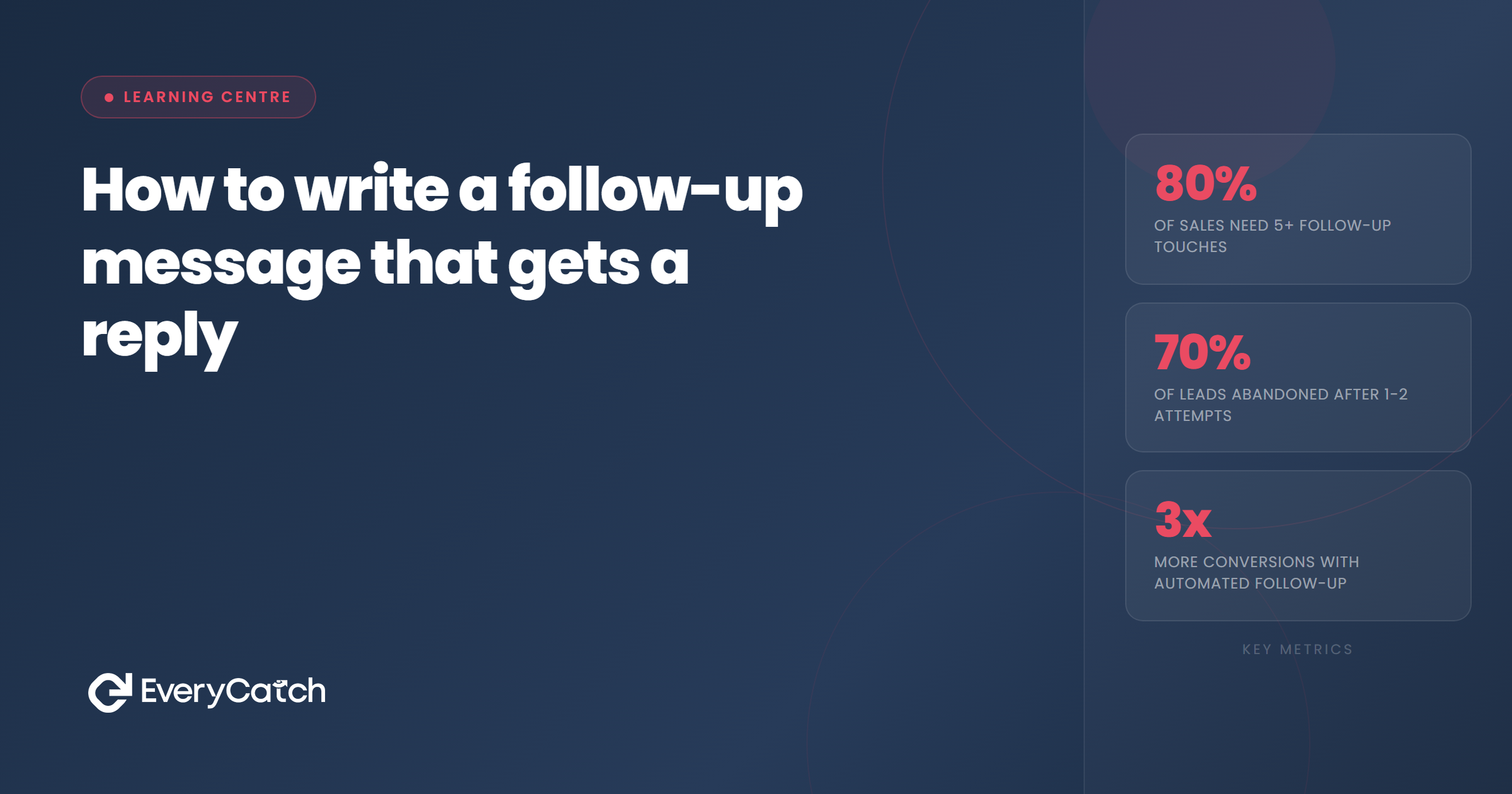
- Most follow-up messages fail because they focus on what you want, not what the recipient needs
- The best structure is context, value, and easy action in under 100 words
- Timing matters: send the first follow-up within 24 hours, the second after 3 days, the third after a week
- Match your channel to how they first contacted you, or use SMS for immediacy
- Avoid apologising for following up, writing long paragraphs, or making vague asks
Why most follow-up messages fail
The problem is not that you are following up. The problem is how you follow up.
Most follow-up messages fail because they sound like obligations. "Just checking in." "Following up on my last email." "Circling back." These phrases tell the recipient nothing new and give them no reason to respond. They signal that you have nothing valuable to say and you are simply hoping they will reply out of guilt or politeness.
The second reason follow-ups fail is length. If your message requires scrolling, you have already lost. People scan their messages in seconds. If they cannot understand what you want and why it matters in that first glance, they move on.
The third reason is lack of specificity. Generic messages like "Let me know if you're still interested" do not work because they require the recipient to do all the thinking. What are they supposed to be interested in? What happens next? Why should they care today instead of next week?
The follow-up messages that get replies do three things: they remind the recipient who you are and what you discussed, they offer something valuable, and they make it easy to respond. Everything else is noise.
The three-part structure
A follow-up message needs three components, in this order.
First, context. Remind them who you are and when you last spoke. Make this short, specific, and relevant. "We spoke last Tuesday about your kitchen extension" works better than "I'm following up on our conversation." The specific detail proves you remember them as an individual, not a number in your CRM.
Second, value. Give them a reason to respond today. This could be new information, an answer to a question they asked, a link to something you promised, or a clear benefit. "I've found three suppliers who can deliver the tiles you liked within your budget" is value. "Have you made a decision yet?" is not.
Third, an easy action. Tell them exactly what to do next, and make it simple. "Reply with yes if you'd like me to send quotes" is clear. "Let me know your thoughts when you get a chance" is vague. The easier you make it to respond, the more likely they will.
This structure keeps messages under 100 words. Short messages get read. Long messages get skimmed, then ignored.
An example that works
Here is what this structure looks like in practice:
"Hi Sarah, we spoke on Monday about repairing the damp in your loft. I've checked with our surveyor and we can start week of the 15th. Does that suit? Reply YES and I'll send the full quote."
Sixty-one words. Context, value, clear action. The recipient knows who you are, what you can do for them, and how to move forward. They can reply in one word.
Tired of writing follow-ups that get ignored?
See how EveryCatch automates your entire follow-up sequence so every lead gets a response.
Book a free discovery callWhen to send it
Timing is the difference between persistence and pestering.
Send your first follow-up within 24 hours of the initial contact. This is when your conversation is still fresh in their mind. Wait longer and you become just another name in their inbox.
If you get no reply, send a second follow-up three days later. This message should add new value, not repeat the first one. Share something helpful, answer a question they might have, or remove a barrier. "I realised you asked about payment plans. We can split it into three instalments, no interest."
If you still hear nothing, send a third message one week after the second. This is your breakup message. Make it short, polite, and final. "Hi John, I haven't heard back so I'm guessing now isn't the right time. I'll close your enquiry, but reply any time if things change."
The breakup message gets replies. It works because it removes pressure and gives people permission to say no. Some people respond because they appreciate the clarity. Others respond because they realise they are about to lose the option.
After three attempts over ten days, stop. Sending more messages does not increase replies. It just damages your reputation. How many times you should follow up depends on the value of the job and how the lead came to you, but three is the standard for most service businesses.
Which channel to use
The channel you use changes how people respond.
If the lead contacted you by email, reply by email. If they called, send a text. If they filled in a web form, check if they gave a mobile number. SMS gets read faster than email, and reply rates are higher.
Text messages work because they are personal, immediate, and low-effort. An email requires opening an app, reading a subject line, and deciding to engage. A text just appears. The barrier to response is lower, so more people reply.
That said, texts only work if they sound like texts. Do not send a 300-word formal letter by SMS. Keep it conversational, brief, and direct. "Hi Dave, spoke earlier about your boiler. Can book you in for Thursday 10am. That work?" is a text. "Dear Mr Thompson, further to our telephone conversation this morning" is not.
Email works for detailed information, quotes, and formal confirmations. Use it when the reply needs to include documents or when you are sending something the customer will want to keep. But for quick nudges and check-ins, SMS wins.
Common mistakes to avoid
Do not apologise for following up. "Sorry to bother you again" makes you sound like an inconvenience. You are not bothering them. You are offering a service they enquired about. Confidence matters.
Do not ask if they received your last message. They did. Their inbox works. If they did not reply, it is because they were not ready, not because the message got lost. Asking this question wastes words and makes you sound uncertain.
Do not write long paragraphs. Every sentence you add reduces the chance of a reply. Cut ruthlessly. If it does not add context, value, or make the action clearer, delete it.
Do not use pressure tactics. "This offer expires tomorrow" or "I can only hold the slot until Friday" might work in some industries, but they backfire in service businesses where trust matters. People do not want to feel rushed into hiring a tradesperson. Urgency works when it is real, not manufactured.
Do not ask open-ended questions like "What are your thoughts?" or "Do you have any questions?". These force the recipient to do work. Make it binary. "Does Tuesday work?" or "Want me to send the quote?" get answers. Vague questions get ignored.
Ready-to-use templates
Here are templates you can adapt to your business. Swap in your details, but keep the structure.
First follow-up (24 hours)
"Hi [Name], we spoke yesterday about [specific job]. I've checked availability and can start [date]. Want me to send a quote? Just reply YES."
Second follow-up (3 days later)
"Hi [Name], just a quick one. I know you were worried about [concern they mentioned]. We've done [number] similar jobs in [area], happy to share photos. Let me know if that helps."
Third follow-up (breakup message, 7 days later)
"Hi [Name], haven't heard back so guessing now's not the right time. I'll close your enquiry but feel free to get in touch if things change. No pressure."
After a quote is sent
"Hi [Name], quote sent over this morning. Main thing is [key benefit or detail]. Any questions, just reply. Otherwise let me know if you'd like to go ahead."
After a site visit
"Hi [Name], thanks for showing me round today. As discussed, I'll get the quote to you by [day]. Anything else you need in the meantime, just shout."
These templates work because they are short, specific, and easy to respond to. Adapt the details but keep the principles. Context, value, action.

From the EveryCatch team
We help service businesses turn more enquiries into paying customers by automating follow-ups, replies, and appointment booking. Every system is built around what actually gets responses, not what sounds professional.