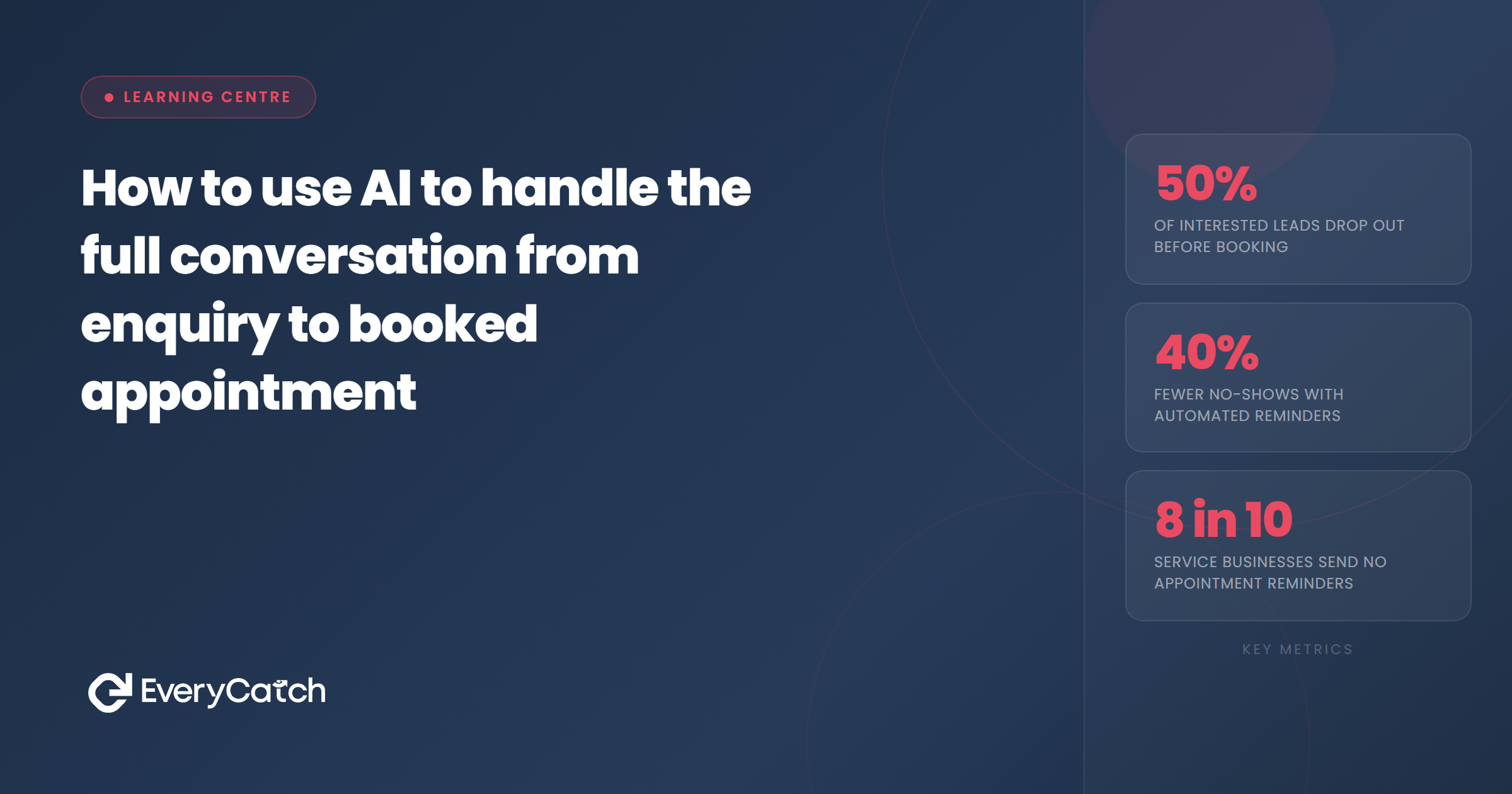

- AI can handle the complete enquiry-to-booking conversation without a human in the loop for every step.
- It responds in seconds, which is the single biggest factor in whether a lead converts.
- Qualification happens through natural conversation, not a clunky intake form.
- The handoff to a human happens at a defined point, not randomly, so nothing gets lost.
- The booked appointment lands directly in your calendar, confirmed and ready.
The honest answer is that AI handles this conversation the same way a skilled receptionist would, except it never finishes its shift. When a prospect sends their first message, regardless of the time or day, AI responds within seconds. It greets them, establishes what they need, asks qualifying questions, checks availability, and books the appointment. The whole exchange can take under two minutes, and the customer never knows they're not talking to a person.
Most service businesses lose leads not because they gave a bad quote, but because they didn't respond fast enough. A prospect who sends a message at 9pm is often ready to book. If they get a reply the next morning, they may have already moved on. Understanding why the booking step loses more leads than most businesses realise is the first step to fixing it.
What AI actually does during the enquiry conversation
An AI-powered enquiry handler is not a chatbot with a fixed script. It reads the incoming message, identifies intent, and responds naturally. If a prospect says "I need someone to fix a leaking pipe this week," the AI recognises this as an urgent service request, not a general enquiry, and responds accordingly. It might confirm the type of work, ask for the address or postcode, check whether mornings or afternoons suit better, then offer two or three available slots.
The AI works from the context you give it during setup. You define what services you offer, what questions need asking before a booking can be made, what your available hours look like, and what the customer should be told once they confirm. That context shapes every conversation without you having to write individual scripts for every scenario.
The speed-to-lead capability underpinning this is what makes it commercially effective. It is not just about convenience. Studies consistently show that the likelihood of converting a lead drops sharply with every minute of delay. AI eliminates that delay entirely.
How the AI-to-booking conversation flows step by step
The process follows a predictable shape, even though the language adapts to each person. The AI receives the first message, identifies whether it is a genuine enquiry or something else (a complaint, an existing customer question, a wrong number), and routes accordingly. For genuine new enquiries, it moves into qualifying mode.
Qualifying does not mean interrogating. The AI asks the two or three questions that genuinely matter for your business. A cleaning company might need to know the property size and type. A physiotherapy clinic might need to know what the issue is and whether it is a new or returning patient concern. The AI gathers this through natural back-and-forth, not a form.
Once it has what it needs, it presents available slots. The customer picks one, the AI confirms, sends a summary to the customer, and the appointment appears in your calendar. From the prospect's point of view, it felt like a quick, easy conversation with someone who knew what they were talking about.
AI enquiry qualification: getting the right information without friction
One of the reasons AI-handled conversations convert better than static booking forms is that questions feel conversational. A form asks ten fields at once and loses people before they finish. A conversation asks one thing, gets an answer, asks the next, and builds momentum.
The qualification questions also serve a business purpose beyond data collection. They signal to the prospect that you care about the details. A business that asks "is this a residential or commercial property?" before booking comes across as organised and experienced. A business that just says "pick a slot" from a calendar feels transactional.
Want to see how AI handles your specific enquiries?
Book a free call and we'll show you what an automated enquiry-to-booking conversation looks like for your type of business.
Book a free discovery callWhere the handoff to a human happens
AI handles the routine well, but every business has situations that genuinely need a person. The key is defining those situations in advance rather than letting the AI guess. Complex pricing discussions, complaints, requests that fall outside your normal service area, and customers who explicitly ask to speak with someone, these are the moments where the conversation routes to a human. The AI flags the conversation, sends a notification, and the customer is told someone will be in touch shortly.
The handoff is clean because the human who picks it up can see the full conversation history. They do not start from scratch. They know what the customer needs, what has already been discussed, and what the next step is. That continuity is what makes the hybrid model work without annoying customers.
For the vast majority of service enquiries, though, the handoff never happens. The AI qualifies, books, confirms, and closes the loop without anyone needing to step in. That is the point.

From the EveryCatch team
EveryCatch is built for service businesses that are tired of losing leads to slow response times and manual booking processes. The system handles enquiry conversations automatically, so your calendar fills without you having to be available at every hour of the day.