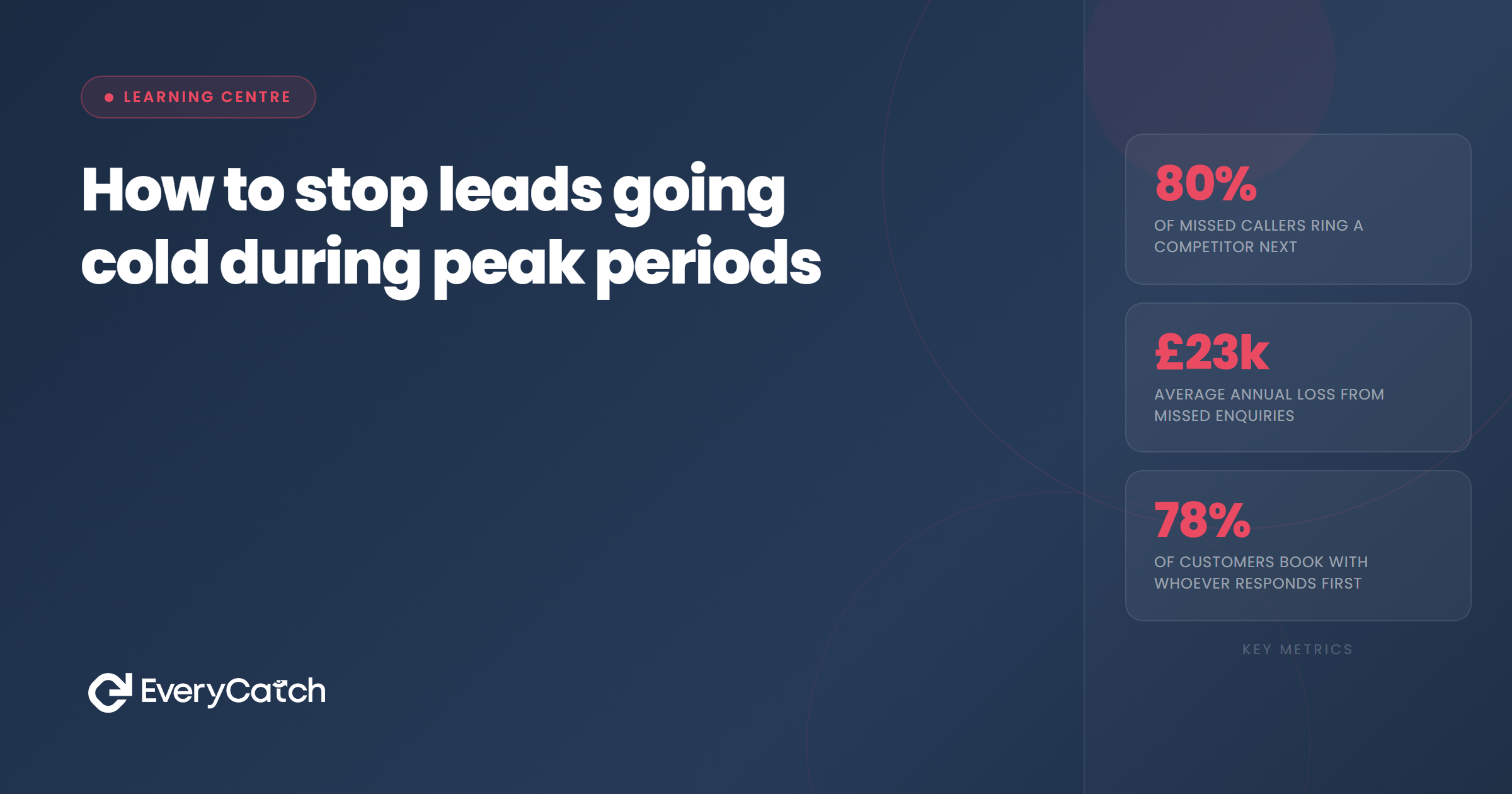

- Leads go cold fastest during peak periods because response times stretch exactly when enquiry volume spikes.
- An automated first reply within minutes holds a lead's attention even when you cannot speak to them for hours.
- Triage enquiries by urgency and value so your limited time goes to the leads most likely to book.
- Short automated follow-up sequences keep leads warm while you are on the tools, without any extra admin.
- Leads that go quiet during a rush are not dead, and a post-peak reactivation message recovers a surprising share of them.
Peak periods are cruel. The weeks when your phone rings most are the same weeks you have the least time to answer it. A heating engineer in the first cold snap of November, a landscaper in April, an accountant in January, all of them face the same problem. Demand surges, response times collapse, and enquiries that would have become paying customers in a quiet month simply drift away to a competitor who replied first.
The frustrating part is that you never see it happen. Nobody emails to say they went elsewhere. The lead just goes quiet, and by the time you get around to calling back, the job is gone. Stopping that pattern does not require hiring staff or working longer days. It requires a system that responds for you when you cannot.
Why peak periods kill more leads than quiet ones
The maths works against you twice during a busy spell. Enquiry volume goes up, so there are more leads to handle. At the same time, your availability goes down, because you are actually doing the work those leads represent. Every hour of delay hits a bigger pile of enquiries than it would in a quiet week.
Buyer behaviour makes it worse. During peak season, your customers are usually contacting several businesses at once, because they know everyone is busy and they want whoever can fit them in. Research on lead response has shown for years that the first business to reply wins a disproportionate share of the work. When a homeowner has messaged three plumbers about a boiler that failed this morning, the one who responds in five minutes usually gets the job. The one who responds tomorrow gets nothing. We covered the wider cost of this in how much missed leads really cost your business, and the numbers are worst in exactly the months you feel too busy to care.
Plan for your peaks before they arrive
Most service businesses know when their busy periods fall. Trades see them around weather changes and holidays. Professional services see them around deadlines and year ends. Yet very few businesses change anything about how they handle enquiries when those periods start. They simply absorb the chaos and accept the losses.
Look back at last year's enquiries and jobs. Identify the four to eight weeks when volume was highest, then check what happened to your response times during them. If you cannot measure that, treat it as a warning sign in itself, because you cannot fix a leak you cannot see. Even a rough count of calls that went to voicemail during your last rush will tell you how much work is escaping. Once you know your peaks, you can put the next three steps in place before the surge, not during it.
Automate the first reply so nobody waits in silence
The single biggest change you can make is guaranteeing that every enquiry gets a response within a few minutes, regardless of what you are doing. This does not mean you personally reply instantly. It means an automated message goes out the moment someone calls and gets no answer, fills in your website form, or messages your Facebook page.
The message does three things. It confirms their enquiry landed, which stops them assuming you are ignoring them. It sets an honest expectation, such as telling them you are on a job and will call back by a specific time. And it asks a useful question, like what the job involves or what postcode they are in, which starts a conversation and gives you information before you even pick up the phone. A missed call that triggers an instant text behaves completely differently from a missed call that rings out. One holds the lead in place. The other sends them straight to the next name on Google. There is a fuller breakdown of this in what is missed call text back and how does it work.
How many leads did your last busy season cost you?
A fifteen minute call is enough to work out where enquiries are slipping through and what an instant-response setup would look like for your business.
Book a free discovery callTriage enquiries so your time goes where it earns most
When you finally get twenty minutes between jobs, you should not be working through enquiries in the order they arrived. Some leads are worth ten times more than others, and some will book with whoever answers first while others are happy to wait a week. Peak periods demand a rough triage.
Sort incoming enquiries into three buckets. Urgent and valuable leads, such as an emergency job or a large quote request, get a personal call at the first opportunity. Standard enquiries get a proper reply the same day, even if that reply is a text arranging a call for tomorrow. Low-value or vague enquiries can sit with the automated sequence a little longer. If your automated first message asks a qualifying question, the replies do the sorting for you. You open your phone to a list of enquiries that have already told you what they need, which turns triage into a thirty second scan instead of a round of guesswork calls.
Keep follow-up running while you are flat out
A single reply is rarely enough, even when it lands quickly. People get distracted, especially the ones whose problem is not urgent. In a quiet month you might remember to chase them. In a peak month you will not, and you should not have to. This is where a short automated follow-up sequence earns its keep.
A simple structure works well. Send the instant acknowledgement, then a check-in the next day if they have not replied, then a final nudge two or three days later. Three touches, spaced out, polite and brief. Each message should feel like it came from a busy human rather than a machine, and the moment the lead replies, the sequence stops and a real conversation takes over. Businesses running this kind of sequence consistently convert leads that would otherwise have evaporated, and the whole thing costs zero minutes of your day. If you want to build one properly, how to build a follow-up sequence that converts goes through it step by step.
Recover the leads that still slipped through
Even with a good system, some leads will go quiet during a rush. Do not write them off. A lead who enquired three weeks ago and heard nothing useful is not necessarily lost. Some of them never solved their problem. Others had a poor experience with whoever they chose instead.
Once the peak eases, send a short reactivation message to everyone who enquired but never booked. Keep it human and low pressure. Something as simple as asking whether they still need the work done, and mentioning that your diary has opened up, is enough. Response rates on these messages surprise most business owners, and every recovered lead is revenue you had already paid to attract through your marketing. It also smooths your cash flow, because peak-season leads recovered after the rush help fill the quieter weeks that follow. A pipeline view that shows every open enquiry in one place makes this exercise take minutes rather than an afternoon of digging through voicemails and old texts.

From the EveryCatch team
EveryCatch helps service businesses catch every enquiry with instant responses, automated follow-up, and a clear view of every lead in play. We write these guides so busy owners can fix the leaks in their pipeline, whether they use our platform or build it themselves.