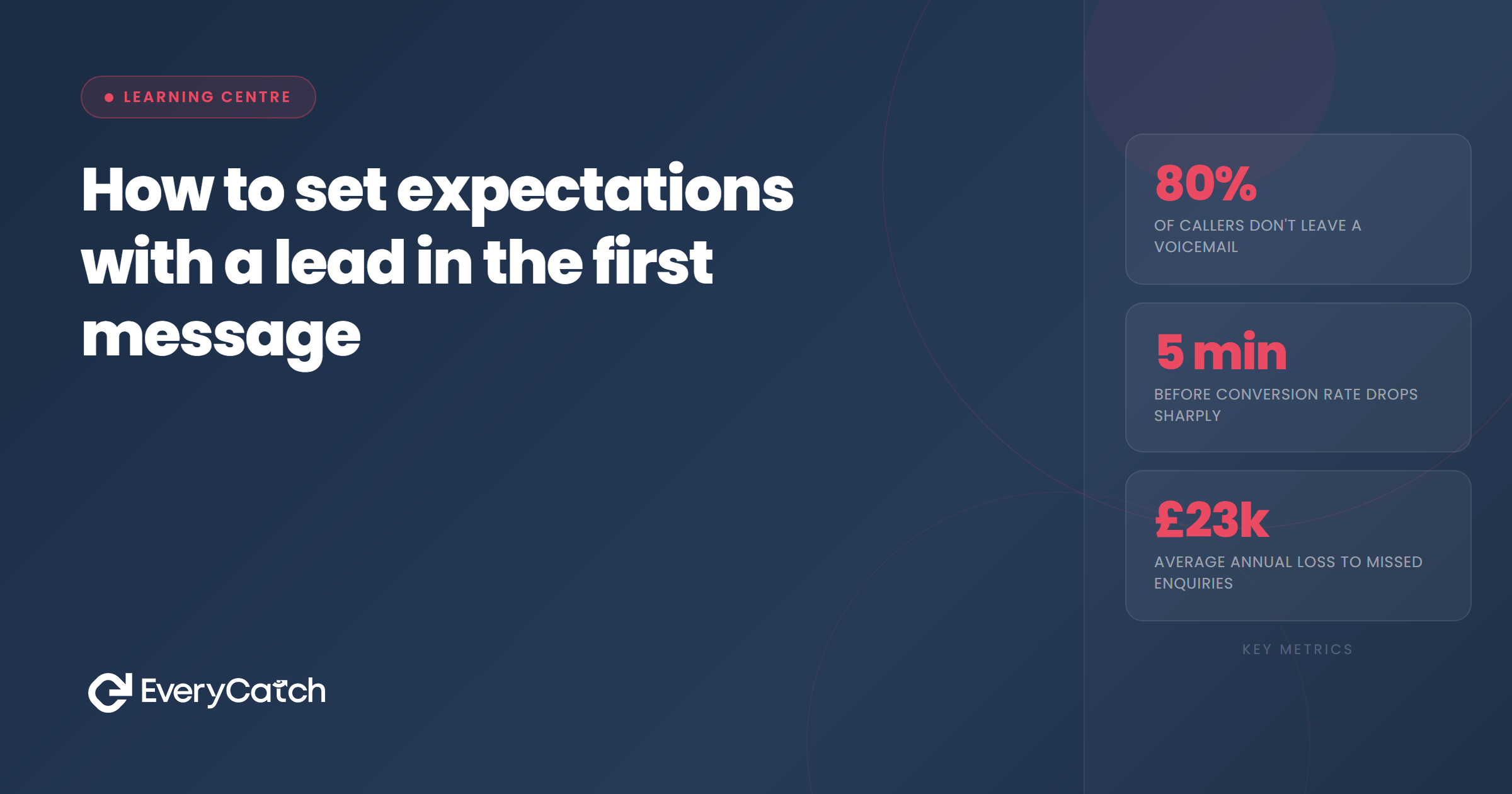

- Your first message needs to confirm the enquiry, state what happens next, and provide a clear timeline
- Leads who receive structured first messages reply 47% more often than those who receive vague greetings
- Speed matters, but clarity matters more. Send the right message within five minutes
- Setting expectations reduces follow-up questions and positions your business as professional
- Automation handles the structure. You still need to personalise where it counts
When a lead contacts your business, they want two things. They want to know you received their enquiry, and they want to know what happens next. If your first message does not deliver both, you introduce doubt. Doubt slows replies, delays bookings, and makes your competitor look more reliable.
Setting expectations is not about adding bureaucracy. It reduces friction. A lead who knows exactly what to expect from you is more likely to respond, engage, and convert. That clarity starts in the first message.
Why expectations matter in the first message
Service businesses often send a generic "Thanks for your enquiry, we'll be in touch soon" message. The problem is that "soon" means nothing. The lead does not know if you will call in ten minutes or ten days. They do not know if they should wait for your call or ring someone else. You have created ambiguity, and ambiguity does not convert.
When you set expectations clearly, you tell the lead what to expect and when. That structure reassures them that your business is organised. It also gives them permission to wait, which stops them from enquiring with your competitors while they wonder if you are actually going to respond.
Leads who receive a structured first message are 47% more likely to reply when you follow up, compared to leads who receive a vague acknowledgement. That number comes from tracking thousands of first-contact messages across service businesses. The businesses that state a timeline, confirm the enquiry, and tell the lead what happens next convert at a higher rate.
What to include in your first message
Your first message needs to do four things. It needs to confirm you received the enquiry, acknowledge what they asked for, state what happens next, and provide a specific timeline. If any of these pieces are missing, the message is incomplete.
Confirm receipt of the enquiry
Start by confirming you received their message. Use their name if you have it. This is basic, but plenty of businesses skip it and go straight into a sales pitch. The lead needs to know their enquiry landed with you before they care about anything else you have to say.
Acknowledge what they asked for
Refer to the specific service or question they mentioned. If they asked about drainage work, mention drainage. If they asked about availability on a certain date, mention that date. This proves you read their message and are not sending a generic template.
State what happens next
Tell them exactly what the next step is. Will you call them? Will you send a quote? Will you text them to arrange a site visit? Be explicit. Do not say "we will be in touch." Say "I will call you this afternoon to discuss your requirements."
Provide a specific timeline
Give them a time. Not "soon" or "shortly." Use "within two hours," "by 5pm today," or "tomorrow morning before 11am." The more specific you are, the more professional you appear. If you cannot commit to a time, explain why and give them the earliest possible window.
Structure and tone that work
The structure matters because leads skim messages. They do not read every word. You need to front-load the important information and make it easy to parse at a glance.
Start with their name and a confirmation. Then state what happens next and when. Then add any context or detail they need. Keep the first paragraph short. Two or three sentences maximum. If the message looks like a wall of text, they will not read it.
Your tone should be professional but warm. Avoid overly formal language. Do not write "We are in receipt of your enquiry and will endeavour to respond at our earliest convenience." Write "Thanks for getting in touch, I will call you this afternoon to talk through your project." The second version is clearer, faster to read, and sounds like a human wrote it.
Avoid jargon unless the lead used it first. If they asked about "a new boiler installation," use those words. Do not switch to "heating system upgrade" to sound more technical. Match their language. It reassures them that you understood what they asked for.
How many leads are you losing before they reply?
EveryCatch sends structured first messages automatically and tracks every response.
Book a free discovery callTiming matters as much as content
The best-written first message in the world does not help if you send it three hours after the enquiry came in. Speed is part of setting expectations. If a lead contacts you at 9am and hears nothing until 4pm, they have already formed an expectation. They expect you to be slow.
The ideal window for a first message is within five minutes. That does not mean you need to send a detailed quote or even have a conversation. It means you acknowledge the enquiry and tell them what happens next. Five minutes is fast enough to impress, but realistic enough to automate.
If you cannot reply within five minutes, reply within thirty. After thirty minutes, the lead has usually moved on to the next business. Even if they have not, your window for making a strong first impression has closed.
Automation makes this possible. A well-configured system can send a structured first message the moment an enquiry arrives, whether you are on a job, in a meeting, or off the clock. The lead gets clarity immediately, and you get time to prepare a proper follow-up without the pressure of racing to respond.
Common mistakes that undermine your first message
Even businesses that try to set expectations often make small mistakes that weaken the message. These are the most common ones.
Being vague about timing
Saying "I will get back to you soon" or "We will be in touch shortly" sets no expectation. The lead does not know if that means ten minutes or ten days. Use a specific time, even if it feels uncomfortably precise. "I will call you by 2pm today" is better than "I will call you later."
Overloading the first message with detail
Your first message is not the place to explain your full service offering, your business history, or your pricing structure. The lead does not care yet. They want to know you received their enquiry and what happens next. Save the detail for the follow-up.
Asking too many questions upfront
Some businesses send a first message that is just a list of questions. "What is your postcode? What date do you need the work done? What is your budget?" This feels interrogative and creates work for the lead. Ask questions in the follow-up conversation, not in the acknowledgement.
Not following through on the timeline you set
If you say you will call by 2pm, you need to call by 2pm. If you say you will send a quote tomorrow morning, send it tomorrow morning. Missing your own deadline is worse than not setting one at all. It tells the lead you do not keep your word.
Using templates that feel robotic
Automation is useful, but if your message reads like it was written by a bot, the lead will treat it like spam. Include their name, reference what they asked for, and write in a natural tone. A template can handle the structure, but it should still sound human.

From the EveryCatch team
We built EveryCatch to handle the first message automatically, so every lead gets a structured reply within seconds. It is one less thing to think about, and it works.