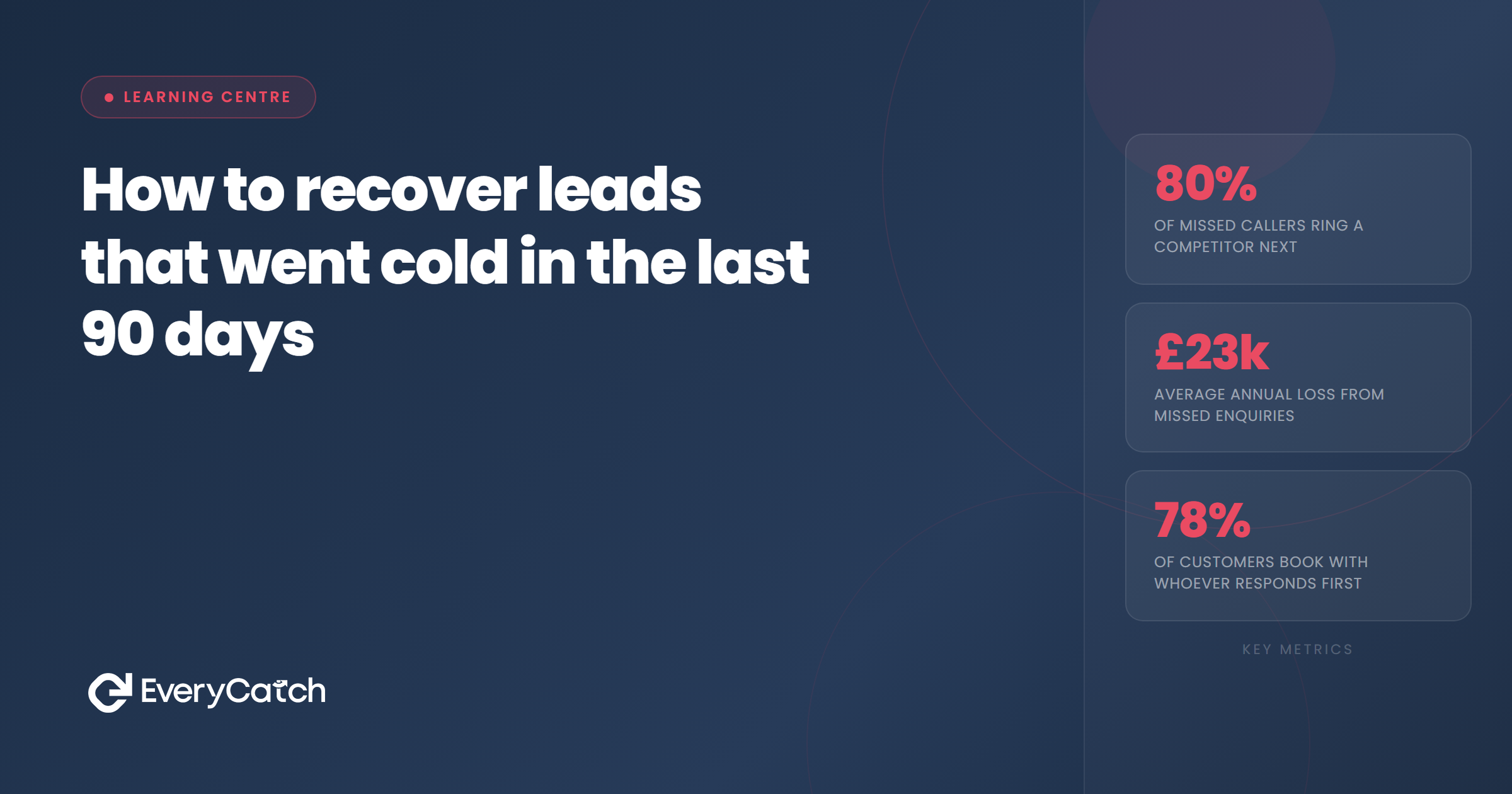

- Leads that went cold within 90 days are still warm enough to recover, because most of them never bought from anyone.
- Start by pulling every unclosed enquiry from your inbox, missed calls, texts and social messages into a single list.
- A short, honest text message outperforms a polished email. Ask a simple question that is easy to answer.
- One message is not a campaign. Plan two or three touches over ten to fourteen days before you close the file.
- Recovery is a one-off fix. An automated follow-up system stops leads going cold in the first place.
Somewhere in your inbox, your call log and your Facebook messages sits a group of people who asked you for a quote in the last three months and never heard back, or heard back once and then nothing. They did not say no. The conversation just stopped. That group is the cheapest source of new work you have, because you have already paid to attract them.
Recovering them is not complicated. It takes a list, a message, and the discipline to follow up more than once. Here is how to do it properly.
Why the 90-day window matters
Leads decay, but they decay more slowly than most owners assume. Someone who enquired last week is hot. Someone who enquired ten weeks ago is lukewarm, but research on buying cycles for home services and local trades consistently shows that a large share of enquirers have still not purchased three months later. They got busy, they got distracted, or every firm they contacted was equally slow to reply, so nobody won the job.
Beyond 90 days, the odds drop sharply. The customer has either bought elsewhere, shelved the project, or forgotten the details of what they asked for. Inside 90 days, they still remember you, they still remember the problem, and a message from you reads as helpful rather than random. That is why this window deserves a focused effort rather than a vague intention to get round to it.
Build the list before you write a word
Most cold leads go cold because they were scattered across five different places. Recovering them starts by getting them into one place. Set aside an hour and work through each channel in turn.
- Search your email inbox for words like quote, price, availability and enquiry, going back 90 days.
- Scroll your phone's call log for missed calls and calls from numbers you never rang back.
- Check text messages, WhatsApp, Facebook Messenger and Instagram DMs for conversations that trail off.
- Open any web form or directory account, such as Checkatrade or Bark, and export unanswered enquiries.
For each lead, record the name, the contact details, what they asked about, and roughly when they enquired. A spreadsheet is fine. The point is a single list you can work through, not a perfect database. If this exercise turns up more names than you expected, that is normal. Our article on auditing your business for missed leads explains why the true number is nearly always higher than owners guess.
Send a message that is easy to answer
The reactivation message has one job, which is to restart the conversation. It does not need to sell, apologise at length, or explain why you went quiet. Short and honest wins. A text message works better than an email for most trades and service businesses, because texts get opened within minutes and replied to in one line.
Something like this does the job: "Hi Sarah, it's Dave from Dave's Plumbing. You asked about a bathroom refit back in March and I don't think we ever got it sorted. Is that still on your list? Happy to pop round and quote this week if so." The message names them, references their specific enquiry, and asks one question with a yes or no answer.
Avoid the temptation to lead with a discount. You do not know yet whether price was the problem, and offering money off before anyone asks trains customers to wait for it. Lead with the enquiry itself. If price turns out to be the sticking point, you can deal with that in the conversation that follows.
How many leads went cold on you this quarter?
Book a free discovery call and we will walk through your last 90 days of enquiries with you, then show you what an automated recovery system would have caught.
Book a free discovery callOne message is not a campaign
Around half the replies you get will arrive after the second or third touch, not the first. People miss texts. They read a message while driving and forget it by dinner. So plan a short sequence rather than a single send. A workable rhythm looks like this: the first message on day one, a brief nudge on day four, and a final message on day ten or twelve that closes the loop politely.
The final message can say something like: "No worries if you've gone elsewhere or parked it for now, just let me know and I'll stop bothering you." That line gets a remarkable number of replies, because it makes not replying feel rude and replying feel easy. Whatever they say, you get certainty, and certainty lets you close the file and move on. We cover the wider principle in why most leads need five or more follow-ups.
Keep notes as replies come in. Mark each lead as booked, still deciding, gone elsewhere, or no response. Those four categories tell you where your real losses come from, which matters for the last step.
When to pick up the phone instead
Texts work for volume, but some leads deserve a call. If the original enquiry was high value, if the customer originally phoned rather than messaged, or if they reply to your text with questions, ring them. A two-minute call converts a hesitant maybe into a booked job far more often than a string of messages does. Call between late morning and early evening, mention their original enquiry in the first sentence, and have your diary open before you dial so you can offer a specific slot on the spot.
Stop the next batch going cold
A 90-day recovery push will win you jobs, and it is worth doing every quarter if you have to. But it treats the symptom. The leads on your list went cold because nothing chased them automatically at the moment they enquired. If a missed call triggered an instant text back, and every enquiry entered a follow-up sequence that kept nudging until the customer answered, this list would barely exist.
That is the system worth building, whether you assemble it yourself or use a service like EveryCatch that sets it up for you. Manual recovery earns back the money you already lost. Automatic follow-up stops you losing it again, and it runs while you are on the tools, in a meeting, or asleep. If you want to see what that looks like in practice, our guide to setting up an automated follow-up system is a sensible next read.

From the EveryCatch team
EveryCatch helps service businesses catch, chase and convert every enquiry with automated lead response and follow-up. We write this Learning Centre so owners can fix the leaks themselves, with or without us.