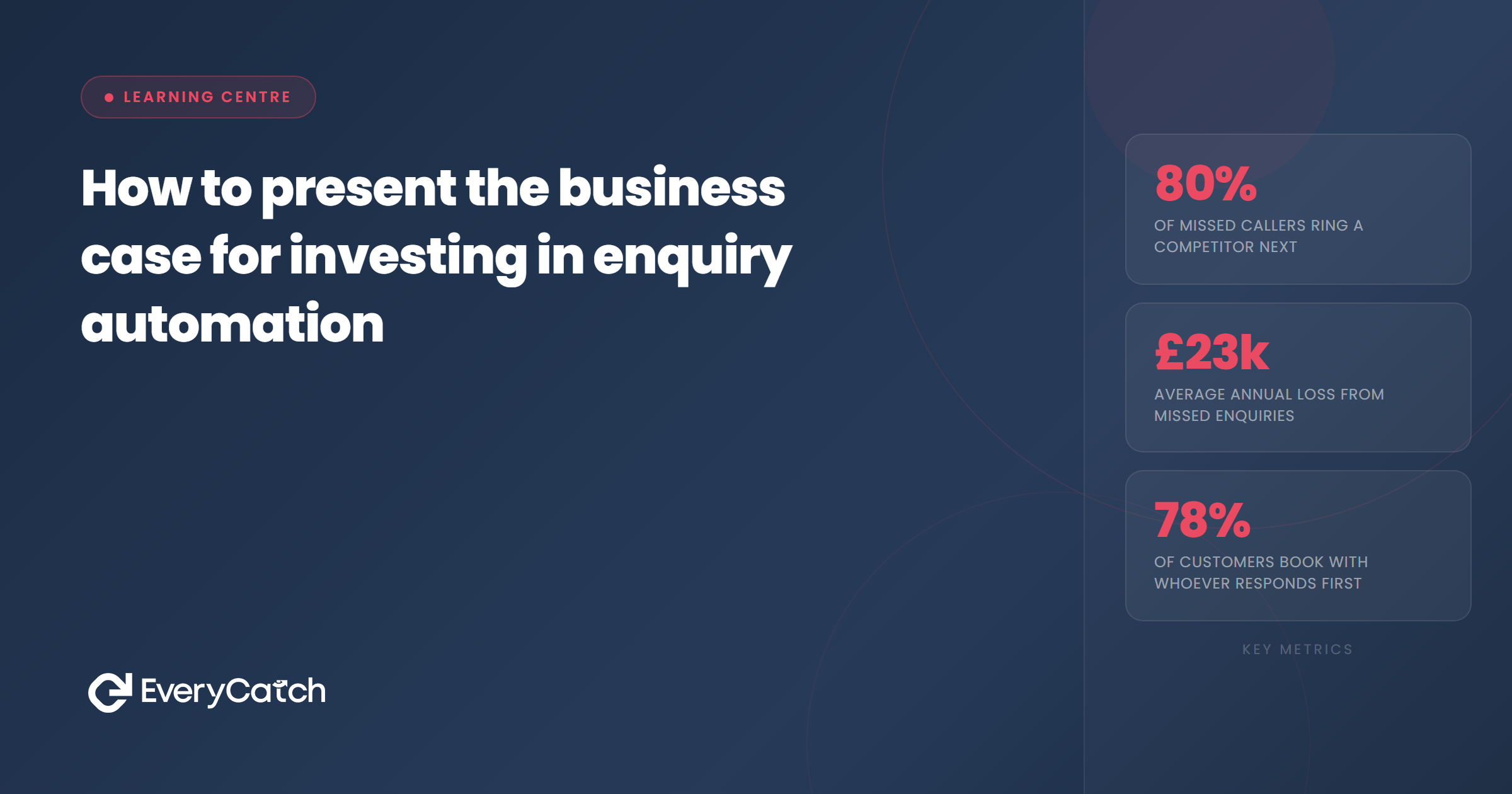

- The strongest business case frames automation as recovering money you already lose, not as a new expense.
- Four numbers build the whole case: enquiries per month, the share that go unanswered, your conversion rate, and your average job value.
- Conservative estimates win arguments. If the case works with your worst assumptions, nobody can pick it apart.
- Most objections come down to trust in the numbers, so track a fortnight of real enquiry data before you present anything.
- Proposing a 90-day trial with a clear success measure is far easier to approve than an open-ended commitment.
At some point, most service business owners have to convince someone that spending money on enquiry automation makes sense. Sometimes that person is a business partner. Sometimes it is a spouse who watches the accounts. Sometimes it is a finance director, or an office manager who has seen software subscriptions come and go. And sometimes, honestly, it is yourself, because parting with a few hundred pounds a month needs a better justification than a gut feeling.
The good news is that enquiry automation is one of the easiest investments in a service business to justify, provided you build the case from your own numbers rather than a vendor's brochure. Here is how to do it.
Frame it as a cost you already pay, not a new expense
Most business cases fail before they start because they get framed the wrong way round. If you open with "I want to spend £300 a month on software", you have invited the listener to look for reasons to say no. New spending always triggers scrutiny.
Flip it. The real question is not whether to spend money on automation. It is whether to keep paying the invisible cost of missed enquiries. Every call that rings out, every web form that waits until tomorrow, every after-hours message that never gets a reply is money leaving the business. That cost exists today. It just does not appear on any statement, which is why it survives year after year without anyone challenging it. Our article on the hidden cost of missed leads covers why this figure stays invisible for so long.
So the opening line of your business case should be something like: "We are currently losing roughly £4,000 a month in enquiries we never respond to. Here is the evidence, and here is what it would cost to fix." That framing puts the burden of proof on doing nothing.
Build the numbers with your own data
You need four figures, and none of them require an accountant.
- Monthly enquiry volume. Count every inbound contact across two typical weeks, then double it. Include calls, web forms, emails, WhatsApp messages, and social enquiries. Phone records and form notifications make this straightforward.
- The missed percentage. During the same fortnight, log how many of those enquiries went unanswered, or were answered more than an hour later. Most owners guess this sits around 5 to 10 per cent. When they actually measure it, the figure is usually 20 to 40 per cent once evenings, weekends, and busy site days are counted. If you want a structured way to do this, see our guide on auditing how many leads your business is missing.
- Your conversion rate. Of the enquiries you do respond to promptly, what proportion become paying customers? Use your honest historic figure, not your best month.
- Your average job value. Take last quarter's revenue and divide it by the number of jobs. If repeat business is common in your trade, note the lifetime value too, but keep the headline calculation to first jobs so nobody accuses you of inflating it.
Then the maths is one line. Missed enquiries per month, multiplied by conversion rate, multiplied by average job value, equals monthly revenue lost. A plumbing firm receiving 60 enquiries a month, missing 25 per cent of them, converting at 40 per cent, with an £850 average job, is losing roughly £5,100 every month. Against a tool costing a few hundred pounds, the comparison does most of your persuading for you.
One rule matters more than any other here. Use conservative assumptions throughout. Assume the automation only recovers half the missed enquiries. Assume recovered leads convert at a lower rate than normal ones. If the case still shows a return of five or ten times the cost, and it usually does, then the sceptic in the room has nowhere to attack.
Want help putting real numbers on your missed enquiries?
We will walk through your enquiry channels with you and show you what the leak is actually costing, with no obligation attached.
Book a free discovery callStructure the pitch so it takes five minutes
A business case for a decision this size should fit on one page. Long documents signal uncertainty. Use this structure.
The problem, with evidence. State how many enquiries went unanswered in your measured fortnight, and what that costs annually. Real examples land harder than percentages, so include one or two. "On Tuesday the 14th, a caller rang three times during the afternoon and never got through. They did not call back."
The proposed fix. Describe what the automation actually does in plain terms. Missed calls get an instant text back. Web form enquiries receive a reply within seconds rather than hours. Follow-up messages go out automatically until the lead responds or books. Avoid software jargon entirely, because the person approving this cares about outcomes, not features.
The cost, all of it. State the monthly fee, any setup cost, and the time someone will spend reviewing responses. Hiding costs is how business cases lose credibility later.
The expected return, conservatively stated. Present your break-even point. If the tool costs £300 a month and your average job is worth £850, one recovered job every three months covers it. Everything beyond that is profit. Break-even framing is powerful because it sets a bar so low that opposing it feels unreasonable.
Handle the objections before they are raised
Three objections come up in almost every one of these conversations, and you should address them in the pitch rather than waiting to be ambushed.
"Customers will hate automated replies." The evidence points the other way. A customer who receives an instant text saying "Sorry we missed you, we will call back within the hour" feels acknowledged. A customer whose call rings out and hears nothing feels ignored, and typically phones your competitor within minutes. The automated message is not replacing a human conversation. It is holding the customer's attention until a human is free.
"We can just answer the phone better." Perhaps, but this has presumably been the plan for years, and the missed enquiries in your data happened anyway. Discipline-based fixes fail because they depend on people being available at exactly the moment the phone rings, including evenings, weekends, and the middle of a job. Automation does not have a bad day.
"It is another subscription we will forget about." This one deserves a real answer, which is a review date. Commit to measuring recovered enquiries and booked jobs after 90 days, and to cancelling if the numbers do not justify the cost. A good provider makes this data visible, and any provider who resists measurement is telling you something.
Propose a trial, not a commitment
The final move is to shrink the decision. Nobody has to approve enquiry automation forever. They only have to approve a 90-day trial with a defined success measure, for example "the system recovers at least three enquiries per month that would otherwise have gone unanswered". Month-to-month terms make this genuinely low risk, which is why EveryCatch operates without long contracts. If the numbers work, the trial simply continues. If they do not, you cancel, and the only cost was three months of finding out.
Framed this way, the business case stops being an argument about spending and becomes a small, measurable experiment against a documented loss. That is a conversation you can win in five minutes, because the alternative on the table is continuing to pay for missed enquiries and getting nothing back at all.

From the EveryCatch team
EveryCatch helps UK service businesses respond to every enquiry instantly, follow up automatically, and stop losing work to slow replies. We write these guides to answer the questions owners actually search for, honestly and with real numbers.