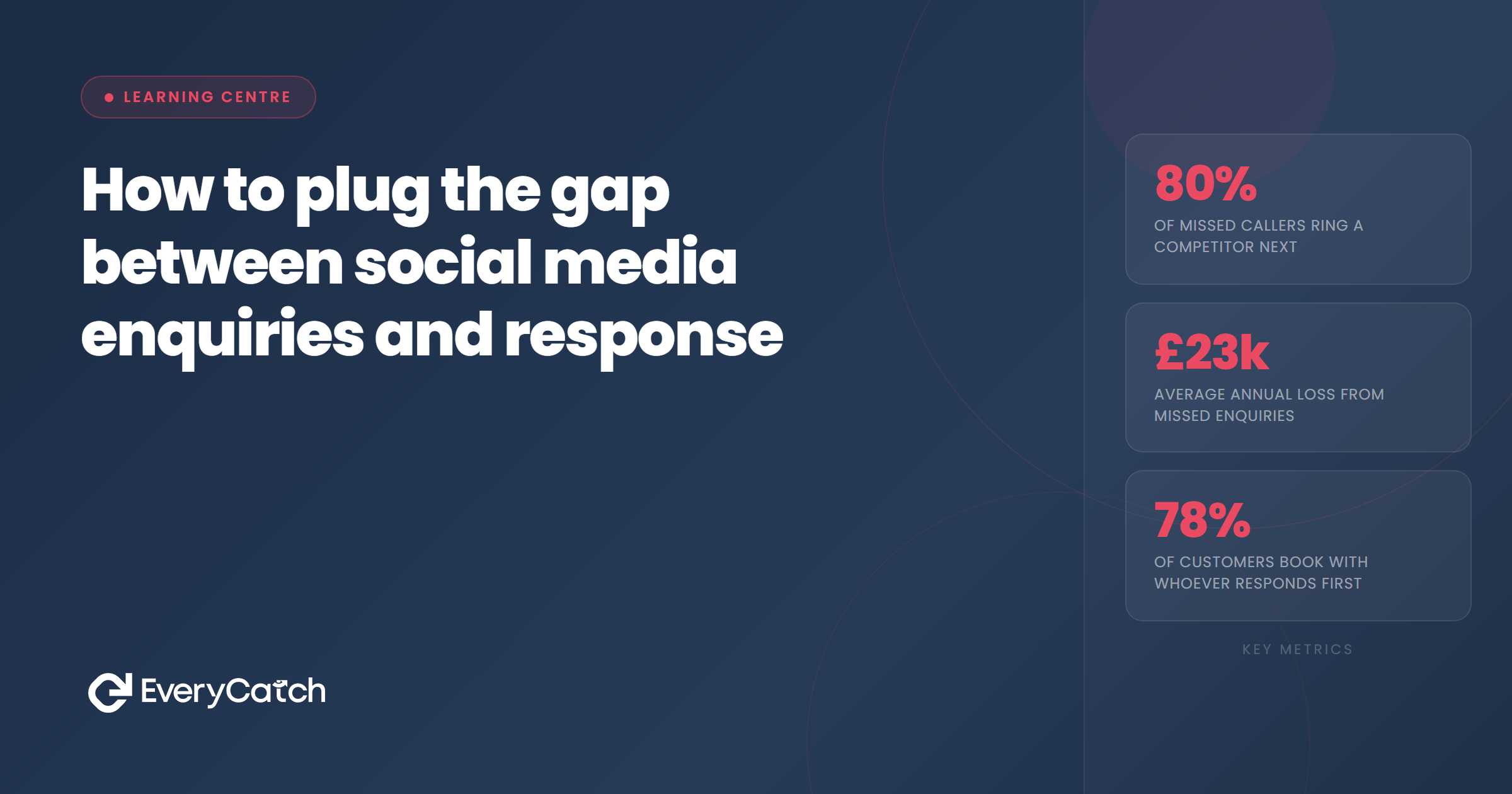

- Social media enquiries fail quietly because platforms bury messages in secondary inboxes and nobody is assigned to check them.
- A buyer who messages you on Facebook or Instagram has usually messaged two or three competitors at the same time, so speed decides who wins.
- Instant automated acknowledgement holds the enquiry open while a human catches up, and it works on every major platform.
- Consolidating Facebook, Instagram, WhatsApp and web chat into one shared inbox removes the app-hopping that causes most misses.
- The goal of a social conversation is to move it to phone or text within a few messages, because that is where jobs actually get booked.
A message arrives on your Facebook page at 7.40pm on a Tuesday. Someone wants a quote for a bathroom refit, or a boiler service, or a garden clearance. You see the notification on Thursday, reply, and hear nothing back. The person was real, the job was real, and the money went to whoever answered first.
This pattern repeats itself across almost every service business that runs social pages. The enquiries arrive, but they arrive into a system that was never designed to catch them. Plugging the gap is not complicated, but it does require you to treat social messages as leads rather than as chat.
Why social enquiries slip through in the first place
Social platforms are built to keep people scrolling, not to help businesses manage enquiries. Facebook splits messages between a main inbox, a message requests folder and comment threads. Instagram does the same, and it hides messages from people who do not follow you in a requests tab that most page owners never open. Add WhatsApp, TikTok comments and the odd LinkedIn message, and you have five or six separate places where a paying customer could be waiting.
The second problem is ownership. In most small businesses, nobody is formally responsible for social messages. The owner checks when they remember, an office manager glances at Facebook occasionally, and everyone assumes someone else has it covered. An enquiry that lands during a busy week can sit unread for days without anyone realising a lead ever existed. We cover this wider pattern in our article on where missed leads hide in your business.
The third problem is timing. People browse social media in the evening and at weekends, exactly when your business is closed. Research on lead response consistently shows that the odds of connecting with an enquirer collapse after the first hour. A message sent at 8pm on Saturday and answered at 10am on Monday has been cold for 38 hours. Most buyers have moved on long before then.
Find where your gaps actually are
Before you fix anything, spend twenty minutes auditing your own channels. Open every inbox your business has: Facebook main and message requests, Instagram primary and requests, WhatsApp Business, comments on your last ten posts, and Google Business Profile messages if you have them switched on. Count the unanswered enquiries and note how old they are.
Most owners who do this exercise find at least a handful of genuine enquiries they never saw. Some find dozens. Then work out your typical response time on the messages you did answer. If the honest number is measured in days rather than minutes, you now know the size of the leak. Our guide to calculating what missed leads cost your business will help you put a pound figure on it, which tends to make the fix feel a lot more urgent.
Set up instant acknowledgement on every channel
You cannot personally answer every message within five minutes, and you do not need to. What you need is an immediate, automatic first reply that acknowledges the enquiry, sets an expectation, and asks a useful question. Something like: "Thanks for getting in touch. We usually reply within the hour during the day. So we can help quickly, what job do you need doing and what area are you in?"
That single message changes the psychology of the wait. The enquirer knows they have been heard, they have a reason to stay engaged, and they often supply the details you need before a human even picks up the thread. Facebook and Instagram both support automated replies natively, and WhatsApp Business offers greeting and away messages. The native tools are basic, but basic beats silence.
The stronger version of this uses conditional automation, where the first reply can qualify the lead, offer a booking link, or trigger a follow-up sequence if the person goes quiet. That is where dedicated systems earn their keep over free platform settings.
How many social enquiries went unanswered last month?
We will audit your channels with you on a short call and show you exactly where enquiries are falling through.
Book a free discovery callRoute everything into one shared inbox
App-hopping is what kills response times. If answering your enquiries requires opening four apps and remembering to check two hidden folders, misses are guaranteed. The fix is to connect every channel to a single unified inbox, so Facebook messages, Instagram DMs, WhatsApp chats, web form submissions and text messages all land in one stream that the whole team can see.
A shared inbox solves the ownership problem at the same time. Every enquiry becomes visible, assignable and impossible to quietly lose. You can see at a glance which conversations are waiting for a reply and how long they have waited. It also means the person who happens to be free can answer, rather than the one person who has the Facebook login.
This is the approach EveryCatch takes. Social channels, calls, texts and web enquiries feed one inbox, automated first replies go out instantly on every channel, and unanswered leads trigger follow-up rather than falling off the edge of a notification screen. If a lead does go quiet, a follow-up sequence keeps working the conversation without anyone having to remember.
Move the conversation off the platform quickly
Social messaging is where enquiries start, not where jobs get booked. Your aim in any social conversation should be to get a name, a phone number and a rough description of the job within the first few messages, then move to a call or a text thread. Phone numbers survive; Instagram threads get buried under memes within a day.
There is a practical reason for this beyond convenience. Once you hold the person's number, you control the relationship. You can send a quote, confirm an appointment, chase a decision and ask for a review, all without depending on whether a platform decides to show them your message. A simple line works well: "Easiest thing is for me to give you a quick ring. What's the best number and when suits?"
Treat the platform as the front door and your own contact list as the house. Every enquiry that makes it inside is one you can actually manage, measure and win.

From the EveryCatch team
EveryCatch helps service businesses catch and convert every enquiry, whether it arrives by phone, text, web form or social media. We write these guides to share what we see working across hundreds of real customer conversations every week.