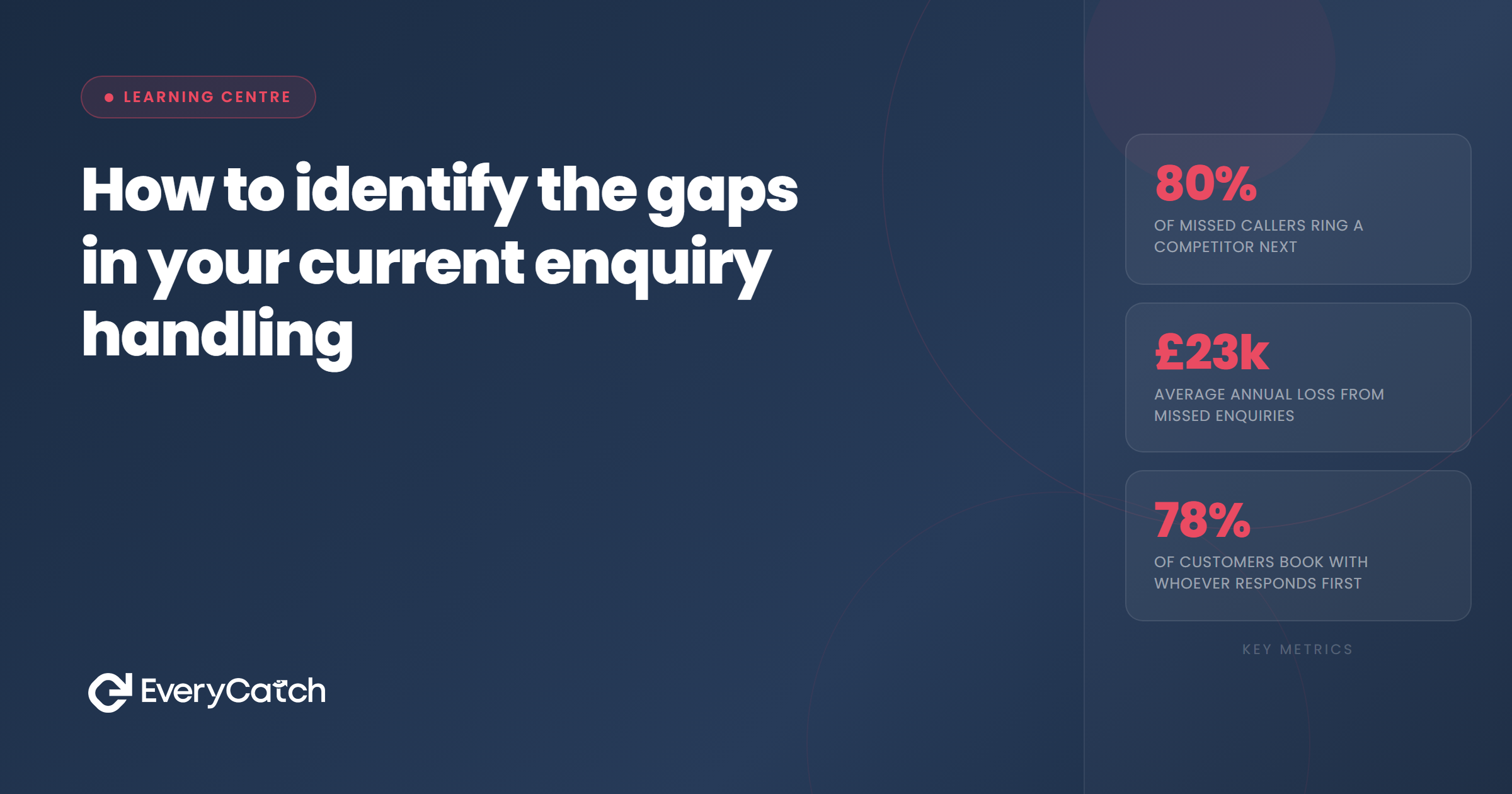

- Most enquiry gaps hide in channels the owner never personally checks, so a full audit starts with listing every route a customer could use to reach you.
- The fastest way to find weaknesses is to enquire with your own business through each channel and time what happens.
- Response speed matters more than answer rates. An enquiry answered after 24 hours often performs no better than one that was missed entirely.
- Follow-up is where most businesses lose the enquiries they did catch, because contact usually stops after one attempt.
- Fix the gap with the highest volume and slowest response first, since that is where the most revenue is leaking.
You cannot fix what you have not found. Most owners assume their enquiry handling works because the phone rings, the diary fills and the business keeps trading. The gaps only become visible when you go looking for them deliberately, and almost every business that runs this exercise finds more leakage than expected. The good news is that a proper audit takes an afternoon, not a month, and the method below works for any service business.
Start by mapping every channel a customer could use
Write down every possible route an enquiry can take into your business. That usually includes your main phone line, any mobile numbers listed online, your website contact form, direct email, Facebook Messenger, Instagram DMs, WhatsApp, Google Business Profile messages and any directory or lead-generation sites you appear on. Most owners are surprised by the length of this list, because half of these channels were set up years ago and forgotten.
For each channel, answer two questions honestly. First, who is responsible for checking it? Second, how often does that actually happen? If the answer to the first question is "whoever sees it" then the real answer is nobody. Unowned channels are the most common gap of all, and social media inboxes are the usual culprits. A customer who messages your Facebook page expects a reply within hours. If nobody has opened that inbox since March, you have found your first leak.
Pay particular attention to the phone. Calls that ring out or hit voicemail are the largest single source of lost enquiries for trades and service businesses, and most callers who reach voicemail simply ring a competitor instead. We covered the scale of this problem in how many leads your business is actually missing, and the numbers are consistently worse than owners predict.
Test your own business like a customer would
Mapping tells you where enquiries could arrive. Testing tells you what actually happens when they do. Enquire with your own business through every channel on your list, or better still, ask a friend whose number and name your team will not recognise. Send the website form at 7pm on a Tuesday. Ring the main line during your busiest hour. Message the Facebook page on a Saturday morning. These are the times real customers enquire, so they are the times you should test.
Record three things for each test: whether you got any response at all, how long it took, and what the response asked you to do next. That third point matters more than most people realise. A reply that says "thanks, we'll be in touch" leaves the customer waiting. A reply that offers a specific next step, such as a booking link or a proposed call time, moves them forward. If your responses acknowledge the enquiry but do not advance it, that is a gap even though something technically happened.
Run the out-of-hours test too. Somewhere between a third and half of enquiries for most service businesses arrive outside working hours, and what happens to those enquiries between 6pm and 8am is usually the difference between a full diary and a quiet week. If your after-hours test produced silence until the next morning, note it. You will almost certainly find that your competitors' silence lasts just as long, which means fixing it puts you ahead of them.
Not sure where your enquiries are going?
Book a free discovery call and we will walk through your channels with you and show you exactly where leads are slipping through.
Book a free discovery callMeasure real response times, not assumed ones
Owners routinely believe they respond to enquiries within an hour. The records almost never agree. Pull the last twenty enquiries you can trace, whether from email timestamps, form notifications or call logs, and work out the actual gap between the enquiry arriving and your first meaningful reply. Meaningful is the key word. An automated receipt email does not count. The clock stops when a human, or a message that behaves like one, engages with what the customer asked.
The reason this matters is that lead value decays fast. Research on lead response has shown for years that the odds of qualifying a lead collapse within the first hour, and an enquiry answered the next day converts at a fraction of the rate of one answered in five minutes. If your median response time is measured in hours rather than minutes, speed is your biggest gap, regardless of how good your answer rate looks. Our article on why speed to lead matters more than lead volume goes deeper on the evidence.
While you have the records open, look for patterns. Do enquiries from one channel consistently wait longer than others? Do Friday afternoon enquiries sit until Monday? Patterns tell you whether the gap is a system problem or a people problem, and the fix is different for each.
Check what happens after the first contact
Catching the enquiry is only half the job. The other half is what happens when the customer does not book immediately, and this is where most businesses quietly lose the leads they worked hardest to win. Take ten enquiries from the last three months that did not convert and trace what contact they received. In most businesses the answer is one reply, then nothing.
That single-attempt pattern is a gap in its own right. Customers who ask for a quote are rarely ready to decide the same day. They are comparing options, waiting on a partner, or simply busy. A business that follows up two, three or five times over the following fortnight wins a meaningful share of those undecided enquiries, and the follow-up does not need to be clever. A short check-in message beats silence every time. If your audit shows follow-up stopping after one touch, you have found a gap that costs you finished quotes, not just cold leads.
Prioritise the gaps by volume and value
By this point you will likely have a list of several gaps: an unmonitored channel or two, slow responses at certain times, a dead zone outside working hours and follow-up that stops too early. Do not try to fix everything at once. Rank each gap by how many enquiries pass through it and how completely those enquiries are being lost. A missed-call problem on your main line usually outranks a slow Instagram inbox, simply because the phone carries more volume and callers give up faster than messagers do.
Then decide whether each fix is a process change or a system change. Some gaps close with a rule, such as making one named person responsible for the Facebook inbox. Others need automation, because no rota can answer an enquiry at 11pm or send the fourth follow-up message reliably. This is the problem EveryCatch was built for. It sends an instant text when a call goes unanswered, responds to form and message enquiries within seconds at any hour, and keeps following up automatically until the customer replies or books. Whether you solve it with software or with discipline, the audit gives you something most competitors do not have: an honest picture of where your enquiries actually go.

From the EveryCatch team
We help service businesses catch and convert the enquiries they are currently losing, from missed calls to forgotten follow-ups. Everything we publish in the Learning Centre comes from what we see working across hundreds of real customer accounts.