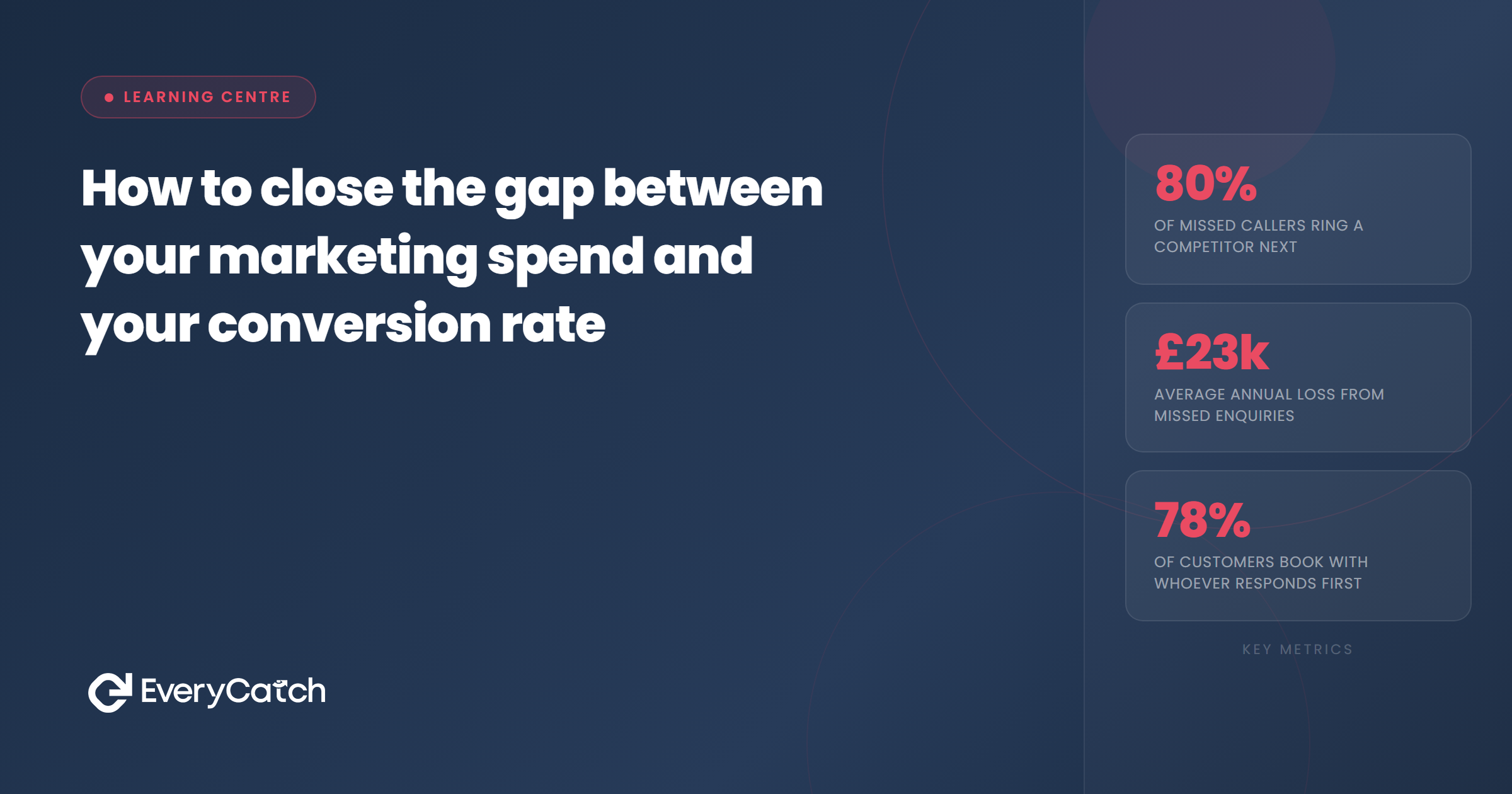

- A low conversion rate usually points to a broken follow-through process, not weak marketing.
- Measure conversion at three separate stages: enquiry to conversation, conversation to quote, and quote to job. Each stage fails for a different reason.
- Slow response is the most expensive leak. Leads contacted within five minutes convert many times more often than leads contacted the next day.
- Fixing follow-up is cheaper than buying more leads, and the improvement compounds across every pound you already spend.
- Only increase your marketing budget once your response and follow-up systems can handle the volume you already generate.
You spend money on ads, your phone rings, enquiries land in your inbox, and yet the jobs booked at the end of the month do not match the budget going out at the start. That gap between what you spend and what you convert is the single most common frustration we hear from service business owners, and it is almost never solved by spending more.
The instinct is to blame the marketing. Fire the agency, switch platforms, rewrite the ads. Sometimes that is right. More often, the leads were fine and the problem sits in the hours and days after each enquiry arrives. Closing the gap starts with knowing exactly where leads leave, then fixing the leak before you pour more water into the bucket.
Measure the gap before you try to close it
You cannot fix a number you have never calculated. Pull up last month's figures and work out three simple ratios. First, of every enquiry that came in, how many did you actually speak to? Second, of the people you spoke to, how many received a quote? Third, of the quotes you sent, how many became paid work?
Most owners guess at these numbers and guess badly. When they count properly, the results are uncomfortable. A business generating 60 enquiries a month often speaks to 40, quotes 25, and wins 10. That is a 17 per cent end-to-end conversion rate, and the biggest single loss happened before a single conversation took place. Twenty people raised their hands and never heard back in time to matter.
Break the funnel into stages because each stage fails for a different reason. Enquiry to conversation fails on speed and availability. Conversation to quote fails on qualification and admin. Quote to job fails on price, trust, and follow-up. If you only track the end-to-end number, you will treat all three problems as one and probably fix none of them. We cover the counting method in more detail in how to calculate what missed leads cost your business.
Why the gap exists in the first place
Marketing and conversion are handled by different systems in most small businesses. Marketing is handled by an agency, a platform, or a scheduled routine. Conversion is handled by whoever picks up the phone, which usually means the owner, and the owner is on a roof, under a sink, or in a meeting when the enquiry lands.
This is why the gap grows as marketing improves. Better ads produce more enquiries, more enquiries arrive while you are busy, and a bigger share of them go unanswered. Plenty of businesses have watched their conversion rate fall in the same month their lead volume rose, and concluded the leads were poor quality. The leads were the same. The capacity to respond had simply run out.
The other cause is timing. Buyers who fill in a form or call a tradesperson are usually contacting three or four businesses in the same sitting. The first one to reply gets the conversation, and the conversation usually gets the job. If your average response time is measured in hours, your conversion rate is being set by your fastest competitor, not by the quality of your work. We unpack that dynamic in why speed to lead decides who wins the job.
Want to know how much your gap is costing you?
Book a short call and we will walk through your enquiry numbers with you and show you where the leaks are.
Book a free discovery callThe three failure points that waste most budgets
Slow first response
Research on lead response has been consistent for years. Contact a lead within five minutes and your odds of a meaningful conversation are dramatically higher than if you wait even half an hour. Wait until the next day and most of the opportunity has gone. The fix does not require you to answer every call live. It requires an automatic acknowledgement that reaches the lead within seconds, holds their attention, and buys you time to respond properly. A missed call that triggers an instant text keeps the buyer from dialling the next name on their list.
No structured follow-up
Around half of enquiries need more than one touch before they convert, yet most businesses send one reply and stop. The lead who did not answer your first call is not a dead lead. They were driving, working, or comparing options. A short sequence of two or three follow-up messages over the following days recovers a meaningful share of enquiries that would otherwise vanish, and it costs nothing beyond setting it up once.
Quotes that go quiet
The final leak is the quote you sent and never chased. Owners avoid chasing because it feels pushy, but the buyer often reads silence as disinterest. A polite check-in three days after a quote lands lifts win rates noticeably, and a second check-in a week later lifts them again. If chasing feels awkward, automate it, because a scheduled message does not get embarrassed.
Fix things in the right order
Work from the top of the funnel down, because improvements at the top multiply through every stage below. Fix first response before follow-up, and follow-up before quote chasing. A business that lifts its enquiry-to-conversation rate from 65 per cent to 90 per cent has just increased revenue by roughly a third without touching its ad account, its pricing, or its sales technique.
Then make each fix a system rather than a resolution. Deciding to answer the phone faster lasts about a fortnight. An automated text-back, a follow-up sequence, and a pipeline that flags stale quotes carry on working whether you are busy, on holiday, or having a bad week. This is the entire reason EveryCatch exists. We build the response and follow-up layer so the leads you already pay for stop leaking away, and the software does the chasing that owners never quite get round to.
When it is actually right to spend more on marketing
There is a point where more budget is the correct answer. If you are responding within minutes, following up every enquiry, chasing every quote, and still short of work, then your funnel is tight and the constraint really is volume. Increase spend at that point and every extra pound converts at your improved rate, which makes the maths considerably kinder.
Spend more before that point and you are scaling a leak. A funnel that loses half its enquiries loses half of every additional pound too. Tighten first, then pour. The businesses that get the best return on ads are rarely the ones with the cleverest campaigns. They are the ones whose phones get answered, in one form or another, every single time.

From the EveryCatch team
EveryCatch helps service businesses catch and convert the leads they already generate, with instant response, automated follow-up, and a clear view of every enquiry. We write these guides because the fastest way to grow is usually to stop losing what you have.