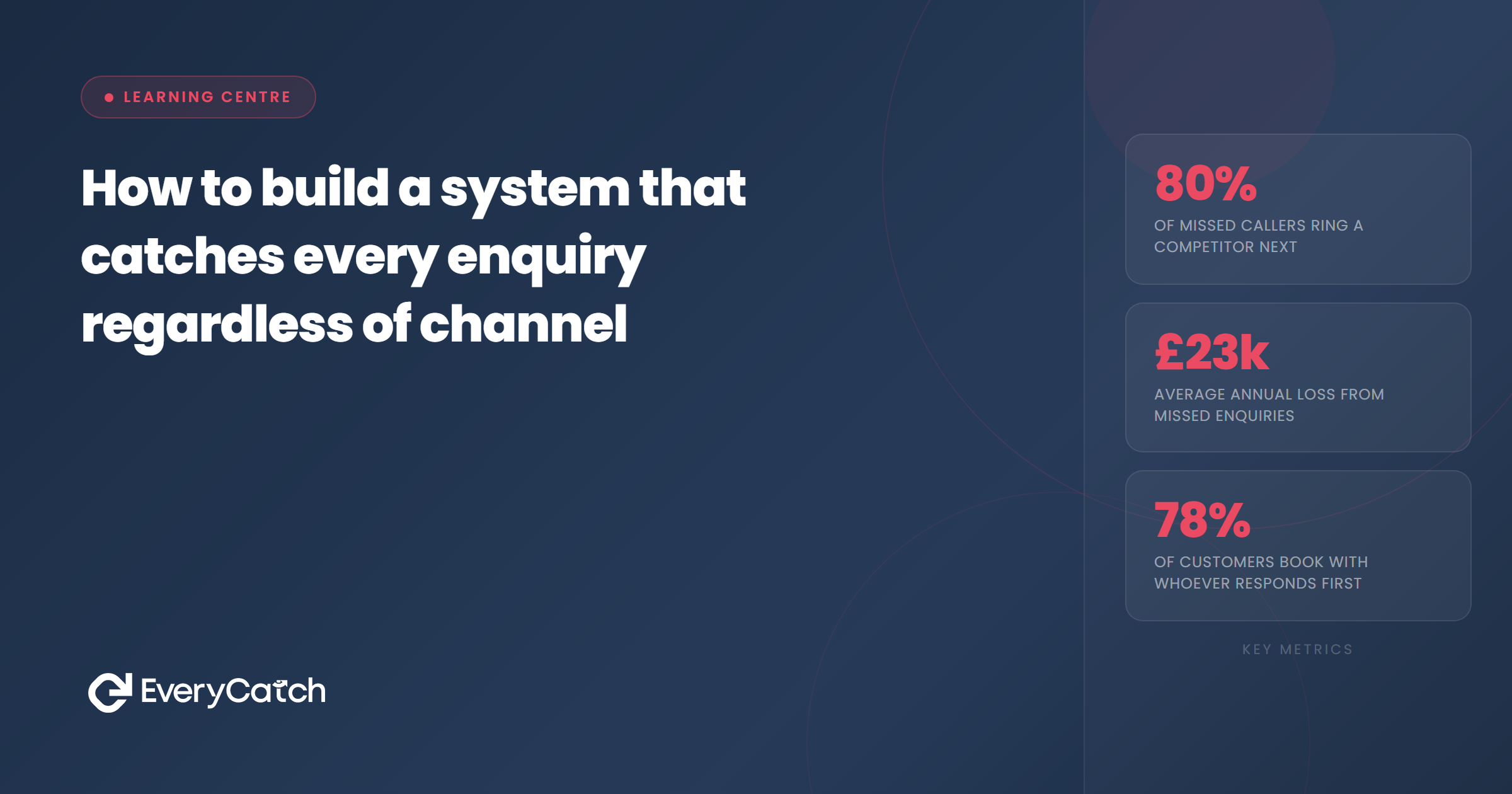

- Most missed enquiries come from channel sprawl, not laziness. Nobody can watch six inboxes at once.
- The foundation of a catch-everything system is a single unified inbox that every channel feeds into.
- Automatic responses buy you time. A lead who gets a reply within five minutes will usually wait for a proper answer.
- Follow-up sequences do the heavy lifting. Most enquiries convert after the second or third touch, not the first.
- You can build this from separate tools, but the joins are where leads escape. Integrated platforms remove the joins.
Ten years ago, a customer who wanted a quote rang your landline. Today they might call your mobile, fill in a website form, message you on Facebook, DM you on Instagram, send a WhatsApp, email you, or leave a question on your Google Business Profile. Every one of those is a real enquiry from a real person with money to spend. And every one of them arrives in a different place.
That is the actual problem behind most missed leads. It is rarely that a business owner ignored a customer on purpose. It is that the enquiry landed somewhere nobody was looking. Building a system that catches everything means designing for that reality rather than hoping you will somehow check seven apps between jobs.
Why enquiries slip through in the first place
Channel sprawl creates three failure points. The first is visibility. A Facebook message notification looks identical to fifty other notifications on your phone, and it gets buried within an hour. The second is ownership. When enquiries arrive in five places, nobody in the business is responsible for all five, so each person assumes someone else saw it. The third is speed. Even when you do spot the message, you spot it hours later, and most leads have already contacted a competitor by then.
Any system worth building has to fix all three. Fixing one on its own does not move the needle much. A business that sees every enquiry but responds slowly still loses the job. A business that responds fast on email but never checks Instagram still leaks from the side.
Step one: map every channel you actually receive enquiries on
Start with an honest audit. Go back through the last month and list every place a genuine enquiry arrived. For most trades and local service businesses the list looks something like this:
- Phone calls, both answered and missed
- Website contact forms and quote request forms
- Email sent directly to your business address
- Facebook Messenger and Instagram DMs
- WhatsApp messages to your business number
- Google Business Profile messages and questions
- SMS replies to previous conversations
Two things usually surprise people during this audit. Missed calls turn out to be a bigger channel than expected, because a missed call is an enquiry that never became a conversation. And social messages often contain enquiries from weeks ago that nobody ever opened. If you find those, you have just proven the problem exists in your business, not just in theory. Our article on auditing your business for lead leaks covers this process in more detail.
Step two: route everything into one inbox
This is the structural fix. Every channel on your list needs to deliver its messages into a single place that you or your team check as part of the daily routine. When one screen shows every conversation, ownership becomes simple. Someone watches that screen, and nothing arrives anywhere else.
There are two ways to achieve it. The manual route uses forwarding rules, email notifications and browser tabs to approximate a unified view. It works up to a point, but it is fragile. Notifications fail silently, forwarding rules break when a platform updates, and missed calls still live on your phone rather than in any inbox. The integrated route uses a platform that connects natively to each channel and pulls conversations into one thread per customer. A Facebook message, a text and a phone call from the same person appear as one conversation history, which matters enormously when you are trying to remember what you quoted them last Tuesday.
Want to see how many enquiries you are missing right now?
We will look at your channels with you and show you exactly where enquiries are landing unseen.
Book a free discovery callStep three: respond automatically on every channel
A unified inbox tells you an enquiry arrived. It does not respond to it. And speed is the difference between winning and losing the job, because research consistently shows that responding within five minutes makes you dramatically more likely to reach and convert the lead than responding within an hour.
You will not personally respond in five minutes while you are on a roof, under a sink or mid-consultation. Nobody will. So each channel needs an automatic first response that acknowledges the enquiry, sets an expectation, and ideally asks a useful question. A missed call triggers an instant text saying you are on a job and asking what they need. A form submission triggers a text and an email within a minute. A Facebook message gets an immediate reply asking for their postcode and a photo of the problem.
The automatic response is not a substitute for a human conversation. It is a placeholder that keeps the lead warm and stops them dialling the next business on the list. Customers are remarkably patient once they know they have been heard. They are remarkably impatient with silence.
Step four: follow up until they answer
Here is where most home-built systems stop, and it is why they underperform. One response is not enough. People get distracted, put the phone down, and forget. A meaningful share of enquiries convert on the second, third or fourth touch, which means a system without automated follow-up quietly abandons a large chunk of the leads it caught.
Build a simple sequence for any enquiry that has not replied. A follow-up message after a few hours, another the next day, and a final check-in a few days later works well for most service businesses. Keep the messages short and human. The moment the lead replies, the sequence stops and a person takes over. That last rule is not optional. Automated messages arriving after someone has already answered make a business look careless.
Step five: decide whether to build it or buy it built
Everything described above can be assembled from separate tools. A shared inbox tool, a missed call text-back service, a form automation platform and an email sequencer will get you most of the way there, typically for somewhere between £80 and £200 per month across subscriptions, plus the setup time and the ongoing job of keeping the connections working.
The weakness of the assembled approach is the joins. Each connection between tools is a point where a lead can fall through, and when it happens you rarely find out until you notice a quiet month. Integrated platforms exist precisely to remove those joins. EveryCatch, for instance, combines the unified inbox, missed call text-back, instant form responses and follow-up sequences in one system, and we set it all up rather than handing you a toolbox. Other platforms take a similar all-in-one approach. What matters less is which route you choose and more that you choose one deliberately, because the default option, checking apps when you remember to, is the one that is currently costing you jobs.
Whichever way you go, test the finished system properly. Send yourself an enquiry through every single channel and time how long each response takes. Do it again a month later. A catch-everything system only earns its name if it still catches everything when nobody is watching it.

From the EveryCatch team
We build lead capture and follow-up systems for service businesses that are too busy doing the work to watch six inboxes. Everything we publish here comes from what we see across the businesses we work with every day.