
- A one-person business misses enquiries because of physics, not laziness. The fix is a system that responds when you cannot, not a promise to try harder.
- Automatic text-back on missed calls is the single highest-impact piece. It turns a dead dial tone into an open conversation within seconds.
- Enquiries scattered across calls, WhatsApp, Facebook and web forms get lost. One shared inbox removes the memory problem entirely.
- Most leads need three to five follow-ups before they respond. Automated sequences do this without you touching your phone.
- Two short admin windows per day beat constant phone-checking. The system holds leads warm between them.
Running a service business on your own means you are the technician, the receptionist, the quoter and the accounts department. When the phone rings at 2pm, you are usually up a ladder, under a sink or mid-conversation with a paying customer. The enquiry goes to voicemail, the caller rings the next name on Google, and you never even know what the job was worth.
The honest answer to the question in this title is that you cannot build a no-miss system out of your own attention. You have one pair of hands and they are already busy. What you can build is a set of automated responses that catch, acknowledge and hold every enquiry until you are free to deal with it properly. Here is how to do that, piece by piece.
Why one-person businesses miss the most enquiries
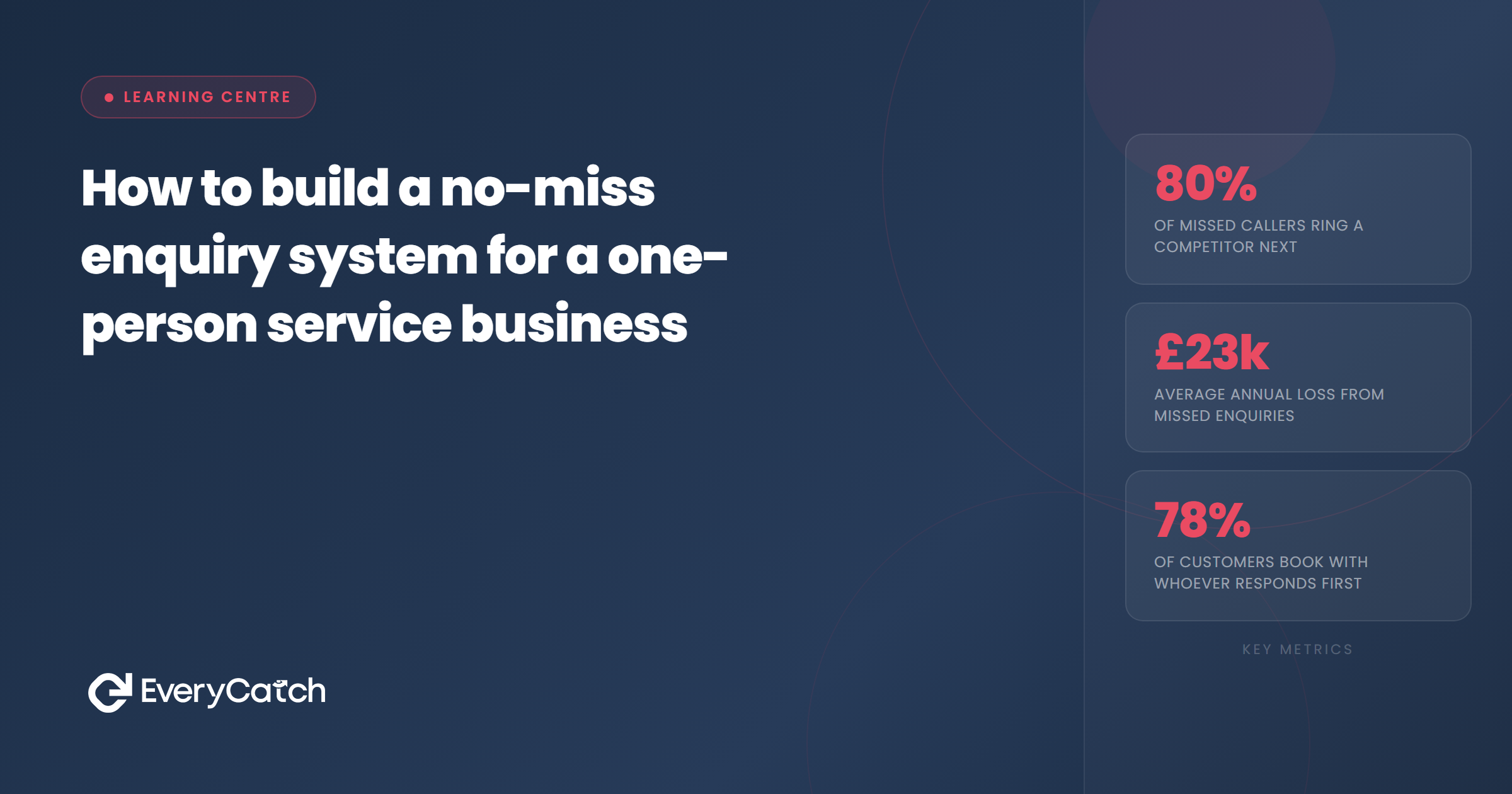
Larger firms miss leads through disorganisation. Sole traders miss them through simple unavailability. Research into UK small businesses consistently finds that somewhere between a third and a half of inbound calls go unanswered, and the rate climbs for tradespeople who spend most of the day physically working. Around 80 per cent of callers who reach voicemail do not leave a message. They just call your competitor.
There is a second problem layered on top. Even the enquiries you do catch arrive across four or five channels: phone, text, WhatsApp, Facebook Messenger, your website contact form and sometimes email too. Each one lives in a different app. When your record-keeping system is your own memory at the end of a ten-hour day, leads fall through the cracks even after they have reached you. We covered the scale of this in how much missed calls actually cost a small service business, and the numbers are uncomfortable. Two missed jobs a week at an average value of £300 is over £30,000 a year.
So the system needs to solve two things at once: instant response when you are unavailable, and a single place where nothing can be forgotten.
Step one: catch every missed call automatically
Missed call text-back is the foundation, and it should be the first thing you set up. The mechanism is simple. When a call rings out or hits voicemail, the caller receives a text within seconds that says something like: "Hi, this is Dave from Dave's Plumbing. Sorry I missed you, I'm on a job right now. Reply here with a few details and I'll come back to you shortly."
This one message changes the psychology of the missed call. The caller no longer feels ignored. They have an open conversation with you, and most people would rather type a quick reply than start ringing round other firms. In practice, a large share of missed callers respond to the text with the job details, which means you come off site to a written enquiry rather than a mystery number in your call log. If you want the detail on setting this up, read our guide to how missed call text-back works.
Keep the message short, human and specific to you. Templates that sound like a call centre get ignored. Templates that sound like a busy tradesperson get replies.
Step two: pull every channel into one inbox
The second piece is consolidation. Every enquiry, whatever channel it arrives on, should land in one place. That includes text replies to your missed call message, WhatsApp enquiries, Facebook and Instagram messages, website form submissions and email.
A unified inbox does two things for a solo operator. First, it removes the app-hopping. Instead of checking six places, you check one. Second, it creates a visible record of every open conversation, so "did I ever reply to that woman about the fence?" stops being a question you answer from memory. Unanswered conversations sit there looking at you until they are dealt with, which is exactly what you want.
You can approximate this with a spreadsheet and discipline, and some people do. But the manual version depends on you transferring information at the end of a long day, which is precisely when discipline fails. A tool that captures everything automatically is worth the modest monthly cost the first time it saves a single job.
Want this built for you rather than by you?
EveryCatch sets up missed call text-back, a unified inbox and automated follow-up for one-person service businesses, usually within a week.
Book a free discovery callStep three: automate the follow-up
Catching the enquiry is half the battle. The other half is persistence. Industry data repeatedly shows that most enquiries need three to five contact attempts before they convert, yet most small businesses stop after one. As a sole operator you have neither the time nor the headspace to remember that the loft insulation enquiry from Tuesday needs chasing on Friday.
Automated follow-up sequences handle this for you. A new enquiry that has not booked gets a friendly nudge the next day, another two days later, and perhaps one more the following week. Each message is short and helpful rather than pushy: "Hi Sarah, just checking whether you still need that quote for the bathroom. Happy to pop round this week if so." The sequence stops the moment the person replies or books.
This is the part of the system that quietly recovers the most money, because it works on leads you would otherwise have written off. We go deeper on message timing and wording in our article on follow-up templates that win back quiet leads.
Step four: protect your quoting and admin windows
The final piece is behavioural rather than technical. Constant phone-checking destroys your productivity on the tools and still misses calls anyway. A better pattern is two fixed windows per day, perhaps 20 minutes at lunch and 30 minutes in the early evening, where you work through the inbox, send quotes and confirm bookings.
This only works because the automation holds leads warm in between. The missed call text has already acknowledged them. The follow-up sequence is already running. Nobody is sitting in silence wondering whether you exist. You get to respond thoughtfully instead of frantically, and your evenings stop being a scramble through call logs and half-remembered conversations.
Add a booking link to your messages if your work suits it. Letting a customer pick a survey or quote slot themselves removes an entire round of back-and-forth, which for a solo business is often the difference between a booked job and a stalled one.
What this looks like in a normal working day
Put the four pieces together and a typical day changes shape. A call comes in at 10.15 while you are mid-job. The text-back fires within seconds. The caller replies with the job details at 10.19 and gets an automatic acknowledgement telling them you will respond by early afternoon. At 12.45 you open one inbox, see three new enquiries with details already written down, reply to each and send one quote. A lead from last week gets its third automated nudge at 4pm and finally replies to book. You confirm it during your evening window.
Nothing in that day required you to answer a phone on a ladder. Nothing depended on your memory. That is what a no-miss system means for a one-person business: not superhuman availability, but a structure that makes your unavailability invisible to the customer.

From the EveryCatch team
EveryCatch helps UK service businesses catch, respond to and convert every enquiry with automated lead response, follow-up sequences and a single shared inbox. We write these guides so you can fix the problem yourself, whether or not you ever work with us.