
- A lead audit only needs a 30-day window, a spreadsheet, and access to your phone log, inbox, and social messages.
- Every enquiry gets one row with six columns: date, source, name, first response time, follow-up count, and outcome.
- Missed calls are the most commonly forgotten source, so pull your carrier call log rather than relying on voicemail.
- The two numbers that matter most are your response rate and your average time to first reply.
- Repeat the audit quarterly, because the leaks move as your marketing and workload change.
Most service business owners can tell you how many jobs they completed last month. Far fewer can tell you how many people asked for one. That gap is where money quietly disappears, and a lead audit is how you measure it. The good news is that you do not need software, a consultant, or a week of admin. You need one honest afternoon and the records you already have.
What a lead audit actually is
A lead audit is a complete list of every enquiry your business received during a fixed period, with the fate of each one recorded next to it. It answers three questions. How many people contacted you? How quickly did you respond? And how many of those enquiries turned into booked work?
Thirty days is the right window. Anything shorter gives you too small a sample to trust, and anything longer turns the afternoon into a fortnight. Pick the most recent full month, because your memory of individual enquiries fades fast and you will need it to fill gaps in the records.
Be clear about what counts as a lead before you start. A lead is any inbound contact from someone who is not already a customer and who might want to buy. That includes missed calls with no voicemail, a Facebook comment asking for a price, and the web form submission you meant to reply to. If you only count the enquiries you answered, the audit will flatter you and teach you nothing. Counting the ones that slipped through is the entire point, and it is the reason most businesses underestimate how many leads they miss.
Step 1: Gather every enquiry source
Set aside the first hour for collection. You are pulling raw records from every channel a customer could have used to reach you. For most service businesses that list looks like this:
- Phone. Download your call log from your mobile carrier or phone system, not just your voicemail. A caller who hangs up after four rings is still a lead, and carrier logs capture them while voicemail does not.
- Email. Search your inbox and spam folder for the month, including any shared or info@ addresses that staff monitor loosely.
- Website forms. Check the form tool's own submission log, because notification emails sometimes fail silently.
- Social messages. Open Facebook Messenger, Instagram DMs, and WhatsApp, and check message requests as well as the main inbox.
- Directories and platforms. Checkatrade, Bark, Google Business Profile messages, or whatever your trade uses.
Owners are routinely surprised by this stage alone. The carrier call log in particular tends to reveal a cluster of short, unanswered calls during working hours, which is exactly when you were on a job and could not pick up. Those callers rarely leave voicemails and even more rarely call back, a pattern we cover in what happens when customers cannot reach your business.
Step 2: Build the sheet
Open a blank spreadsheet and create six columns: date received, source, contact name or number, time to first response, number of follow-ups, and outcome. Then work through your gathered records channel by channel and give every enquiry its own row. De-duplicate as you go, because the person who called twice and then emailed is one lead, not three.
The response time column deserves care. Record the gap between the enquiry arriving and your first meaningful reply, in hours. An automated acknowledgement does not count. If you never responded at all, write "none" rather than leaving the cell blank, because blanks get ignored later and "none" is the most important entry in the whole audit.
For outcomes, keep the categories simple: booked, quoted but lost, still open, or never responded. Resist the urge to add nuance. Four categories are enough to show you where the leak is, and a sheet you finish beats a taxonomy you abandon.
Want to skip the spreadsheet next quarter?
EveryCatch captures every call, message, and form in one place and tracks the response time automatically, so the audit builds itself.
Book a free discovery callStep 3: Trace what happened to each lead
This is the longest stage, usually ninety minutes to two hours, and it is where the audit earns its keep. For each row, follow the thread. Did someone reply? How long did it take? Was there a second touch when the first got no answer, or did the conversation simply stop?
Be strict with the "still open" category. An enquiry from three weeks ago with one unanswered reply is not open in any meaningful sense. Mark it as lost unless there is a concrete next step scheduled. Owners tend to keep dead leads in the open column because it feels better, and the audit only works if it hurts a little.
While you trace, note who responded in each case. If one person handles enquiries brilliantly and another lets them sit for two days, that pattern will show up here, and it changes the fix from "we need a new system" to "we need to redistribute one task".
Step 4: Read the numbers and act on them
With the sheet complete, calculate four figures. Total enquiries received. Response rate, meaning the percentage that got any reply at all. Average time to first response for the ones you did answer. And conversion rate, meaning booked jobs divided by total enquiries.
Benchmarks help you judge what you find. Research from lead response studies consistently shows that replying within five minutes makes you many times more likely to win the job than replying after an hour, and that odds keep falling as the clock runs. If your average response time is measured in hours or days, the conversion rate at the bottom of your sheet is not a reflection of your prices or your reputation. It is a reflection of your speed.
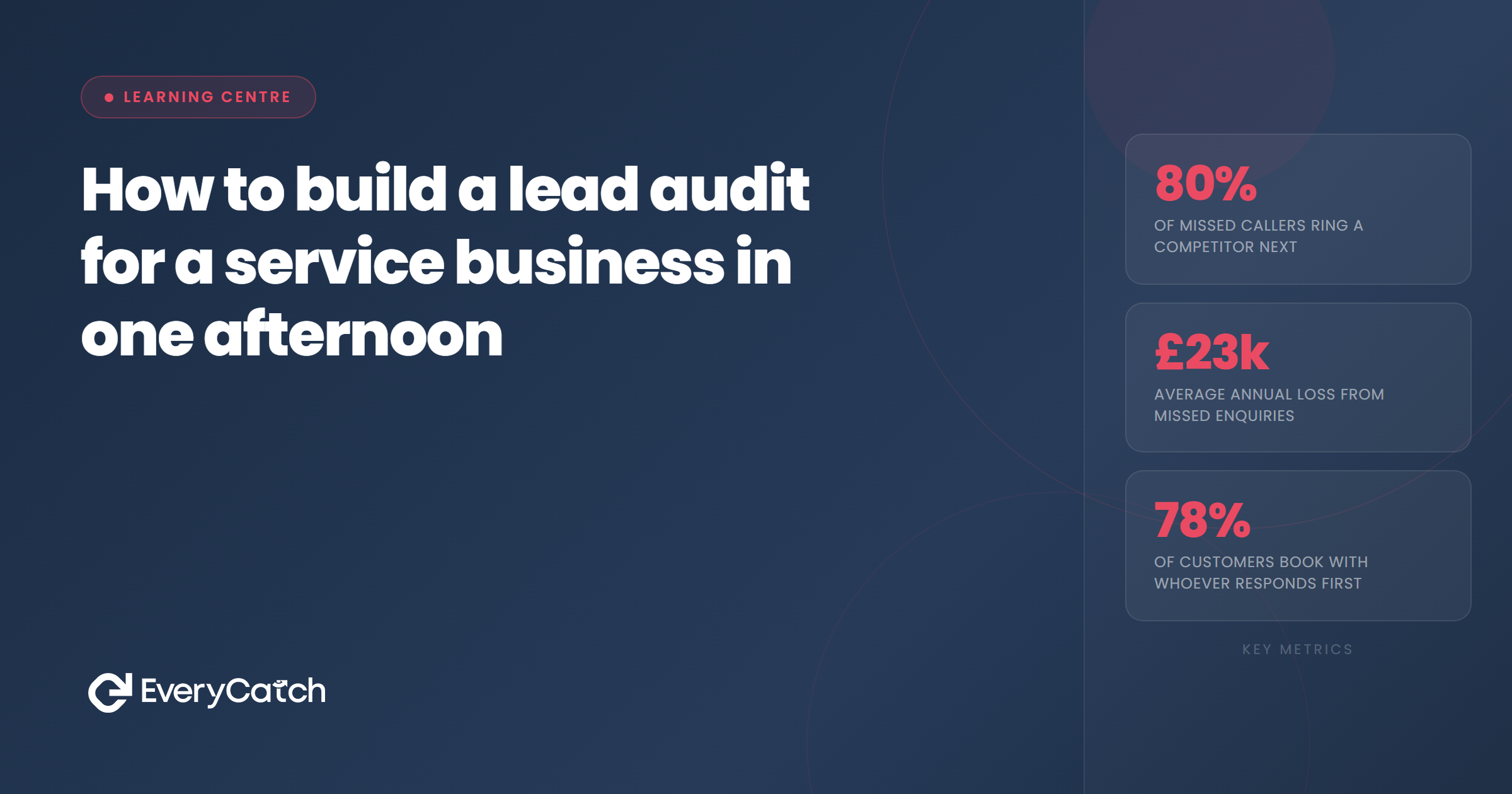
Then multiply the leads marked "never responded" by your average job value. That figure is the cost of the leak per month, and it is the number to hold in mind when you decide what to fix first. For most businesses the highest-value fix is not more marketing. It is catching the enquiries the existing marketing already generates, starting with the missed calls that cost more than most owners realise. Repeat the audit every quarter with the same six columns, because the leak moves as your channels and workload change, and a single snapshot goes stale quickly.

From the EveryCatch team
EveryCatch helps service businesses catch and convert every enquiry with instant lead response, automated follow-up, and missed call text back. We write the Learning Centre to share what we see working across hundreds of trades and service businesses.