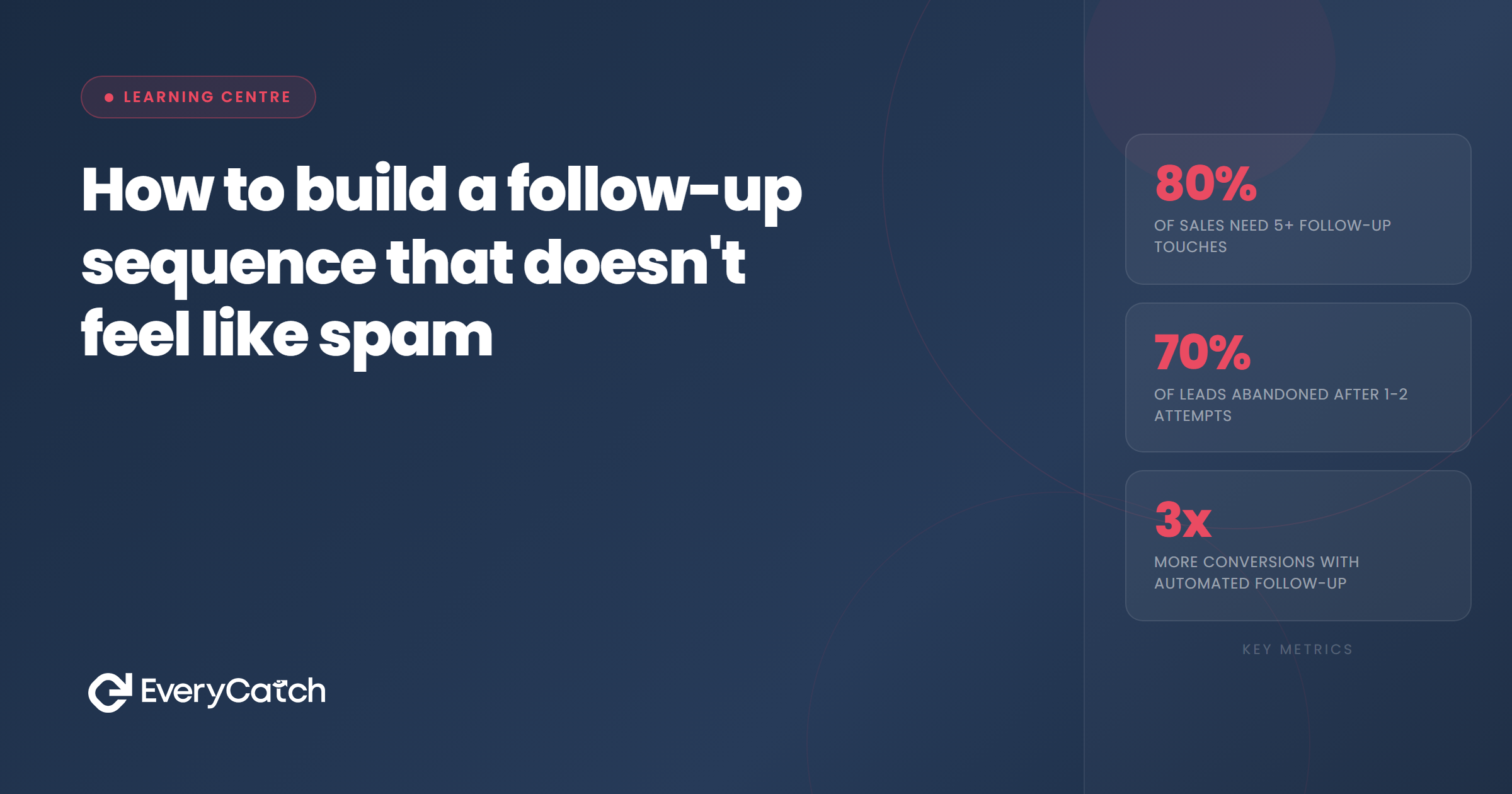

- Spam happens when automation runs without context, variation, or respect for the lead's situation
- Good sequences space messages according to the lead's likely decision timeline, not your sales targets
- Varying your message type, medium, and reason for contact keeps sequences feeling human
- Tracking engagement allows sequences to adapt, stopping when appropriate or escalating when there's interest
- Always offer an easy way to opt out, and honour it immediately when someone takes it
Most business owners understand they need to follow up with leads. The question is how to do it without crossing the line into harassment. You want to stay on someone's radar without making them reach for the unsubscribe button.
The difference between effective follow-up and spam is not whether you automate it. Automation is fine. The difference is whether your sequence respects the person receiving it, adapts to their behaviour, and brings something useful to the conversation.
What makes follow-up feel like spam
Spam is characterised by three qualities. It ignores whether the recipient wants to hear from you. It repeats itself without variation or new information. It serves the sender's needs without considering the recipient's context.
When your follow-up sequence exhibits any of these qualities, it crosses into spam territory. The lead who filled out a form on Tuesday does not want the same "just checking in" message on Wednesday, Thursday, and Friday. They do not want six voicemails that say nothing except "call me back." They certainly do not want to feel hunted.
Spam happens when you treat follow-up as a volume game. Send enough messages and someone will respond. That approach works if your only goal is to extract a reply, but it destroys your brand with everyone who does not reply. Those people remember how you made them feel.
Good follow-up sequences start from a different premise. The lead expressed interest. They gave you permission to continue the conversation. Your job is to nurture that interest without exhausting their patience.
Space your messages properly
Timing is the first defence against feeling like spam. If someone requests information about your service, they are probably comparing a few options and making a decision within days or weeks, not hours. Your sequence should match that natural timeline.
A common mistake is front-loading everything. First message within minutes, second message the next day, third message two days later. You have sent three touchpoints in under a week, and the lead has barely had time to think.
Better spacing gives people room to breathe. An immediate response to confirm you received their enquiry is expected. The next message can come 48 hours later, not 24. After that, you can stretch to three or four days between messages, then a week.
This rhythm mirrors how people actually make buying decisions for services. They request quotes. They compare. They discuss with a partner or colleague. They circle back when they are ready. Your sequence should support that process, not rush it.
Different services have different natural timelines. Emergency plumbing has a short decision window. Renovations have a long one. Adjust your spacing to fit what you sell, but always err on the side of more space, not less.
Vary the message and medium
Repetition is the hallmark of spam. If every message says the same thing, you train the recipient to ignore you. Vary what you say and how you say it.
Your first message might confirm the enquiry and set expectations. The second could share a case study or example project. The third might answer a common question. The fourth could be a simple check-in asking if they have what they need. Each message has a distinct purpose.
Medium matters too. If your first three messages are emails, the fourth could be a text. If you have been texting, try a voicemail. Different channels feel less intrusive when used sparingly, and they catch people at different moments.
Voicemail deserves special mention because it is easy to do badly. A voicemail that just says "give me a call" is a waste. A voicemail that shares one specific piece of information, like your availability for an appointment this week, gives the recipient something to act on.
Variation also applies to tone. Early messages can be more formal. Later ones can be more casual. You are building a relationship over time, and your language should reflect that progression.
Want to automate follow-up without feeling like spam?
We will build you a sequence that adapts based on how leads actually behave.
Book a free discovery callUse context to adapt your approach
The best sequences change based on what the lead does. If someone opens every email you send but never replies, that is different from someone who has not opened anything. If someone clicked through to your pricing page, that is different from someone who has not engaged at all.
Context-aware sequences branch. If the lead books an appointment after your second message, the sequence stops. If they open your third email but do not reply, the fourth message acknowledges that they have been looking and offers to answer specific questions. If they have gone silent, the fifth message might be a soft exit: "I will stop reaching out unless you let me know you want to continue the conversation."
This kind of branching requires a system that tracks engagement. You need to know whether emails were opened, whether links were clicked, whether voicemails were listened to. Without that data, every lead gets treated the same, and your sequence cannot adapt.
Context also includes the source of the lead. Someone who called you directly is further along than someone who filled out a web form. Someone referred by an existing customer needs a different approach than someone who found you on Google. Your sequence should reflect these differences.
Give people an easy out
Nothing says spam louder than making it hard to stop receiving messages. Every email in your sequence should include an unsubscribe link. Every text should say "reply STOP to opt out." Every voicemail should mention that they can email you to be removed from follow-up.
When someone opts out, honour it immediately. Do not send "one last message" to ask why. Do not wait until your system processes the request in 48 hours. Stop.
Including an exit option in every message paradoxically makes people less likely to use it. They know they can stop the messages if they want to, so they tolerate a few more. Remove that escape hatch and you create resentment.
Some sequences include a "not interested" option alongside the unsubscribe. This is useful because it gives you cleaner data. Someone who unsubscribes might just be decluttering their inbox. Someone who selects "not interested" is telling you they have made a decision. You can handle those two scenarios differently in your CRM.
Lead with value, not just reminders
Every message in your sequence should give the recipient something. That might be information, a resource, an answer to a common question, or a specific next step they can take. It should not just be a reminder that you exist.
"Just following up" is not value. It is a waste of the recipient's time. "I wanted to share how we handled a similar project last month" is value. It gives them a reason to open the message and a reason to keep you in mind.
Educational content works well in follow-up sequences. A short video explaining a common mistake people make when choosing a service provider. A one-page guide to preparing for the kind of work you do. A link to a case study that matches their situation. These assets serve the lead whether they hire you or not.
Value can also be procedural. "Here are the three things I need from you to provide an accurate quote" is helpful. It moves the process forward and makes it easier for the lead to take the next step. That is much better than "let me know if you have any questions."
The tone of value-driven messages is different. You are helping, not chasing. That shift in framing changes how the recipient perceives the entire sequence.

From the EveryCatch team
We build follow-up sequences for service businesses that track engagement, adapt based on behaviour, and stop when they should. Every sequence includes variation by design, proper spacing, and an easy exit.