
- Your true conversion rate includes every enquiry that arrived, not just the ones you answered.
- A one-month audit using your call log, inbox and social messages gives you a reliable baseline in a few hours.
- Most businesses lose more enquiries before the first conversation than at any other stage.
- A realistic enquiry-to-booking rate for local service businesses sits between 30 and 50 per cent, and many run well below it without knowing.
- The audit only pays off if you fix the biggest leak first, which is almost always response speed or follow-up.
Ask most service business owners what their conversion rate is and they will give you a confident answer that turns out to be wrong. The reason is simple. They calculate it from the enquiries they remember, which are the ones they answered and quoted. The missed call on a Tuesday afternoon, the Facebook message that sat unread for three days, the web form that landed while they were on a job, none of those make it into the mental maths. An audit forces all of them into the count, and that is where it gets uncomfortable and useful at the same time.
What the enquiry-to-booking rate actually measures
The calculation itself is straightforward. Take the total number of enquiries you received in a period, divide the number that became confirmed bookings by that total, and multiply by a hundred. If 40 people contacted you last month and 14 booked, your rate is 35 per cent.
The difficulty is not the arithmetic. It is the word "total". An enquiry is any inbound contact from someone who wants your service, whether or not you ever spoke to them. That includes missed calls with no voicemail, messages you never opened, and forms that went to a spam folder. If you only count conversations you actually had, you are measuring your quoting skill, not your business. The gap between those two numbers is your missed lead problem, and it is usually the largest single leak in the pipeline. We cover the direct financial impact of that gap in our article on what missed leads really cost your business.
Step one: count every enquiry from the last full month
Pick a recent complete month and pull the raw records from every channel a customer could use to reach you. This takes an hour or two, not days.
- Download your call log from your mobile provider or phone system, and count every inbound call from a number that is not an existing customer or supplier. Count missed calls separately.
- Search your email inbox, including spam and any shared addresses, for enquiries and web form notifications.
- Open Facebook Messenger, Instagram DMs, WhatsApp and any Google Business Profile messages, and count new conversations from prospective customers.
- Check any directories or lead platforms you pay for, such as Checkatrade or Bark, and count the leads delivered that month.
Put each enquiry into a simple spreadsheet with four columns: date, channel, whether you responded, and the outcome. Be strict with yourself. A missed call from an unknown local number counts as an enquiry unless you can prove otherwise, because that is exactly what most of them are.
Step two: record what happened to each one
Now trace every row through to its outcome. For each enquiry, mark one of five results: no response from you, responded but no reply from them, conversation but no quote, quoted but not booked, or booked. You will not have perfect records for everything, and that is fine. Mark unknowns honestly rather than assuming they went well.
This stage is where the audit earns its keep. The overall percentage tells you how big the problem is, but the outcome column tells you where the problem lives. A business converting 25 per cent might be losing leads because nobody answers the phone, or because quotes go out and nobody chases them. Those are completely different problems with completely different fixes, and you cannot tell them apart from the headline number alone.
Want the audit done for you?
On a free discovery call we will walk through your channels with you and show you where enquiries are slipping through, with no obligation to buy anything.
Book a free discovery callStep three: work out where enquiries fall out
With the outcomes recorded, group them into three stages and count the losses at each one.
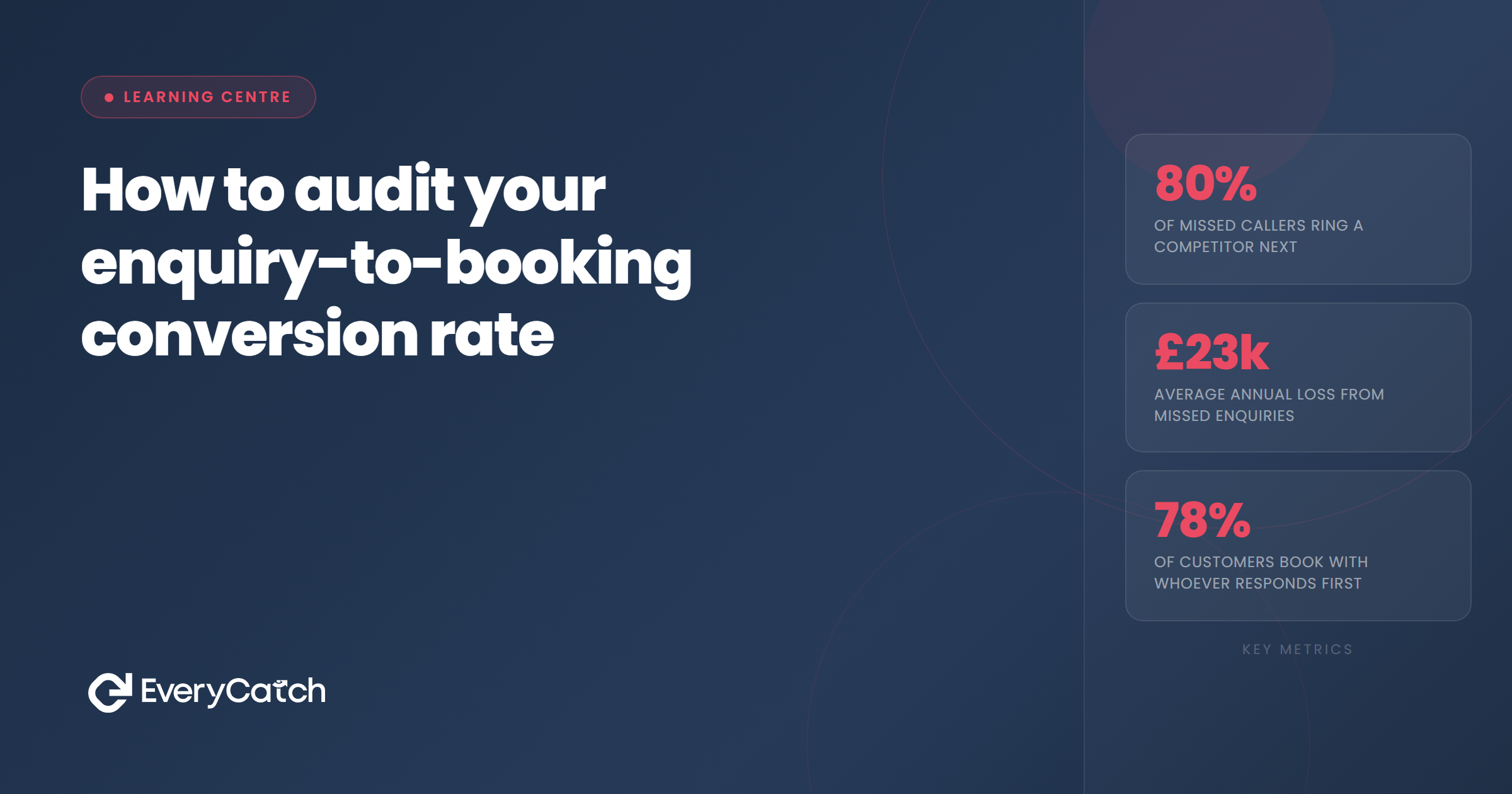
The first stage is contact. How many enquiries never got a response at all? For most businesses we speak to, this is the biggest bucket, driven by missed calls during working hours and messages arriving in the evening. Research from Ipsos suggests around 85 per cent of callers who reach voicemail will not leave a message, and most of them ring a competitor next. If you want to dig into this specific leak, read our guide on why missed calls cost more than you think.
The second stage is conversation to quote. How many people spoke to you but never received a price? These losses usually come from slow quoting or from enquiries that stalled while you were busy on site.
The third stage is quote to booking. How many quotes went out and were never followed up? A single quote email with no chase message converts far worse than the same quote followed by two or three polite check-ins over the following week.
Write the three loss figures down. The largest one is your priority, and everything else waits.
What a good conversion rate looks like
Benchmarks vary by trade and by how qualified your enquiries are, but a local service business with sensible pricing should convert somewhere between 30 and 50 per cent of genuine enquiries into bookings. Businesses that respond within five minutes and follow up every quote often push past that. If your audit puts you below 25 per cent, the problem is almost never your prices or your reviews. It is nearly always speed and follow-up, which is good news, because both are fixable without spending more on marketing.
One caution on interpreting your number. If you buy leads from platforms that sell the same lead to several businesses, your conversion rate on that channel will naturally sit lower, so track each channel separately rather than blending everything into one figure.
Turning the audit into fixes
An audit that ends in a spreadsheet has achieved nothing. Take the biggest leak and put one specific change against it. If missed calls are the problem, set up an automatic text-back so every unanswered caller gets a message within seconds. If quotes are dying quietly, build a follow-up sequence that chases each one at set intervals until you get a yes or a no. If evening enquiries are going cold overnight, add an instant acknowledgement that books people while you sleep.
Then rerun the audit in three months using exactly the same method. The comparison between the two numbers tells you whether the fix worked, and it turns conversion rate from a guess into something you actually manage. Most owners who do this once never go back to guessing, because seeing 20 enquiries vanish in a single month is not something you forget.

From the EveryCatch team
EveryCatch helps service businesses catch every enquiry with instant responses, automatic follow-up and simple pipeline tracking. We write these guides so you can fix the leaks yourself, whether or not you ever work with us.