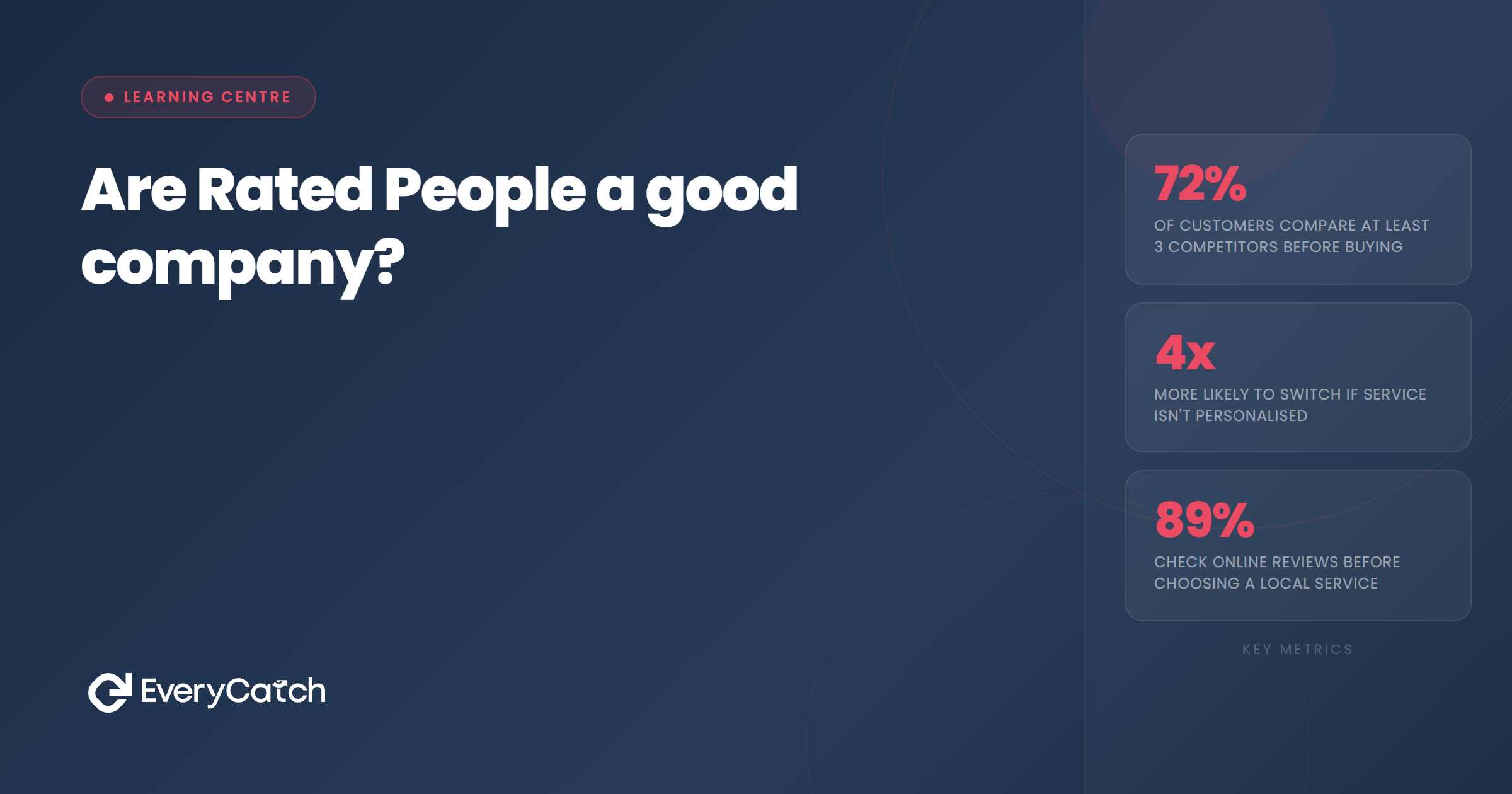
- Rated People is a real, long-running UK marketplace, trading since 2005. The arguments about it concern value for money rather than legitimacy
- Homeowners post jobs free. Tradespeople pay to respond, historically through a credit system priced against the size of the job
- The same enquiry normally goes to several tradespeople, so you are buying the right to compete, and you can pay for a lead you then lose on speed or price
- Judge it on cost per won job rather than cost per lead. That figure reads very differently on a £3,000 bathroom than on a £90 callout
- Rated People finds the enquiry. EveryCatch is what answers it, follows it up and turns the resulting reviews into visible proof, so the two sit together rather than against each other
Is Rated People a legitimate company?
Yes. Rated People launched in 2005 and has traded continuously since, which makes it one of the longest-running trade marketplaces in the UK. A homeowner posts the job they need doing at no cost. Tradespeople registered for that trade and that area pay to respond, then quote and compete for the work in the usual way. Reviews from completed jobs build a public profile that feeds the platform's ranking and badges.
So the literal question has a short answer. This isn't a scam operation, and plenty of tradespeople have filled real diaries through it for years. The criticism you'll find in trade forums and Facebook groups concerns value for money, which is a fairer question and a harder one, because the answer changes depending on your trade, your average job value and how fast you answer the phone.
How Rated People works for a tradesperson
The homeowner describes the job, adds a postcode and a rough timescale. Rated People sorts that request by trade and location, then makes it available to tradespeople covering that patch. You pay to take the lead, contact the homeowner, quote, and either win the job or don't. Nothing about that flow is unusual for a lead marketplace.
Two details inside it decide whether the model earns you money. The enquiry is normally offered to more than one tradesperson, so the thing you're buying is the right to compete, not the job. And you pay at the point you take the lead, before you know whether the homeowner will pick up, whether the budget is realistic, or whether the job matches the description. Both of those risks sit with you, not with the platform.
How much does Rated People cost?
Joining has historically been free, with the cost arriving per lead rather than as a fixed monthly subscription, although Rated People has offered membership and package options at various points and its commercial terms have changed more than once over twenty years. The shape has stayed consistent even as the numbers moved. You buy credits, and taking a lead spends them. A small repair enquiry costs a few pounds to respond to. A full bathroom, a roof or an extension costs considerably more, because leads are priced against the value of the work behind them.
Check the current figures on Rated People's own site before committing, since any price quoted in a forum thread or a blog post from two years ago is probably out of date. The figure worth tracking is your cost per won job. Four leads at £12 each producing one booked job means you paid £48 to win that customer, which is comfortable on a £3,000 bathroom and ruinous on a £90 callout. Run that sum for your own trade before you top up credits for a second month, because it is the only version of the cost question that affects your bank balance.
Paying for leads you then lose on response time?
Every shared lead is a race. A fifteen minute call is usually enough to work out where yours are leaking.
Book a free discovery callThe complaints tradespeople actually make
These grievances come up repeatedly in trade circles, and they're specific enough to take seriously.
Lead quality varies and you carry that risk. Some homeowners post a job, take three calls within the hour and go quiet. Some describe a £400 job that turns out to be a £4,000 one, or the reverse. Some are collecting ballpark prices for a decision they'll make next spring. You paid the same credits for all of them, and the platform doesn't refund you because a homeowner changed their mind.
Shared leads create a race you can lose for reasons unrelated to your work. Several tradespeople get the same enquiry, and the homeowner frequently books whoever rings first with a sensible answer. Quoting carefully on Thursday evening after a long day on site puts you behind someone who replied inside ten minutes on Thursday morning. Being the better tradesperson doesn't help if the job was gone before you called.
Cost accumulates whether or not you win. A month of taking twenty leads and converting three is a real cash outlay against three jobs, and that ratio gets worse in trades with heavy competition in dense postcodes. Price-driven homeowners are part of the mix too, because a posted job invites comparison quotes by design, and some enquiries are gathering the cheapest number rather than the right one. Qualifying those enquiries quickly without losing the good ones is a genuine skill, and the platform doesn't do it for you.
Who Rated People genuinely suits
None of that makes it a bad decision for every trade business. There are honest reasons tradespeople stay on it for years.
It produces inbound enquiries without you running any marketing. For a sole trader with no website, no local search presence and no referral base yet, that gap-filling flow of work has real value, and building the equivalent through search or social takes months. The review profile is a second genuine benefit, because completed jobs on a recognised platform give a new business public proof it could not otherwise show. Tradespeople moving into a new area, or filling quiet weeks between bigger contracts, often use it exactly that way rather than as their main source of work.
The sensible position is to treat it as one paid channel with a measurable cost, sitting alongside referrals, local search and repeat customers. Businesses that get burned are the ones relying on it as their only source of enquiries, because the cost per job never improves and the competition for each lead never eases.
Where EveryCatch sits, and where it doesn't
EveryCatch is not an alternative to Rated People, and comparing the two as substitutes gives a misleading picture. They act on different halves of the same problem.
| Rated People | EveryCatch |
|---|---|
| Finds and sells you the enquiry | Answers and follows up the enquiry you already have |
| Charges per lead, win or lose | Flat monthly fee, no cost per enquiry |
| Works only on jobs posted to its own marketplace | Works on every source, including Rated People, your website, missed calls and referrals |
| Reviews live on its platform profile | Collects reviews to your own Google profile, which you keep |
That distinction matters commercially because of the shared-lead problem above. Every Rated People lead you pay for is being quoted by rivals inside the same window, so the money you've already spent is decided by how fast you respond. Speed to Lead sends an instant reply to a new enquiry while the homeowner is still on their phone, WinLane keeps chasing the ones that go quiet instead of letting them rot in a notes app, and Reputation Spark asks for the review once the job is finished so the proof accumulates on your own Google listing rather than only on a marketplace you rent. If you want the practical version of that first reply, how to reply when a customer asks for a quote covers the wording.
Plenty of tradespeople run both, and that combination is coherent. Buy some enquiries from a marketplace while your own lead sources grow, then make sure none of those paid-for enquiries goes cold because you were up a ladder when it landed. The worst outcome is paying per lead and answering slowly, since you are then funding your competitors' win rate.

From the EveryCatch team
EveryCatch was built for trade and service businesses that lose work in the gap between an enquiry arriving and somebody being free to answer it. Instant response, automated follow-up and review collection run together, whether the enquiry came from a lead marketplace, your website or a missed call.